
Summary: As automated warehouses, robot forklifts and high-speed sorting lines raise the cost of every “slightly off” pallet, repair backlogs quietly drain margin. A compressed wood pallet machine, pairing a GEO automatic spreading system with a 1600T double-cylinder hydraulic press, molds each pallet to a plus-or-minus 1mm dimensional tolerance, nail-free, splinter-free and automation-ready. This guide walks through the scene, the old problem, why molded pallets fit, the structure and parameters that make it work, and the result on the line.
The Scene: Automation Has Arrived, but Pallets Have Not Kept Up
Downstream operations are changing fast. Automated storage and retrieval systems (AS/RS), robot forklifts, and high-speed sorting lines are now standard in modern distribution centers. These systems share one assumption: every pallet is identical.
In practice, that assumption breaks daily. A pallet that sits a few millimeters proud, carries a wood splinter, or has a missing block will trip a sensor, stall a conveyor, or jam an automated lane. One bad pallet can stop a high-throughput line for minutes, and in a 24/7 operation, minutes are measured in thousands of dollars.
The Old Problem: Why Slightly Off Pallets Become a Profit Drain
Traditional nailed wooden pallets are shaped by wood, and wood moves with moisture. Fluctuations in moisture content, temperature and humidity cause natural dimensional variation: warping, cupping, loose boards, protruding nails, wood splinters and chipped corner blocks.
For years this was tolerable. It is not anymore. As a customer and automation rate climbs, the tolerance for inconsistency approaches zero. The downstream response is predictable and expensive:
- Sensors alarm on warped or oversized pallets, so the line stops.
- Inspection standards tighten, so the number of repair parts per pallet rises.
- Repair capacity and labor both get squeezed, so backlogs grow.
The financial toll is real. In 2026, one major pool operator, facing constrained repair capacity alongside stricter automation-driven quality demands, saw single-quarter profit pressure of roughly USD 60 million and was forced into an emergency purchase of 2 million new pallets. The root cause was not demand. It was pallet inconsistency choking automated throughput and overwhelming repair.
Why a Compressed Wood Pallet Machine Fits the Problem
The defect above is a material and process problem, not an inspection problem. You cannot inspect consistency into a nailed pallet that warps with humidity. You have to form consistency in.
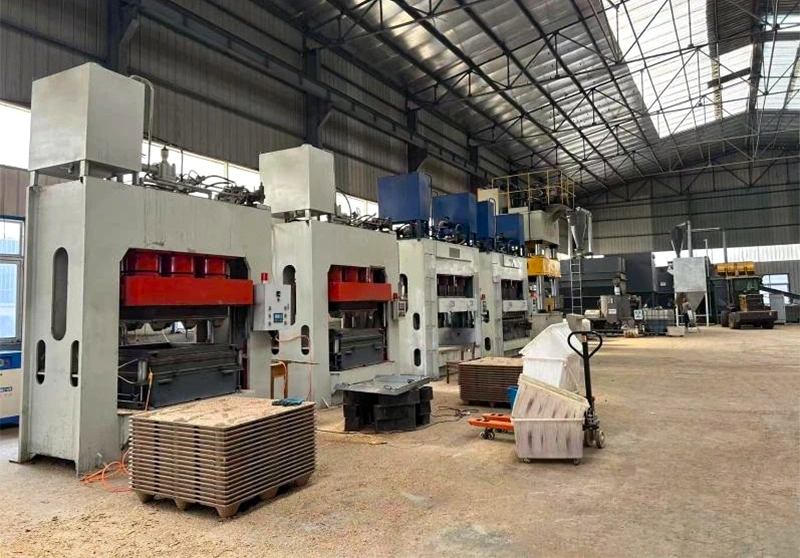
That is exactly what a compressed wood pallet machine does. The EMP AutoML line combines:
- GEO automatic spreading machine, dosing and spreading raw wood fiber mix evenly into the mold every cycle, removing the human variation that causes weight and density drift.
- 1600T double-cylinder hydraulic press, one-shot hot pressing that cures and forms the entire pallet under uniform pressure.
Because every pallet is molded in the same precision cavity under the same pressure curve, each piece comes out with the same dimensions, the same weight, and the same load-bearing geometry, within a plus-or-minus 1mm tolerance. There are no nails to protrude, no boards to warp apart, and no wood splinters to shed onto a sensor.
Put simply: molded wood pallets are born automation-friendly.
Structure, Parameters and Evidence
Consistency is not a claim; it is a function of machine structure. The compressed wood pallet machine is built around a rigid, repeatable forming system.
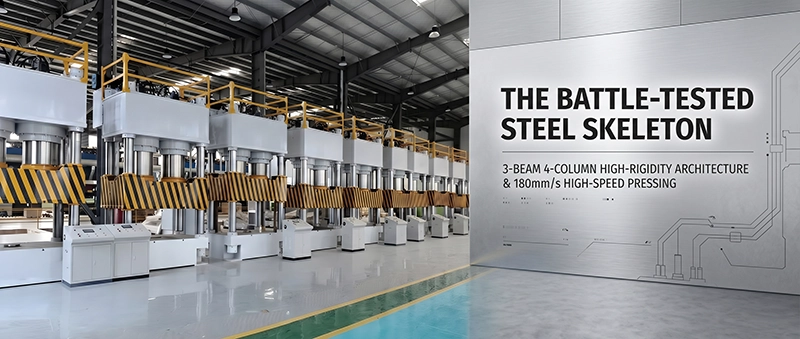
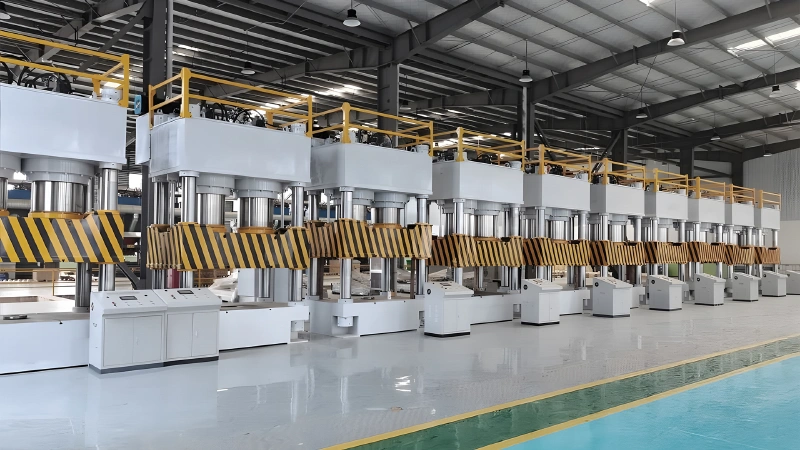
- 3-beam 4-column high-rigidity steel frame, keeping the platen parallel under 1600 tonnes of force, so cavity pressure stays uniform edge to edge. Uneven pressure is what causes thickness variation in cheaper presses.
- 1600T double-cylinder hydraulic system, delivering stable, high tonnage in a single stroke for full-face forming.
- 180mm/s high-speed pressing, short cycle time without sacrificing pressure dwell, so throughput stays high while cure quality holds.
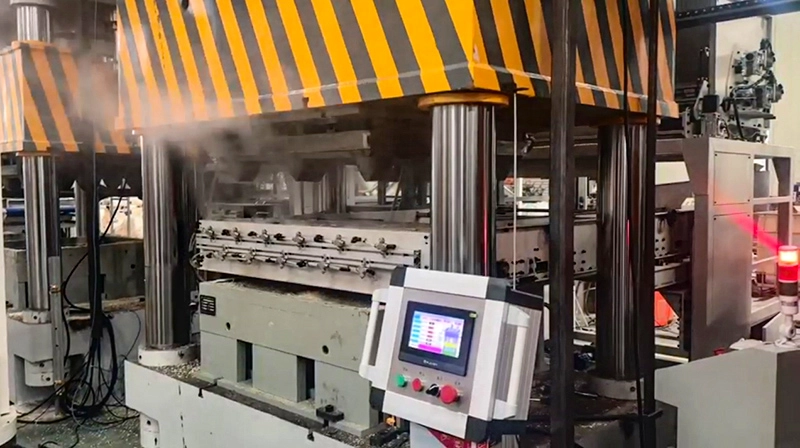
- PLC touch control, so pressure, temperature and dwell are set and monitored digitally, removing operator guesswork from the tolerance equation.
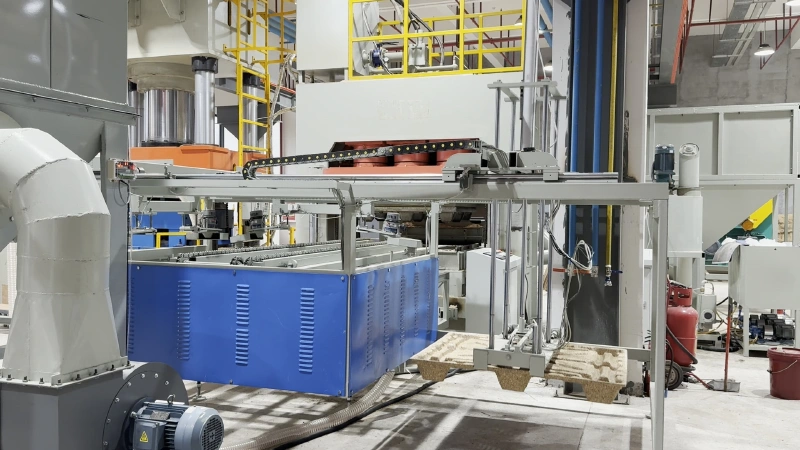
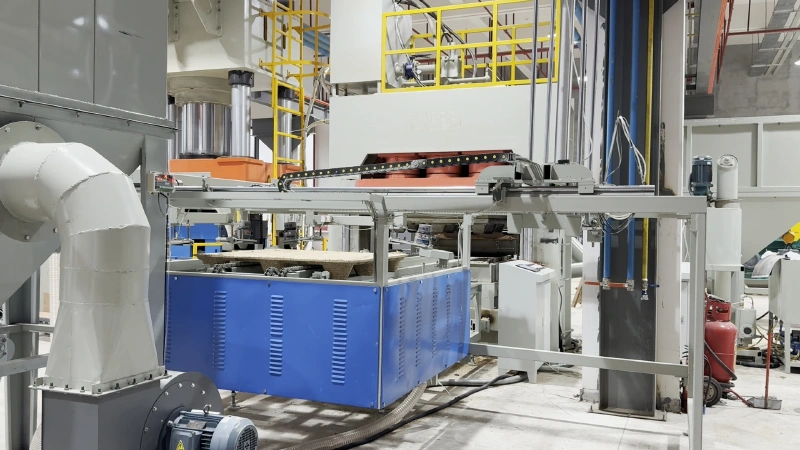
On the automation side, a servo take-out arm demolds and extracts each freshly pressed pallet without manual handling, so the pallet that was formed to a 1mm tolerance is not deformed by being pulled from the mold by hand.
The forming floor itself is a row of 1600T three-beam four-column hydraulic hot presses running in a clean, controlled facility.
The Result: Pallets That Automated Logistics Can Actually Run On
When every pallet leaving the compressed wood pallet machine is dimensionally uniform, nail-free and splinter-free, the downstream math changes:
- No more sensor alarms from pallet geometry, because 1mm tolerance keeps AS/RS lanes, robot forks and sortation conveyors running.
- Lower repair burden, because there are no nails to work loose, no boards to re-fasten, and no wood splinters to shave. The repair parts per pallet figure drops because the defect modes largely disappear.
- Headroom for tighter standards, because when a customer raises its inspection bar, molded pallets already clear it instead of generating a new repair wave.
- Smoother automation onboarding, because high-automation cargo flows can be accepted without the fear of line-stoppage chargebacks.
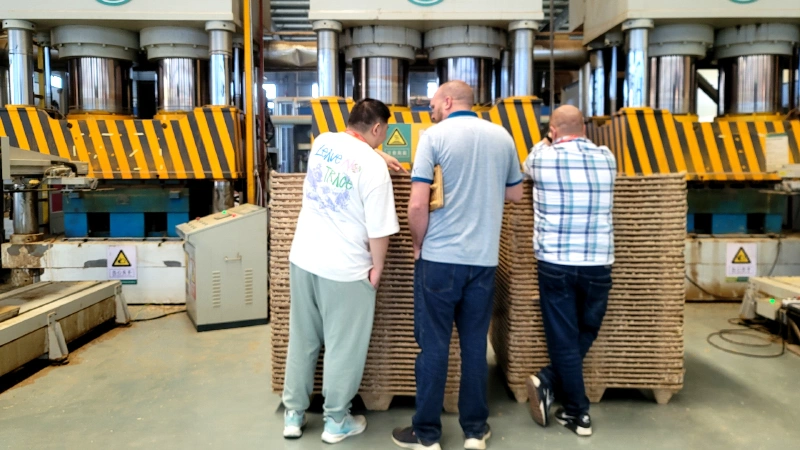
The operator no longer gets complained at for pallets not being square, no longer pays extra repair labor to meet ever-stricter inspection standards, and can take on high-automation freight it previously had to refuse.
Specs at a Glance
| Item | Specification |
|---|---|
| Machine | Compressed wood pallet machine (EMP AutoML) |
| Forming | GEO automatic spreading + one-shot hot press |
| Press | 1600T double-cylinder hydraulic |
| Frame | 3-beam 4-column high-rigidity steel |
| Pressing speed | 180 mm/s |
| Control | PLC touch screen, digital parameter monitoring |
| Demold | Servo take-out arm |
| Pallet tolerance | Plus-or-minus 1mm dimensional consistency |
| Pallet type | Nail-free, splinter-free molded wood pallet |
Take the Next Step
If your customers and automation is outpacing your pallets and consistency, the fix is not more inspection. It is a compressed wood pallet machine that forms tolerance in. Tell us your pallet size, target throughput and the automation standard you need to meet, and we will configure an AutoML line to match.