
A wood pallet making machine hot-presses sawdust and wood fiber into nail-free molded pallets with ±1mm dimensional tolerance—no warping, no splinters, no nail pull-out—so robot forklifts, ASRS cranes, and high-speed sortation lines run with zero unplanned downtime.
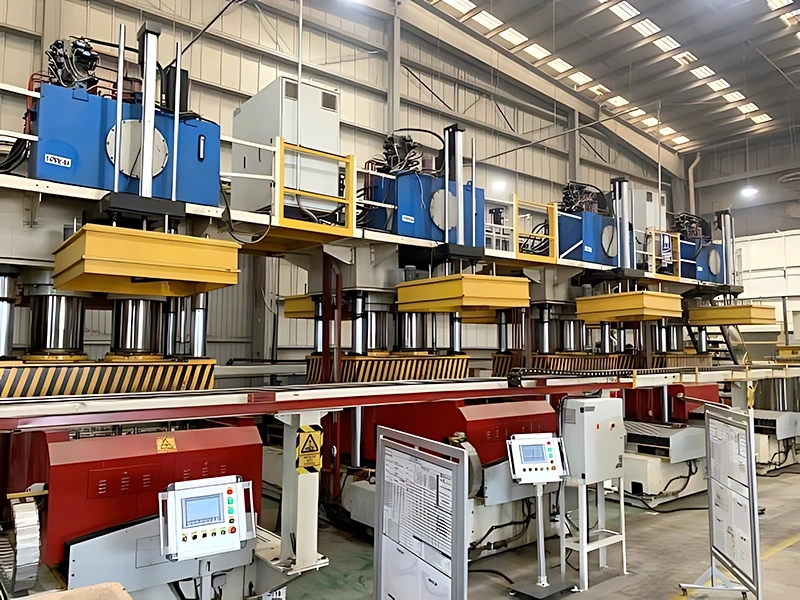
The Scenario: Automation Demands Pallet Perfection
Modern distribution centers are replacing manual handling with automated storage and retrieval systems (ASRS), robot forklifts, and high-speed sortation lines. These systems move freight faster than ever, but they share one non-negotiable assumption: every pallet must be geometrically predictable.
A pallet that is warped by even a few millimeters, carries a protruding splinter, or has a missing corner block will trip a photoelectric sensor, jam a conveyor guide, or prevent a robot fork from seating. The result is an alarm, a line stoppage, and a cascading delay that ripples through the entire fulfillment schedule.
Why Nailed Wood Pallets Cannot Keep Up
Traditional wood pallets are assembled from loose lumber components joined with nails. Wood is hygroscopic—it absorbs and releases moisture with changes in temperature and humidity. Every board expands, contracts, and bows on its own schedule. Over weeks of warehouse cycling, nailed pallets develop:
- Dimensional variance — length, width, and load height drift from unit to unit.
- Nail pull-out and protrusion — fasteners loosen under load cycling, lift above the deck, and snag sensors or conveyor rails.
- Splintered decks and broken stringers — cracked wood creates uneven bearing surfaces that deflect robot forks.
- Warped top boards — bowed decks prevent automated handling equipment from gripping cleanly.
None of this is a manufacturing defect in the traditional sense—it is the inherent behavior of nailed timber. But on an automated line, it becomes an operational liability. Pool operators are forced to tighten inspection standards, which increases the number of repair parts replaced per pallet. Repair capacity and labor both get stretched thin. In 2026, one major pool operator absorbed roughly USD 60 million in quarterly profit pressure from the combined strain of limited repair capacity and escalating quality demands, and had to emergency-source 2 million new pallets just to keep customers supplied.
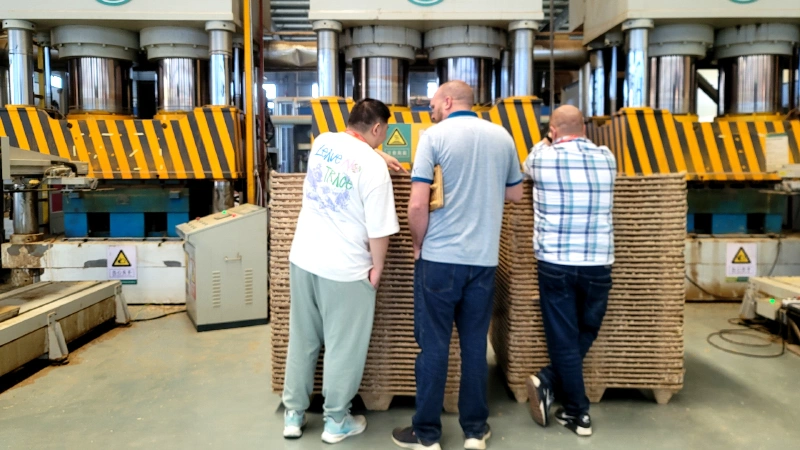
How a Wood Pallet Making Machine Solves the Consistency Problem
A wood pallet making machine eliminates the inconsistency at the source. Instead of nailing loose lumber together, it takes sawdust and wood fiber—material that would otherwise be waste—blends it with a thermosetting resin, and presses it into a single solid pallet under high temperature and pressure. The core equipment chain:
- GEO automatic spreading machine — meters and distributes the sawdust-resin mix evenly across the mold cavity, ensuring uniform density in every pallet.
- 1600T dual-cylinder hydraulic press — delivers 1,600 tons of force in a single hot-press stroke, fusing the fibers into one monolithic block with zero fasteners.
- Precision steel mold — every pallet is formed in the same cavity, so dimensions repeat to within ±1mm.
Because the pallet is molded as a single piece, there are no joints to loosen, no nails to protrude, and no independent boards to warp at different rates. The pallet is dimensionally stable, structurally uniform, and—by design—automation-friendly from the first cycle to the last.
Structure, Parameters, and Visual Evidence
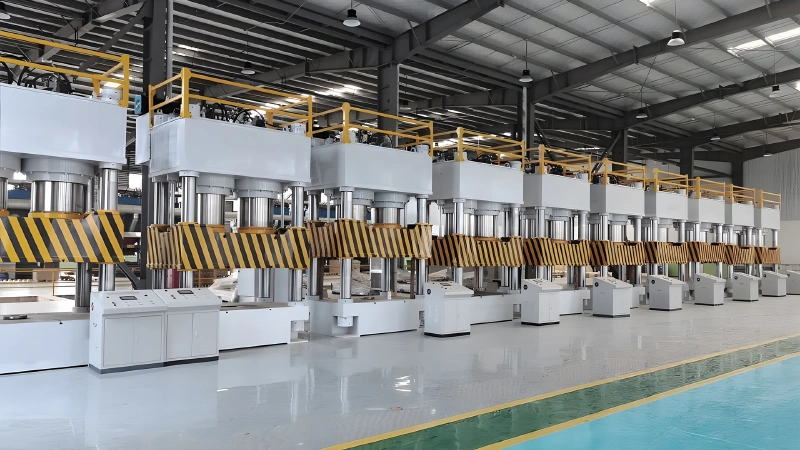
The press uses a three-beam four-column high-rigidity steel frame. This architecture keeps the upper and lower platens parallel under full 1,600-ton load, which is what allows the molded pallet to come out flat and dimensionally true rather than tapered or skewed. Key specifications:
- Pressing force: 1,600 tons (dual-cylinder)
- Pressing speed: up to 180 mm/s for efficient cycle times
- Dimensional tolerance: ±1mm on length, width, and load height
- Fastening method: none—single-piece molded, zero nails
- Surface finish: smooth, no splinters, no protruding metal
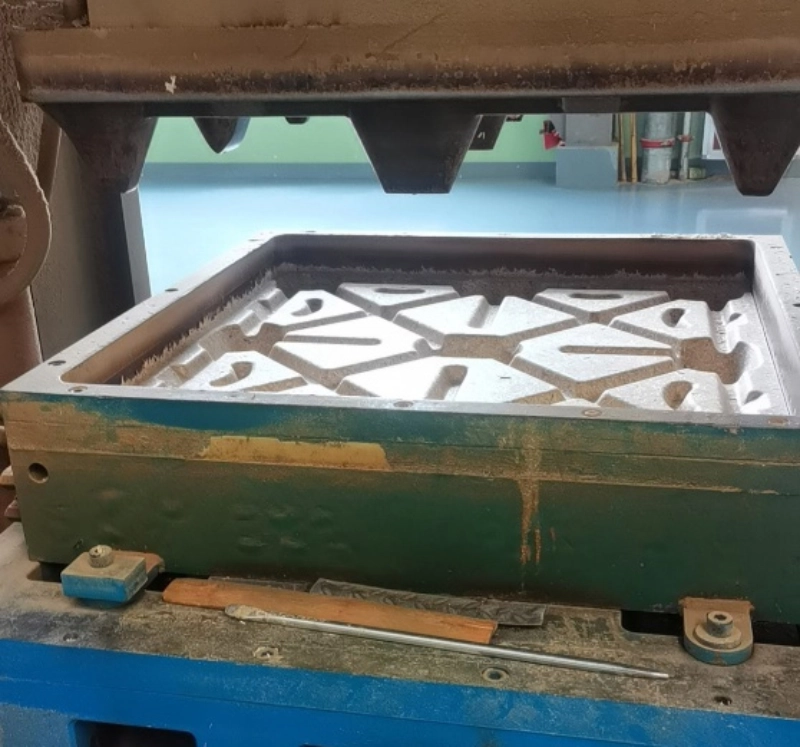
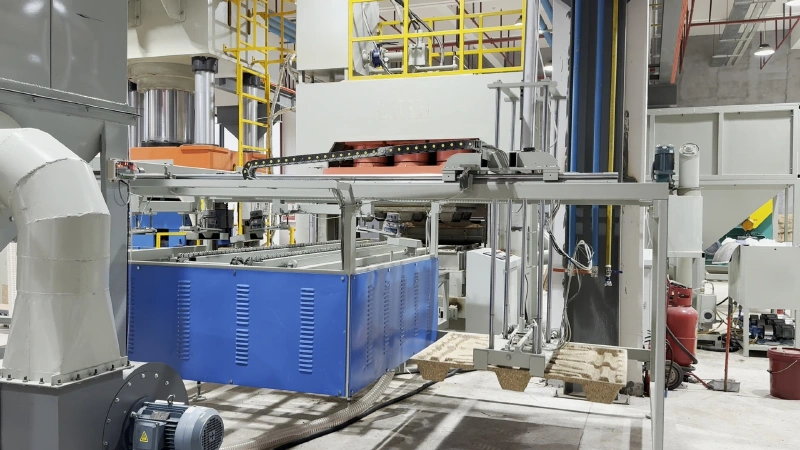
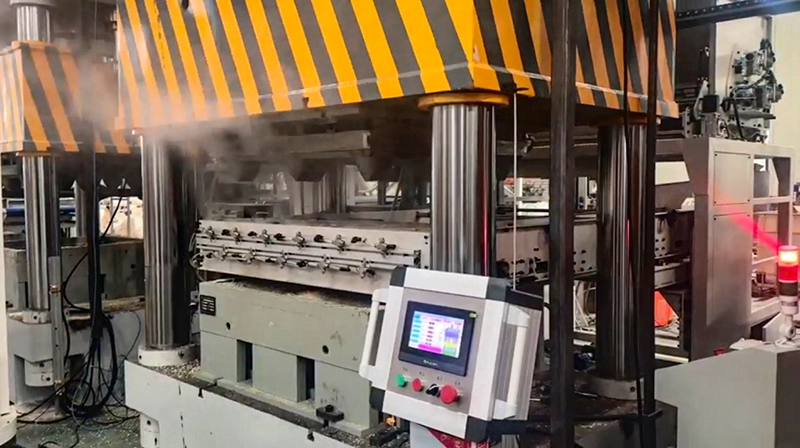
The PLC touch controller governs mold temperature, pressing force, and holding time. Once a recipe is locked in, every pallet in the run is pressed under identical conditions. That repeatability is precisely what automated warehouses require: the 10,000th pallet exits the mold with the same dimensions as the first.
The Result: Zero-Downtime Pallets That Cut Repair Costs
For pallet pool operators and manufacturers serving automated facilities, switching to output from a wood pallet making machine transforms the economics:
- Zero sensor-trip stoppages from warped decks or protruding nails—the pallets are smooth, flat, and dimensionally uniform.
- No escalating repair bills from tightening inspection standards—there are no nails to pull, no boards to replace, and no loose joints to re-fasten.
- Higher automation throughput — robot forklifts seat cleanly on every cycle, ASRS cranes handle loads without misalignment, and sortation lanes run uninterrupted.
- Lower raw-material cost — the machine runs on sawdust and wood fiber that would otherwise be discarded or sold cheaply as waste.
A wood pallet making machine does more than manufacture pallets—it produces pallets that survive the automated warehouse. When every unit shares the same ±1mm geometry, zero nails, and zero splinters, the downstream automation performs the way it was designed to. The repair backlog contracts, the emergency re-purchase budget evaporates, and the operator stops paying for pallet inconsistency twice—once at purchase and again in the repair bay.
Ready to eliminate pallet-driven downtime on your automated lines? A wood pallet making machine turns wood waste into ±1mm nail-free molded pallets that robot forklifts and ASRS systems can rely on. Contact us for line sizing, mold design, and a tailored production plan.