
The Scenario: The Residue Is There — the Margin Is Not
A sawmill’s residue stream is not a problem; it is a ledger. Shavings, offcuts, and sawdust leave the line in steady volume, and most sites already route that volume somewhere — into the boiler, into particleboard, or into low-grade blocks. The wood is accounted for. What is missing from the ledger is the margin.
Residue sold as fuel or feedstock leaves the highest-value conversion to someone else. The sawmill recovers the material but not the money that lives in a finished, export-ready pallet. The value leaks out at the last step — the step where residue should become the product, not just the input to someone else’s factory.
The Old Approach: Recovered, Then Handed Away
The conventional residue routes stop one step short of the margin:
- Energy and boiler fuel — residue is burned for heat, erasing its material value the instant it enters the furnace.
- Particleboard and MDF — residue is pressed into sheet goods, but the margin accrues to the board mill, not the sawmill that grew the tree.
- Blocks and spacers — residue is compressed into components that still must be bought, nailed, and heat-treated by a pallet assembler before they become anything a customer pays a real price for.
Each route recovers the wood and outsources the final, highest-value step. Nailing and heat treatment stay external — and those are precisely the steps that carry cost, certification burden, and the real margin. The sawmill remains a raw-material supplier to its own byproduct.
Why the Presswood Pallet Press Machine Fits
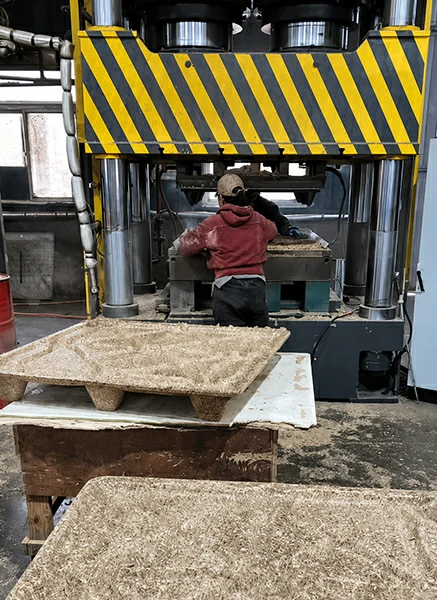
A presswood pallet press machine closes the gap the old routes leave open. It takes the same residue the sawmill already produces and presses it directly into a single, one-piece finished pallet — no nails, no metal fasteners, no separate assembly line.
Because the pallet is molded in one shot, the two steps that normally sit between residue and a sellable product disappear:
- No nailing. The part is a solid molded shape, so there is no fastener, no assembly labor, and no weak joint to fail in transit.
- No heat treatment. Molding applies heat and pressure that bond the residue into a stable, pest-resistant block, removing the ISPM-15 heat-treatment requirement that bolt-together pallets must clear before export.
The sawmill stops selling a byproduct and starts selling the finished product. The residue margin is captured in one pass, at the last step, instead of being shipped away for another plant to finish.
Structure, Parameters, and Visual Evidence
The press is a four-column hydraulic platform engineered for continuous, single-cavity molding. The structure is what makes one-pass conversion dependable at volume:
- Four-column frame — holds the platen parallel under full tonnage, so every pallet leaves the mold dimensionally consistent.
- Heated mold platen — supplies the heat and pressure that fuse the residue into a solid, moisture-stable part and removes the need for post-molding treatment.
- Programmable press cycle — cycle time, pressure, and dwell are set per residue mix, so one machine handles shavings, sawdust, or blended offcuts.
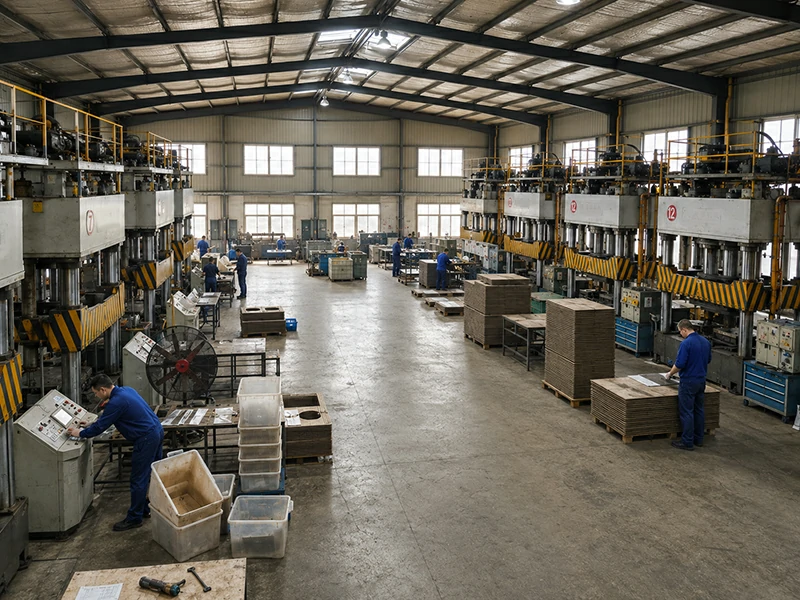
The output is a one-piece molded pallet: nail-free, fumigation-free, and ready for export handling straight from the press.
For capacity, the presswood pallet press machine line spans models Y-1250 / 1600 / 2000 / 2500, covering pilot runs through full plant throughput. The Y32 three-beam four-column configuration is built to dismantle and reassemble, which matters for export plants — the line ships in containers and stands up on site without a fixed foundation.
The EMP Edge: Equipment and Pallet, One Identity
EMP holds two identities in this market: it builds the presswood pallet press machine and it runs pallet production. That dual position changes the economics for the buyer.
A sawmill or residue owner is not buying a standalone press with the hard part left to figure out. It is buying into a partner that already runs the finished product at scale — proven against real residue mixes, real cycle targets, and real export specs.
This is the move a residue-heavy operator such as Pfeifer can make. With existing residue volume and Euroblock compression experience, adding a presswood pallet press machine is a lateral extension: the material knowledge is already in-house, and the output moves up the value chain from component to finished pallet. The margin that used to leak at the last step stays inside the operation.
The Final Result: Residue Becomes the Margin
With a presswood pallet press machine on site, the sawmill’s byproduct stops being a commodity it sells cheap and becomes the finished pallet it ships at full value. The nailing and heat-treatment steps are gone. The export paperwork is simpler. The margin the old residue routes gave away is recovered in a single press cycle.
For a sawmill sitting on residue and a low-value outlet, the last step is the whole game. A presswood pallet press machine is the equipment that lets the sawmill play it — and keep the margin when it does.