
The Scenario: A Wood Recycler Whose Income Rides on Someone Else’s Switch
For a wood recycler, the business looks stable until it isn’t. The collected and chipped wood — Grade A and Grade C offcuts, shavings, and recovered fiber — has value only when a buyer wants it. And for most recyclers, that buyer is a short list of biomass end-users: a handful of power plants burning wood chips for energy.
That concentration is the risk. When a plant shuts down for maintenance, or simply decides to pay less, the recycler’s single revenue channel narrows or closes. The wood chips have nowhere to go. The recycler is forced to discount, to stockpile on the yard, or — worst case — to pay someone to take the material away. The recycler owns the collection, sorting, and crushing capability, but not the outlet that turns that capability into cash.
The Old Approach: One Buyer, One Point of Failure
Selling chipped wood into biomass leaves the recycler exposed at exactly the wrong moment:
- Price taken at the buyer’s timing. A plant that knows it is the only local outlet can press the price down, and the recycler has little room to walk.
- Throughput stranded on downtime. When the plant stops, the recycler keeps collecting but stops monetizing — wood piles up, yard space fills, and carrying cost climbs.
- Paid to dispose. In a weak market, residue can flip from asset to liability, with the recycler paying for removal instead of earning on sale.
The recycler has built the hard part — gathering and pre-processing waste wood at scale — and then hands the final, highest-value step to a buyer who can switch off at will. The margin never reaches the recycler’s own books.
Why a Compressed Wood Pallet Machine Fits the Recycler
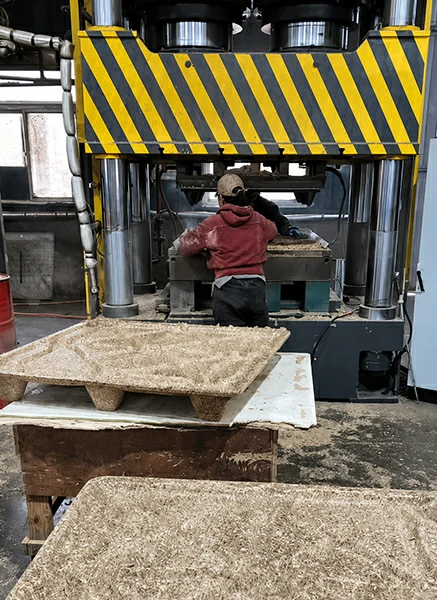
A compressed wood pallet machine lets the recycler close that gap on its own property. Instead of shipping chips out to a biomass buyer, the recycler runs a molded-pallet line and converts Grade A/C waste wood directly into a finished, sellable pallet — an offtake the recycler controls.
This is the structural change: the recycler stops depending on an external terminal and builds an autonomous outlet. When the power plant goes down or drops its price, the line keeps running. The waste wood still becomes a product. The revenue still lands.
The line also slots into what the recycler already does. Collection, sorting, and primary crushing are existing operations; a compressed wood pallet machine takes that stream and carries it the rest of the way to a pallet, rather than leaving it as someone else’s feedstock.
Structure, Parameters, and Process Evidence
EMP supplies the full line, not just a press, so the recycler’s existing crushing step extends straight into pallet production:
- Crushing to ≤5 mm — the recovered wood is reduced to a fine, uniform furnish that molds cleanly and consistently.
- Drying to 8–12% moisture — moisture is pulled into the tight band the molding process needs, so every pallet cures to spec and stays dimensionally stable.
- MDI adhesive blending — the dried furnish is mixed with MDI binder, the same isocyanate chemistry used in export-grade molded wood pallets, giving a strong, low-emission bond.
- Hot pressing into shape — heat and pressure fuse the blend into a one-piece, nail-free, fumigation-free pallet ready for export handling.
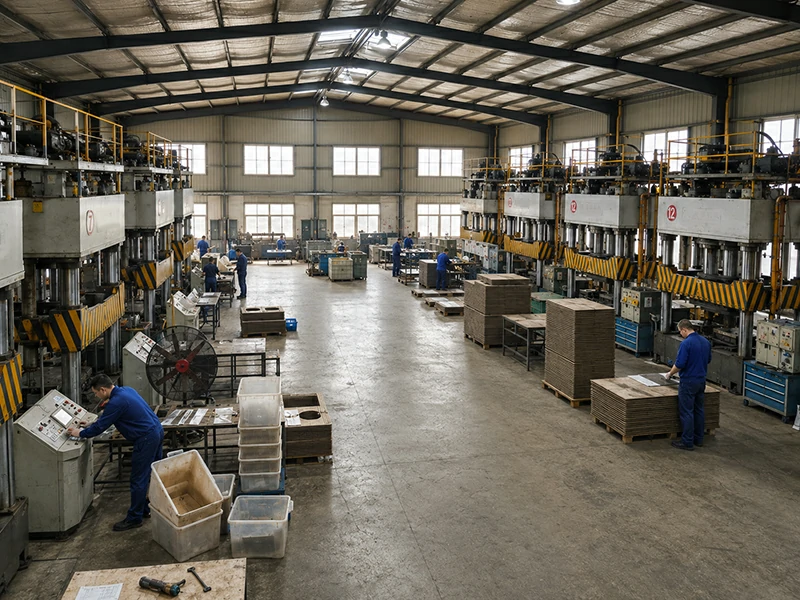
For capacity, the compressed wood pallet machine line spans Y-1250 / 1600 / 2000 / 2500 — four tonnage classes that map to the recycler’s actual waste-wood throughput. A recycler can start at the smaller end, prove the autonomous-offtake model on its own yard, and expand the line as volume and demand grow, rather than committing to a full plant on day one.
The Final Result: The Recycler Owns the Outlet
With a compressed wood pallet machine on site, the wood recycler’s income no longer rides on a power plant’s schedule. Grade A/C waste wood that used to be a chip sale — or a disposal cost — becomes a finished pallet the recycler sells directly. The biomass buyer becomes one optional channel among many, not the only one that decides whether the yard makes money this month.
The recycler keeps the collection and sorting capability it already has, adds the final step it was missing, and captures the margin that dependency used to give away. When the plant shuts down, the line keeps running — and the wood keeps paying.