
The Scenario: Automation Has Moved From Optional to Survival
Across the pallet industry, the largest operators are pouring capital into automation to lift output per worker. The reason is blunt: pallet production is a heavy-labor, high-turnover trade. A traditional nailed wooden pallet line depends on manual nailing, manual board handling and manual stacking, and every one of those stations is under wage pressure. Recruitment is hard, hourly rates keep climbing, and tighter immigration policy has shrunk the pool of entry-level labour that the trade has always relied on. Three forces — hiring trouble, wage inflation, immigration rules — are stacking on top of each other at once.
Any capacity that still depends on manual nailing and manual handling is on the wrong side of that curve: its cost only rises, and its delivery becomes less stable as turnover bites. For a pallet producer, the question is no longer whether to automate, but which automation actually removes labour instead of just speeding it up.
The Problem: Nailing Lines Keep the Labour Cost Built In
A wooden pallet nailing machine still needs operators to feed stringers and blocks, align decks, pull finished pallets and stack them. Add more stations and you add more people, not fewer. The traditional nailed wooden pallet process is, by its nature, an assembly of discrete parts — and discrete-part assembly is exactly where labour sits. When a worker leaves mid-shift, the line stalls; when wages rise, every pallet produced carries that rise forward.
Producers who have already invested in nailing automation often find they have only automated one station, not removed the labour. What they need is a process whose entire chain — from raw material to finished pallet — can run continuously with a small fixed crew.
Why a Molded Pallet Making Machine Fits
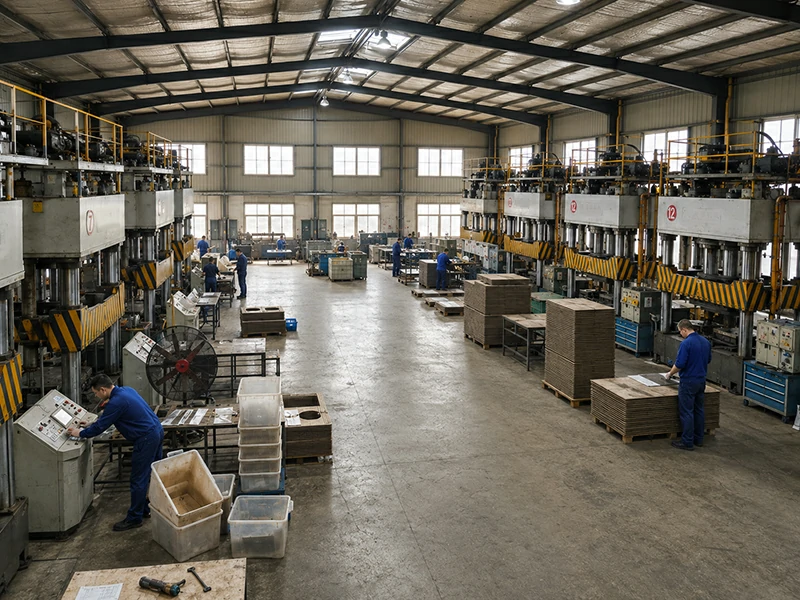
A molded pallet making machine runs a fundamentally different process. Hot press molding is a short-cycle, automatic-cycle process: the mold fills, the press closes, a pallet forms in a single one-press forming cycle, and the ejector (top eject) pushes it out — no nailing, no manual board sorting, no discrete-part assembly. The full chain is continuous:
- Crusher / grinder reduces incoming wood waste, sawdust and wood shavings to fiber.
- Dryer brings the wood fiber and wood chip stream to pressing moisture.
- Glue mixer doses MDI adhesive into the fiber continuously.
- Hot press molding forms the pallet in one cycle, with the conveyor carrying finished units away.
Because compression molding is a closed-cycle process rather than a manual assembly, a molded pallet making machine uses far fewer workers per shift than a nailed-pallet line of comparable output. And for an operator who already runs a molded plant, adding a line with a higher degree of automation directly hedges the wage curve — every automated cycle is a cycle that does not have to be staffed.
Two Tiers, One Platform: Semi-Automatic to Fully Automatic
EMP offers the molded pallet making machine in two configuration tiers on the same process platform. A semi-automatic pallet production line keeps a small crew for load/unload while the press runs its automatic molding cycle; a fully automatic pallet production line adds mechanised feed and discharge to compress the headcount further. The key point for an existing plant: moving from semi-automatic to fully automatic does not mean buying a different machine — it is an upgrade within the same Y32 three-beam four-column hydraulic press platform, not a rebuild.
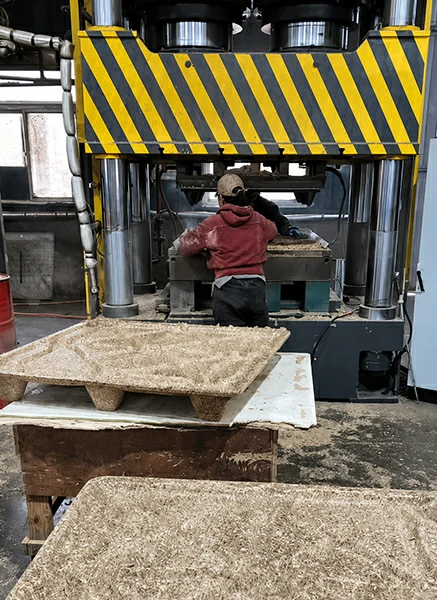
That platform spans four tonnage options so a producer matches the press to the capacity it actually needs, not to a one-size machine:
- Y-1250 hydraulic press — entry single-cavity single station pallet press for standard export pallets.
- Y-1600 hydraulic press and Y-2000 hydraulic press — mid-tonnage for heavier dynamic-load pallets.
- Y-2500 hydraulic press — high tonnage, suitable for a double station pallet press layout that nearly doubles output per cycle.
Structure and Parameters: Evidence the Line Runs With Fewer People
The numbers that matter for a labour-cost argument are the ones that determine how many operators a line actually needs. On a molded pallet making machine, the molding cycle is short enough to sustain an automated hot press rhythm — the press closes, holds, opens and ejects on a fixed timer, so the crew supervises rather than assembles. Platen size and motor power are matched to the chosen mold, and the solid column design of the four columns keeps the platen rigid across off-centre loads, so pallet density stays uniform without operator intervention.
Pressed at a hot press molding density of about 900 kg/m³, the finished pallet meets real logistics thresholds — dynamic load of 1.5–2 tonnes, static load of 5–8 tonnes — fully comparable with a conventional forklift pallet or racking pallet. The pallet itself is nail-free, so no nails / no splinters and a uniform load surface come standard, and the one-piece molded shape will not loosen the way a nailed deck can under repeated handling.
The Result: A Line That Hedges the Wage Curve
For a producer facing rising wages and shrinking labour supply, the molded pallet making machine turns automation from a capital project into a cost hedge. The four-stage crush-dry-glue-press chain runs continuously with a small fixed crew; the press itself runs a short, automatic cycle; and the same platform scales from semi-automatic to fully automatic and across four Y-series tonnages as demand grows. Where a nailing line adds people to add capacity, this line adds cycles.
The outcome is a pallet plant whose per-shift output per worker keeps rising instead of falling — a high output per shift that holds even as wages climb. For large pallet companies already investing in automation, and for smaller producers watching their labour bill climb every quarter, that is the difference between a line that survives the wage curve and one that is crushed by it.