
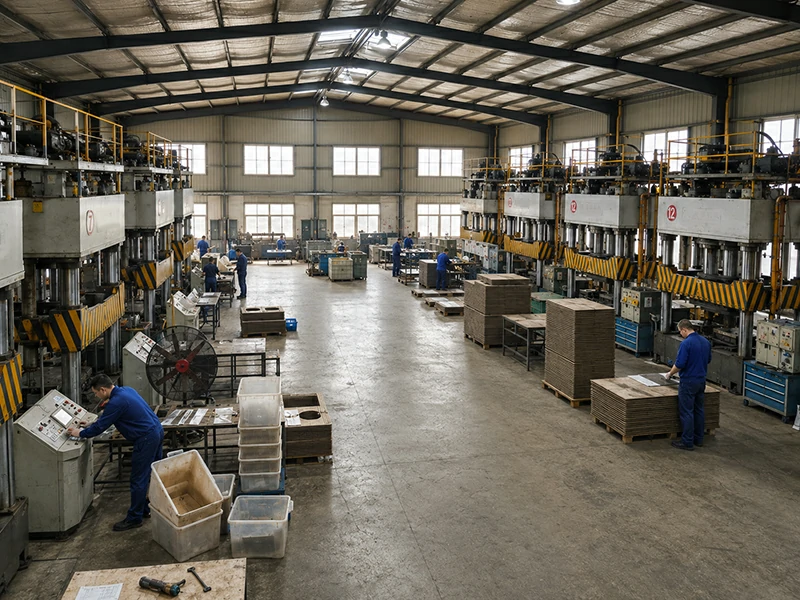
The Scenario: Expansion Plans Stalled at the Equipment Gate
An existing pallet manufacturing plant running molded pallets wants to add a second line. A traditional nailed wooden pallet producer wants to enter the molded category for the first time. Both have the market demand, both have the building, both have the feedstock — and both hit the same wall at the equipment stage.
The wall has three faces. First, European press equipment carries a price tag that dwarfs the payback window for a single new line. Second, the supplier pool for industrial-grade pallet presses is thin: a handful of European brands, a few Asian manufacturers, and not much in between. Third, moving a multi-tonne press across an ocean and onto a factory slab is a logistics problem that many suppliers leave to the buyer. The result is that expansion decisions — sometimes planned for years — sit frozen at the equipment gate.
The Problem: European Pricing, Narrow Choice, and Delivery Risk
European press builders deliver excellent machinery, but the capital outlay for a single forming line can exceed what a mid-size pallet maker earns in a year. Financing the purchase means the first pallet off the new line is already carrying months of interest. And because there are so few suppliers at that tier, there is little leverage to negotiate on price, lead time or aftermarket support.
Cross-ocean delivery compounds the risk. A fully assembled press arrives as an oversized, overweight unit that demands special heavy-haul routing, port handling and crane capacity at the destination — assuming the port can accept it at all. Any delay in customs, any gap in rigging capacity, and the installation window slips by weeks. The producer is not just buying a machine; he is managing a project whose schedule he does not control.
Why the Y32 Three-Beam Four-Column Structure Solves the Delivery Problem
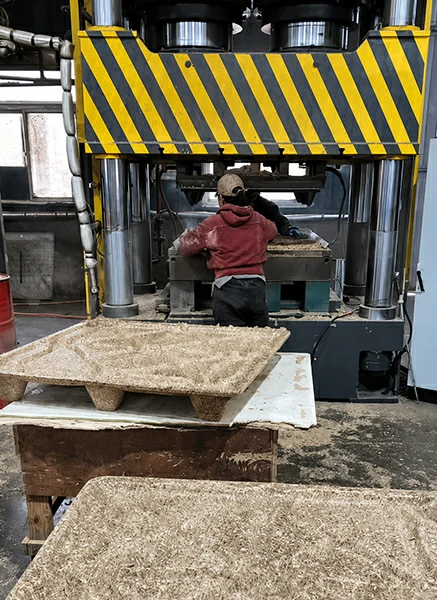
The molded pallet hydraulic press machine is built on the Y32 three-beam four-column hydraulic press platform — a top beam / slide / worktable structure held together by four solid column uprights. That architecture is not an accident of convention. It is the reason EMP chose this structure as the core of its export product line: the press breaks down into its component parts — beams, columns, cylinder, platen, molding die / mold — and each part fits inside a standard shipping container.
At the destination, the same bolted joints that allowed disassembly make reassembly a matter of aligning the columns, torquing the fasteners, and re-installing the hydraulic cylinder and ejector (top eject). No on-site welding, no special foundation beyond a level slab. This is the structural decision that removes the cross-ocean delivery barrier from the expansion equation — the machine travels as general cargo, not as an oversized special-load project.
Four Tonnage Steps: Start With One Line, Then Replicate
The molded pallet hydraulic press machine is offered in four tonnage ratings, so a producer can match the press to his capacity plan — and scale by replication, not by gambling on an oversized first purchase:
- Y-1250 hydraulic press — entry-level single-cavity forming, the lowest-risk starting point for a first molded pallet line.
- Y-1600 hydraulic press — mid-range tonnage for standard 1200×1000 pallets with heavier dynamic-load targets.
- Y-2000 hydraulic press — higher tonnage for denser wood fiber feed or thicker pallet profiles.
- Y-2500 hydraulic press — top tonnage for a double station pallet press configuration that nearly doubles output per cycle.
This is the “one line, then copy” model. A producer can install a Y-1250 hydraulic press, validate the market, train the crew, and then add a second identical line — or step up to a Y-2000 or Y-2500 hydraulic press — knowing the production line layout, the conveyor system, the glue mixer and the dryer are all compatible across the platform. The second installation is faster and cheaper than the first, because the learning curve is already paid for.
Price, Verification, and Turnkey Installation
The price band sits below European equipment and at parity with other Chinese manufacturers — but EMP carries an advantage that a generic general four-column hydraulic press builder does not: EMP operates its own molded pallet factory. The press being sold is the same press running on EMP’s own molded pallet production line, pressing real pallets for real customers. A buyer can verify capacity, molding cycle duration and pallet quality on the production floor before he commits — equipment and pallet maker under one roof.
The line ships as a turnkey pallet plant: crusher / grinder, dryer, glue mixer, preheater, molding die / mold, hydraulic cylinder and conveyor — all specified, matched and commissioned by one supplier. EMP handles factory installation and turnkey plant setup, so the transport and installation concerns that freeze so many expansion plans are addressed in a single contract. The producer’s job is to prepare the slab and the utilities; EMP’s job is to deliver a running line.
The Result: Expansion That Starts With One Line, Not a Leap of Faith
For the in-plant molded pallet maker, adding a molded pallet hydraulic press machine means the second line costs less per unit of capacity than the first — same platform, same tooling logic, same crew skills, container-shipped and turnkey-installed. For the traditional nailed wooden pallet producer entering the molded category, it means the entry point is a single Y-1250 hydraulic press line, not a European-budget megaproject.
Either way, the three barriers that freeze expansion — price, supplier scarcity, and delivery risk — are addressed by the same structural choice. The Y32 four-column hydraulic press ships in pieces, bolts together on-site, comes in four tonnage steps, and is backed by a supplier who runs his own pallet factory. That is how a molded pallet hydraulic press machine turns an expansion plan from a stalled decision into a line that is pressing pallets.