
Why the 1250-1600 ton press take-out post is a safety decision, not a labor decision
A presswood pallet take-out robot changes who is allowed inside the press hazard zone. On a molded wood pallet line running 1250-1600 ton hydraulic presses, the take-out post has always meant an operator leaning into the open mold. The decision to automate that post is now a safety decision: keep the worker out of the press-side danger zone while the press is in cycle, and keep the take-out cycle running on a six-axis arm that handles the 80 degrees pallet directly after demolding.
Why a manual take-out role no longer fits a modern press safety culture
The traditional take-out role on a molded pallet line is three jobs in one: enter the take-out area, remove the pallet from the open mold, and move it to the stacking position. The operator has to repeat that sequence for every press cycle, then repeat the secondary handling needed to build the stack. On a 1250-1600 ton press, that repetition happens inside the press hazard zone while the press is in cycle.
If the press mis-moves, a hand or arm inside the open mold is a crushing or shearing exposure. Even on a well-behaved line, the operator is handling an 80 degrees pallet and breathing the gas that vents from the MDI-glued fiber at the moment the press opens. These are the conditions that made the take-out post a hard-to-fill role even before the recent labor shortage, and the conditions that put the post at odds with the safety culture most plants are now asked to demonstrate in customer audits and ISO/TS 15066 type reviews.
Adding a downstream palletizer does not fix the first handoff. The pallet still has to leave the press and reach the conveyor or stack point while the mold is open. The missing automation node is press tending and robotic offloading at the press hazard zone, not generic warehouse movement downstream.
How a presswood pallet take-out robot removes the operator from the danger zone
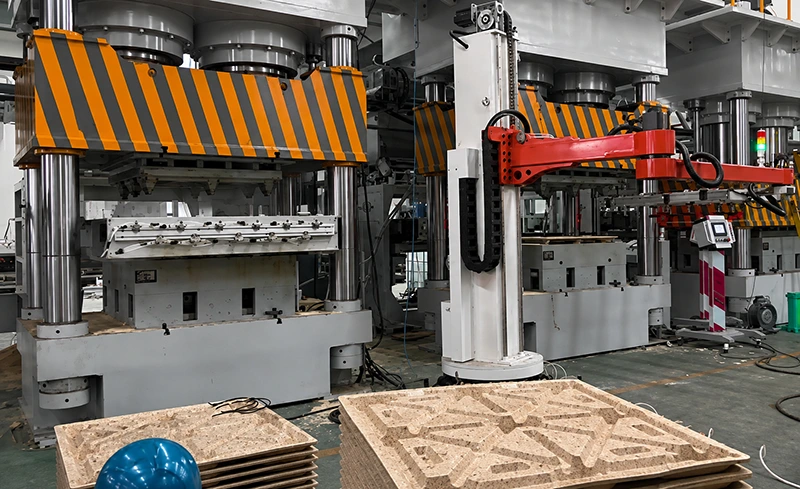
The presswood pallet take-out robot is built for the end of the press cycle, not for general warehouse work. After the press opens, the six-axis articulated arm enters the mold area instead of the operator. A vacuum suction cup end effector is placed on the finished pallet, vacuum is applied, and the arm lifts the pallet out of the press and carries it to the stacking position. Automatic palletizing at the stack point removes the secondary manual move that the old workflow required.
One arm is configured to serve two presses (dual-press tending). The arm alternates between machines as their press timing demands, so take-out capacity can be expanded without assigning one take-out worker to every added press. The robot runs 24 hours a day without shift breaks, heat-rotation, or recruitment risk at the harshest post on the line.
This is the part that is easiest to justify to a decision-maker who owns the safety number: the presswood pallet take-out robot takes the worker out of the press hazard zone, not just out of the take-out job. The saving shows up first as a safety outcome (no operator inside the open mold, no 80 degrees hand-handling), and then as a labor outcome (two take-out posts per two-press line are removed from the headcount plan). For plants whose customers audit their safety culture, that order is the selling point.
Structure, parameters, and the evidence to verify
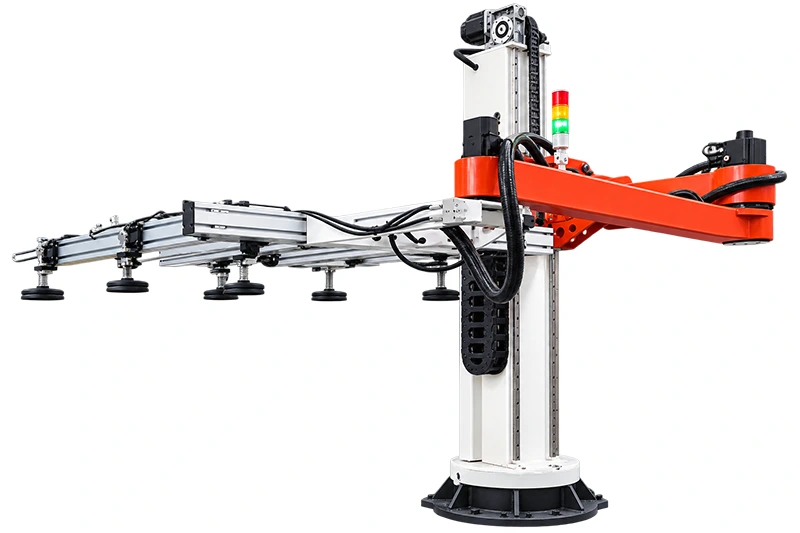
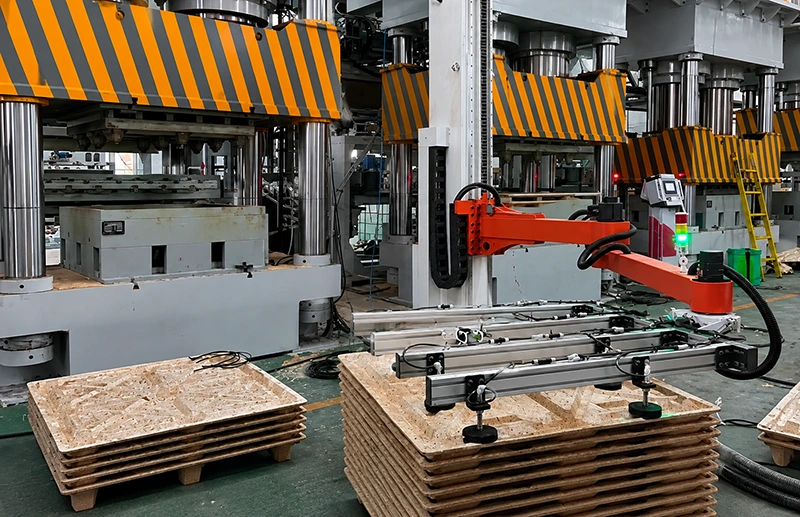
The indexed product imagery shows the engineering features relevant to the press hazard zone: a long-span handling structure with linear guide movement, a multi-cup vacuum gripping head, cable-chain routing for the press-side duty cycle, a safety signal tower, and a protected work-cell layout around the four-column press. The press-side images support the relationship between the press, the transfer arm, and the molded product stack; they show a unit installed beside a running press, not a generic warehouse robot.
The currently documented facts about the presswood pallet take-out robot are six-axis articulated motion, vacuum suction gripping, service for two presses, handling of 80 degrees pallets, integration from press take-out to automatic stacking, and line-level PLC control integration with the press cycle.
Payload, reach, repeatability, suction-cup count and size, vacuum pressure, controller or PLC model, installation dimensions, power supply, and air supply remain application-specific items to confirm with EMP engineering before quoting. The robot is sold as part of the line, so those values are sized to the press tonnage, the pallet geometry, and the stack pattern the buyer is running.
The result: capacity expansion without sending another worker into the press hazard zone
For a plant scaling from a semi-automatic line to a fully automatic presswood pallet line, the take-out robot closes two gaps at once. It closes the forming-to-stacking gap by lifting the pallet directly out of the press and placing it on the stack, and it closes the capacity-to-hazard-zone-headcount gap by removing the two take-out operators per two-press line from the press hazard zone.
The operating message is direct. The plant can add a shift, add a press, or raise the cycle rate without adding a worker to the press danger zone, and the safety audit aligns with the configuration because the configuration removes the operator from the open mold instead of asking the operator to be more careful inside it. Before ordering, the plant should map press cycle timing, pallet geometry, stack pattern, safety guarding, conveyor handoff, and PLC interfaces. When those conditions match, the presswood pallet take-out robot lets production capacity increase without take-out labor increasing at the same rate, and without the hazard-zone headcount increasing at all.