
Manual Take-Out at 1250–1600 Ton Presses Is the Job Safety Cannot Defend
A presswood pallet line is built around a four-post hydraulic press in the 1250–1600 ton class. When the press opens after a 4–5 minute cycle, an 80°C pallet sits in the mould cavity and waits to be lifted, indexed, and stacked. In most plants we walk into, that lift is still done by a worker standing at the open press. The presswood pallet take-out robot exists because that single motion — operator inside the open mould of a hot, high-tonnage press — is the job that no safety policy, PPE rule, or training drill can honestly defend. Customers who build their reputation on a strong safety culture reach the same conclusion we did: the fix is to take the worker out of the danger zone, not to coach the worker on how to stand inside it.
Where the risk actually lives
- The mould cavity of an open 1250–1600 ton press is an unguarded pinch point the moment the ram retracts. A single late-cycle hand-fault becomes a crush or amputation injury.
- Freshly pressed pallets come out of the mould at around 80°C. Repeated handling of hot workpieces creates chronic burn exposure for the operator, even when no incident is reported.
- Presswood pallets are bonded with MDI glue. At mould-opening temperature the off-gas sits directly in the operator’s breathing zone. Pulling the operator away from the breathing zone is the only engineering control that scales.
- Press cycle time is short, the take-out window is narrow, and the operator is physically close to moving platens. Guarding-light curtains and two-hand controls do not eliminate the exposure; they only shorten it.
Why the existing controls do not close the gap
- Light curtains trip the press on intrusion, which is exactly what makes the operator rush the take-out step before re-arming. The behaviour pressure increases, not decreases.
- Two-worker take-out shifts the injury from crush to musculoskeletal strain, and removes one headcount but doubles the exposure time of the second worker.
- Gloves, sleeves, and cooling stations reduce symptoms but leave the same root cause in place: a human inside the hazard zone, on every cycle.
What a Presswood Pallet Take-Out Robot Changes
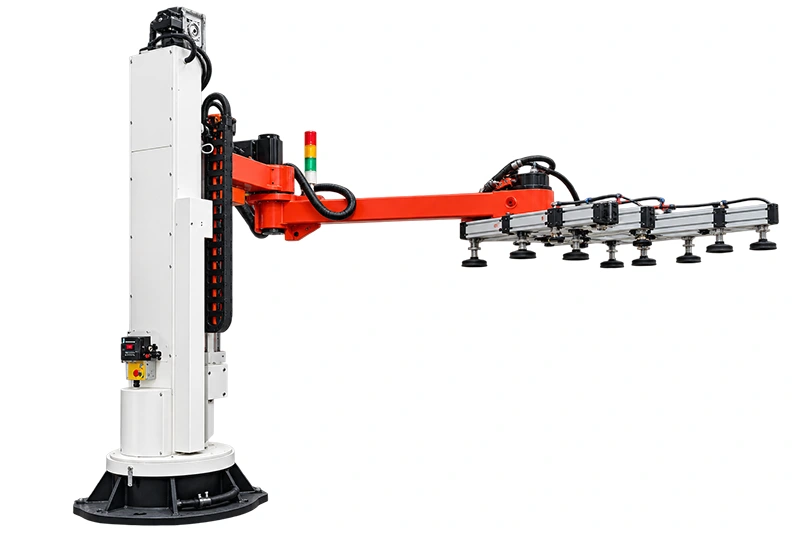
The presswood pallet take-out robot does not add a new safety device on top of the manual job. It removes the manual job. The robot enters the open press, grips the hot pallet with a multi-cup vacuum suction beam, lifts it clear of the cavity, and transfers it directly to the stacking position. The operator steps out of the cycle entirely and is repositioned as a line supervisor, not a press-side hand.
Designed for the presswood line, not adapted from a general palletizer
- Multi-axis articulated arm with a vacuum suction cup end effector, dimensioned for the presswood pallet footprint rather than cartons or bags.
- Specified to handle pallets coming out of the mould at 80°C — the take-out step does not wait for the pallet to cool to a hand-safe temperature.
- One arm covers two presses: the dual-press tending layout lets a single presswood pallet take-out robot serve the 1250-ton press and the 1600-ton press on the same line, replacing two dedicated take-out workers.
- PLC control integration with Siemens or Mitsubishi cabinets already on the line, so the take-out step is sequenced with the press open/close signals rather than overlaid as a black box.
- 24/7 continuous operation — the robot does not slow down for the third shift, the holiday week, or the morning after a hard weekend, which is when manual-extraction incidents cluster.
What the line gains the moment the robot is commissioned
- The press danger zone becomes a fenced cell with no scheduled human entry during normal production.
- Manual extraction injuries — the line item no plant manager wants to explain in an audit — come off the risk register because the manual step itself is gone.
- Take-out labour cost is removed: the two headcounts previously dedicated to each press are redeployed to upstream glue mixing, downstream inspection, or stacking oversight.
- Cycle time is no longer capped by how fast a worker can safely grip an 80°C pallet under a hot press.
Structural Evidence From the Press-Side Installation
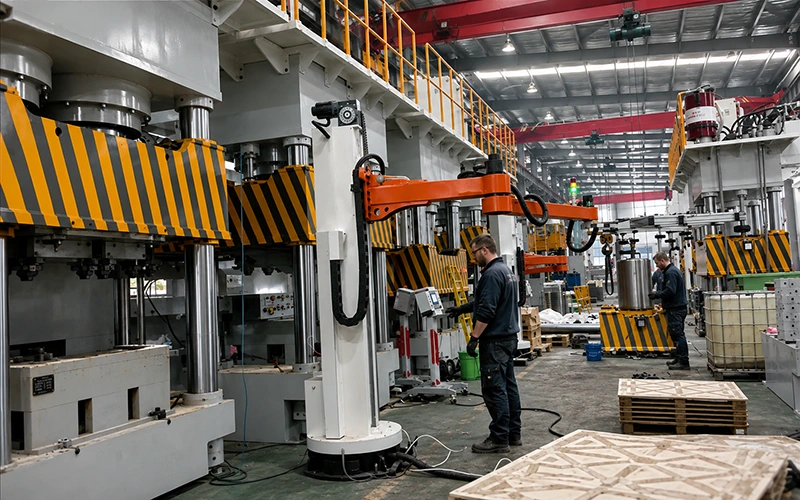
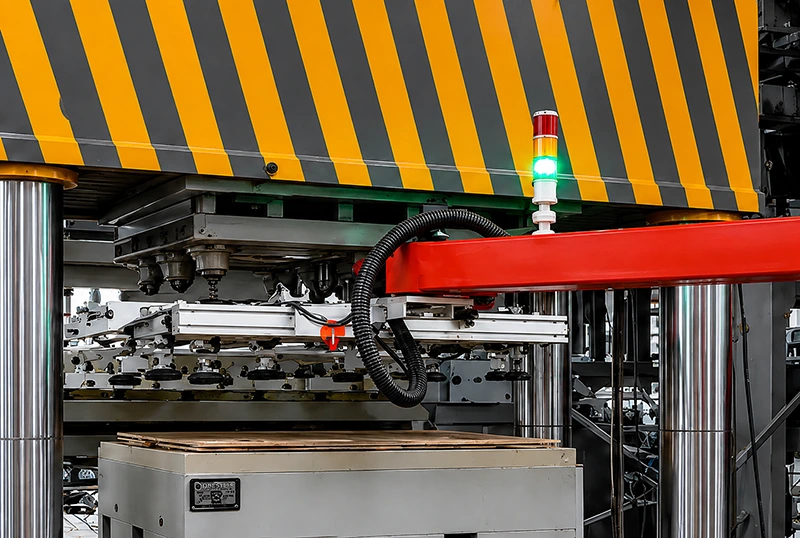
The images below are not renderings. They are taken on a presswood line where the presswood pallet take-out robot is already installed between two four-post hydraulic presses. Read them as the field evidence for the claims in the previous section.
What you are looking at, line by line
- The robot column stands between the two press frames, inside the floor area the presses already occupy. Take-out reach is set by the press opening, not by a separate overhead gantry.
- The suction beam carries multiple vacuum cups spread across the pallet face, so the pallet is lifted flat on the first grip rather than pinched at one edge.
- Hose and cable routing is carried on the arm structure rather than trailing across the floor, keeping the press cell free of trip hazards.
- The operator interface is positioned outside the cell, so routine production does not require anyone to step into the press danger zone.
What the Line Looks Like After AutoG
The result we see on every presswood line that has switched is the same shape, regardless of the customer’s existing automation depth: the press cell becomes unmanned during production, the take-out step becomes part of the press cycle rather than a separate manual motion, and the safety incident risk that the customer’s leadership had been quietly carrying for years is removed from the risk register in one project.
- Press danger zone operator entry during normal production: from every cycle to none.
- Take-out headcount per press: from one dedicated worker to zero.
- Press cycle cadence: no longer gated by manual handling speed; the 1250–1600 ton press can run its full 4–5 minute cycle uninterrupted.
- Site safety audit narrative: the line moves from “PPE and training mitigate a known hazard” to “the hazard is engineered out at the source.”
- Production continuity: the cell runs through the night shift, the weekend, and the holiday week without a take-out labour dependency.
If your presswood line is still opening on a manual take-out, this is the conversation to have before the next safety audit, not after the next incident.