
Why New Presswood Pallet Plants Get the Industrial Wood Chipper Sizing Wrong
A first pallet plant is rarely priced like a tenth plant. The capex question most owners get wrong is the first chunk of equipment downstream of the press, not the press itself — and that first chunk is almost always an industrial wood chipper. Two failure modes show up in every new project:
- Buy too big, capital sinks before sales arrive. European turnkey lines (Andritz, Bruks, Pallmann-class) are quoted in the multi-million-Euro range, are sized for plants running tens of tons per hour, and rarely publish a price because their configuration is built around a specific downstream line you do not yet have. A new entrant that mirrors a 30 t/h reference plant is buying a machine sized for a downstream capacity it will not reach for years.
- Buy too small, growth caps in year two. The opposite trap is the cheapest 2–3 t/h disc or hammer-only setup. It clears year-one cash but bottoms out against the press’s real consumption the moment a stable ISPM 15 export order lands. Owners then face a second capex event — and a second round of installation, foundation, and downtime.
Either mistake traces back to the same root: sizing the industrial wood chipper to a future state nobody has verified, in either direction. A 2024 entrant shipping roughly 50–100 pallets per shift and listing 300+ pallets/shift of nameplate capacity is the canonical example — a plant visibly oscillating between betting capex on growth and staying too small to win export orders. The middle path is what this article is about.
Three Industrial Wood Chipper Tiers, Not One Big Quote
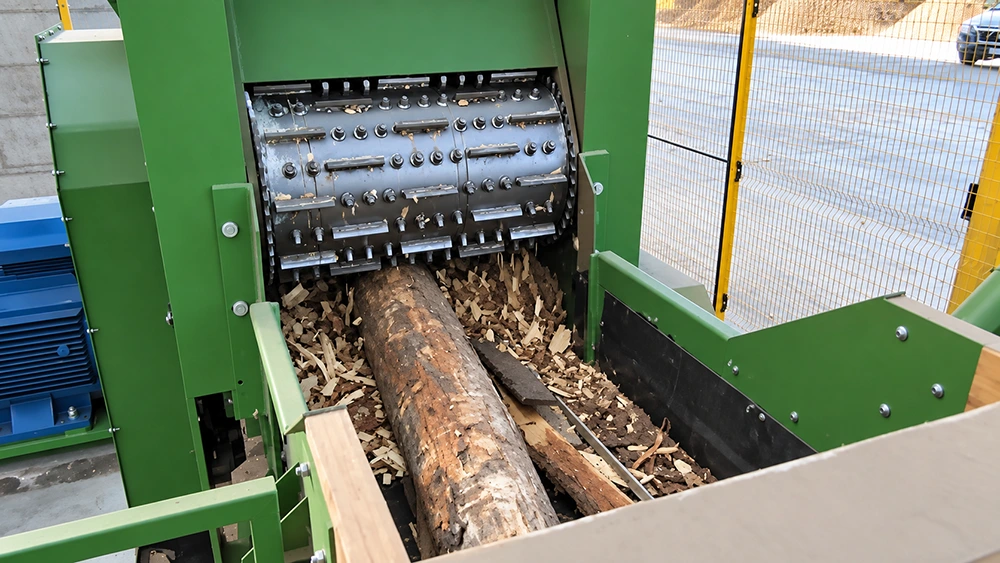
The EMP drum wood chipper lineup is intentionally built in three capacity tiers so a new plant can match motor power to first-year chip demand and step up later. All three share the same drum design logic (horizontal knife roller, hydraulic feed, fly knife + counter knife geometry, 30–35 mm chip target):
- X-215 industrial wood chipper — 45 kW, 4–5 t/h. The entry tier. Sized for a single presswood pallet press in its first 12–18 months, when the dryer, hammer mill, and downstream conveyor are not yet on the floor. Same drum geometry as the bigger models; just a shorter rotor and a smaller drive.
- X-216 industrial wood chipper — 55 kW, 6–8 t/h. The mid tier. Covers the most common case: one press plus a downstream hammer mill, plus enough spare capacity for a second shift on the press within the first 24 months. This is the tier most “Greenfield” plants end up specifying once a real sales forecast is on the table.
- X-218 industrial wood chipper — 110 kW, 8–12 t/h. The expansion tier. Specified when a second pallet press is being added inside the first year, or when the chipping section has to feed a dryer, hammer mill, and storage bin in one continuous run.
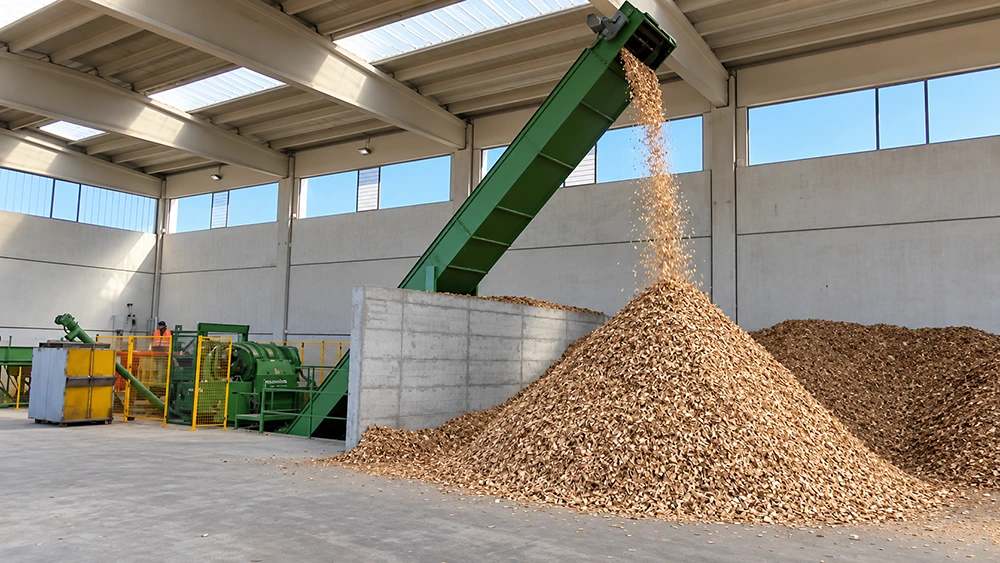
The three tiers share chip geometry (30–35 mm nominal length, set by the same fly knife / bed knife gap), share the hydraulic feed roller principle, and share the same feed-inlet dimension family. The cross-tier consistency is what lets a plant move from X-215 to X-216 without re-engineering the downstream sieve, dryer feed, or storage layout — the chip spec stays compatible.
Why an Industrial Wood Chipper in Drum Form Suits a New Pallet Plant’s Feedstock
A new pallet plant’s feed hopper does not see clean, debarked, knot-free pine like a pellet mill in central Europe. It sees:
- Small-diameter branches and slab edges from local sawmill residue (cheap or zero-cost feedstock)
- Slabs and offcuts from joinery shops
- Used pallets, packaging timber, and demolition formwork (very low feedstock cost, but irregular geometry and foreign-body risk)
- Planer shavings when a downstream hammer mill is added later
The drum industrial wood chipper geometry — a horizontal knife roller with multiple fly knives mounted across the rotor face and a stationary counter knife — is built for irregular geometry. The fly knife cuts against the bed knife as the log passes through the feed chute; chips fall through a sizing screen below. Two structural consequences matter for a new plant:
- Feed rate tolerates variation. Logs that are too long, too crooked, or partially forked still pass through the chute rather than jamming the rotor. A disc chipper, by contrast, wants clean geometry — it jams on branches the drum machine handles.
- Knife service is mechanical, not a black box. The fly knives are bolt-on and replaceable in pairs; the counter knife is adjustable for chip length. Spare-part lead time and on-site knife change are real, measurable items, not vendor-side promises.
The honest limit: a drum industrial wood chipper does not have a built-in metal detector. Feedstock that contains nails from used pallets or demolition formwork needs pre-sorting before it enters the feed chute — a wood crusher with a metal-detection stage is the alternative for plants that take heavily contaminated waste wood.
Buy the Chipping Section First or Buy the Whole Line First
Most new plants also mis-size the scope of the first purchase, not just the machine size. There are two reasonable orderings:
- Single chipping section first. A 45 kW industrial wood chipper plus a short discharge conveyor into a floor pile. This is the smallest sensible footprint, lets the new plant prove chip supply against real press demand, and leaves every downstream decision open until sales volume justifies it.
- Turnkey line at the start. A 55 or 110 kW industrial wood chipper plus discharge conveyor, hammer mill, dryer feed bin, and dust extraction, all from one supplier. Higher capex, but every interface is pre-engineered and the plant skips a year of trial-and-error on chip spec mismatches.
The middle path is the one we see most often in working projects: start with the chipping section at the right tier (X-215 for a single press, X-216 once a real sales forecast exists), then add the dryer and hammer mill inside months 6–14 once the press line is paying for itself. That staged investment is the structural reason a three-tier drum chipper lineup exists at all — a single model would force buyers into one of the two failure modes above.
What to Confirm Before You Buy an Industrial Wood Chipper
For a new presswood pallet plant, four checks decide which tier to order and which ordering to pick:
- First-year pallet output forecast, not aspirational nameplate. Convert the realistic year-one pallet count into a t/h chip figure using the plant’s planned moisture and chip spec. If the figure is below 4 t/h, an X-215 industrial wood chipper is the right starting point. Between 4 and 8 t/h, plan to start at X-215 and specify X-216 as the year-two upgrade. Above 8 t/h, an X-218 industrial wood chipper from day one is justified.
- Feedstock form, not just feedstock species. Branches, slab edges, and used formwork all run on the same drum machine — but a plant taking predominantly used pallets with nails needs a feed pre-sort. Confirm the upstream feed design before specifying the chipper.
- Downstream chip spec. The presswood pallet line downstream wants a 30–35 mm chip, not fines. A drum industrial wood chipper’s sizing screen is what controls this; replacing it for a finer screen drops throughput and raises knife wear without benefit.
- Installation envelope. A drum industrial wood chipper at 45 / 55 / 110 kW is a rotating heavy machine and needs a concrete foundation and vibration isolation per the installation drawing — “no foundation” claims from competing brands do not apply to this geometry. Confirm civil works early enough not to delay the chipping section delivery.
The Result: Match the Industrial Wood Chipper Tier to the Year of the Plant You Are Building
A new presswood pallet plant that buys an industrial wood chipper as a single, monolithic capex item will either tie up cash it does not have yet or buy a cap on growth that costs more to undo than to plan around. The three-tier drum lineup (X-215 / X-216 / X-218, 45 / 55 / 110 kW, 4–12 t/h) and the staged buy (single section first, downstream stages added when sales justify them) are the practical structure that keeps a year-one plant solvent and a year-three plant unconstrained. The whole exercise is matching the machine to the year of the plant you are actually building, not the year you hope to reach.
Talk Through Your Industrial Wood Chipper Sizing
If you are sizing a new presswood pallet line — or adding capacity to an existing one — and want to walk through which drum chipper tier fits your first-year sales forecast and feedstock mix, send us your planned pallet output and your feedstock form. We will spec the X-215 / X-216 / X-218 choice against your actual numbers, not a generic quote.