
The Export Pallet Plant’s Chip Stage Is Now an Audit Item
A presswood pallet plant selling into the EU — with the US and Japan alongside it — is not audited only on its finished pallets. Electronics and food buyers run long qualification cycles: sample submission, dimensional and load testing, then a factory audit. A new plant ramping capacity is at its most fragile precisely during that window. One failed load test or one out-of-tolerance pallet dimension does not cost a re-test; it costs the account.
The chip preparation stage sits at the front of that chain. Chip geometry, chip moisture and the stability of both decide what the press sees, and what the press sees decides the pallet’s density profile and load rating. When a new plant’s chip supply drifts, every downstream stage inherits the drift. That is why the equipment choice for this stage — and specifically an electric wood chipper rather than a diesel mobile unit or an outsourced chip contract — has become a compliance question rather than a production question.
Where the Old Arrangements Break Under Audit
Three arrangements are common in new export plants, and all three fail at the same point:
- Outsourced chips fail the traceability question. A recovered-wood chain-of-custody audit asks where the fibre came from. If your chip supplier blends intake from multiple sources without lot records, you cannot answer — and the pallet, not the chip, is what gets rejected. Outsourcing the chip stage outsources the records you are being asked to produce.
- A diesel mobile chipper fails the installation question. A tow-behind diesel unit in the yard has engine exhaust in the working area, fuel stored on site, and no fixed guarding, dust extraction connection or documented installation. It is a contractor’s machine, not a fixed installation an auditor can assess against a machinery safety file.
- An undocumented fixed machine fails the file question. Even a properly installed chipper is a problem if the supplier hands over a manual and nothing else. When the buyer’s auditor asks for the risk assessment, the technical file inputs and the declaration covering that machine, “we’ll get it from the supplier” is not an answer that survives a qualification visit.
And underneath all three sits a change in the rulebook itself, which turns a one-time purchase into a documentation commitment.
What Actually Changes on 20 January 2027
Machinery Directive 2006/42/EC is repealed on 20 January 2027 and replaced by Machinery Regulation (EU) 2023/1230. Two practical consequences follow for a plant specifying chip preparation equipment now:
- The instrument changes shape. A directive is transposed into national law; a regulation applies directly. Documentation prepared against the old national transposition is not automatically the documentation the new instrument expects.
- Notified-body involvement may become mandatory for this category. Under the new regulation, machinery listed in Part A of its scope requires mandatory third-party conformity assessment by a notified body. Whether woodworking machinery — and specifically chip preparation equipment — is listed in Part A is still being finalised. If it is, the route to placing the machine on the EU market changes from self-declaration to an assessed route.
The classification is genuinely still in motion, and we would rather say so than sell you a certainty that does not exist yet. What we do commit to is tracking it: the model documentation set for each machine we ship is updated as the classification and the harmonised standards settle, rather than being frozen at whatever was current on the day of purchase. For a plant buying a machine in 2026 that has to stay compliant past 2027, that commitment is worth more than a certificate dated today.
Why an Electric Stationary Drum Machine Fits an Audited Export Plant
An electric wood chipper resolves the installation question and the drive question at the same time:
- Electric drive removes the engine from the workshop. No diesel exhaust in the chip preparation area, no fuel storage, no engine emission compliance to document. For a plant also managing wood dust — a recognised dust-explosion risk in this industry — taking combustion out of the chipping hall simplifies the dust and ignition-source assessment considerably.
- Stationary installation makes the machine assessable. A fixed machine on a concrete foundation, with fixed guarding, a connected dust extraction point and a documented electrical installation, is a machine an auditor can walk. A mobile unit cannot be assessed the same way.
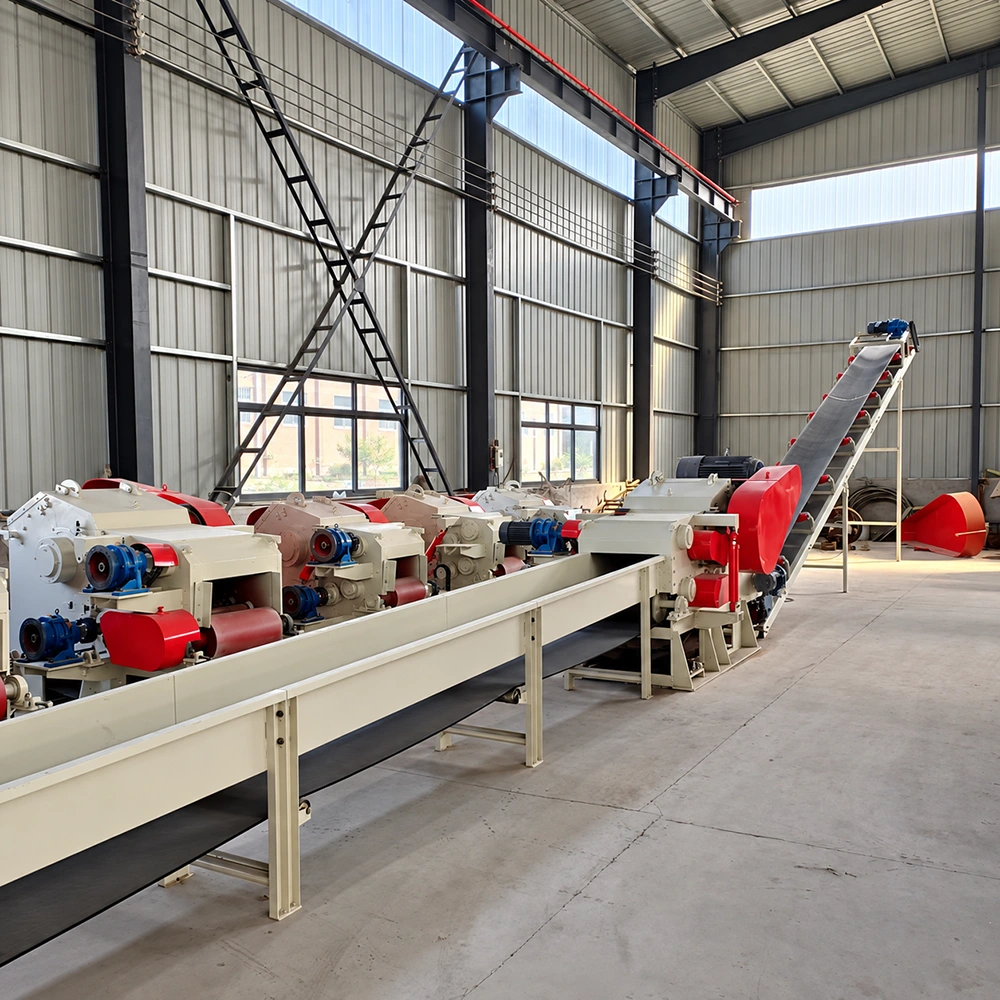
- The drum geometry holds chip spec under variable feedstock. The horizontal knife roller works against a stationary counter knife, with a sizing screen below dropping 30–35 mm chips onto the discharge conveyor. The hydraulic feed roller pulls irregular pieces — branches, slab edges, used formwork — through the chute without the rotor jamming. Uniform chip size is what keeps the press, and therefore the pallet, stable.
Capacity is specified in three tiers so the machine matches the plant’s audited output rather than an aspiration: the X-215 electric wood chipper at 45 kW for 4–5 t/h, the X-216 at 55 kW for 6–8 t/h, and the X-218 at 110 kW for 8–12 t/h. All three share chip geometry, so stepping up a tier later does not force a change to the downstream sieve, dryer feed or storage layout. Purchase scope is likewise split: a single chipping section to prove the stage, or the full export line configuration — chipper, discharge conveyor, hammer mill, dryer feed and dust extraction — as one documented package.
Structure and Parameters an Auditor Will Ask About
When a buyer’s auditor walks the chip preparation stage, the questions are specific. These are the corresponding facts for the drum machine:
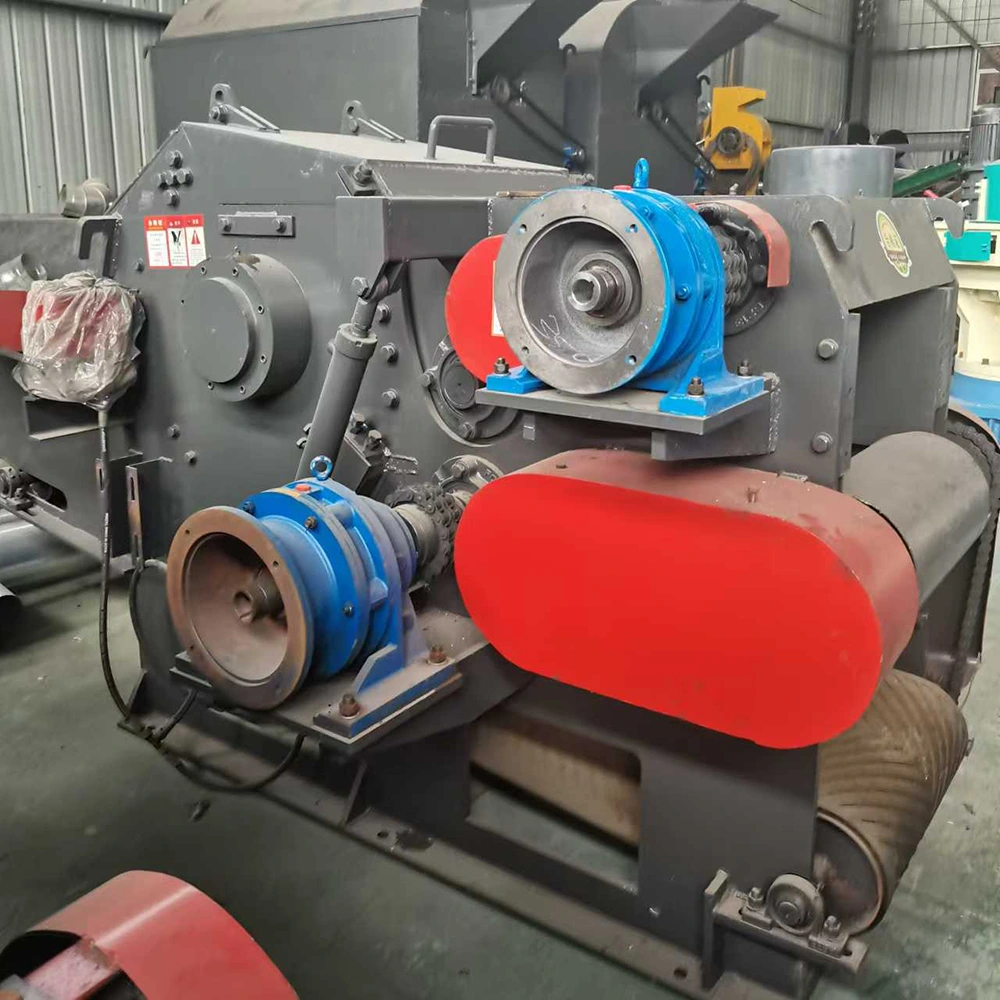
- Cutting geometry and knife service. Alloy steel fly knives bolt to the knife roller in pairs and are replaceable in pairs; the counter knife is adjustable for chip length. Knife-gap setting, knife replacement interval and spare-part lead time are documented service items, not verbal assurances.
- Chip specification. Nominal 30–35 mm chip length, set by the fly knife and bed knife gap and held by the sizing screen. This is the number that links the chipper to the press, and the number your pallet dimensional records trace back to.
- Feed and guarding. Hydraulic feed roller with continuous feeding operation, fixed guarding around the feed chamber and drive side, and warning signage at the inspection points.
- Installation and commissioning. The machine is a rotating heavy machine and requires a concrete foundation and vibration isolation to the installation drawing. On-site commissioning and overseas engineer installation are part of the delivery scope, and the commissioning record is part of the file your auditor will want to see.
- Electrical documentation. The electrical package — motor nameplate data, drive ratings, enclosure and earthing details, control circuit documentation — is prepared for the destination market, so the local inspection and your own maintenance records start from the same drawings.
What We Do and Do Not Claim
Being precise here matters more than being agreeable, because a compliance claim that does not survive an audit is worse than no claim:
- We prepare and maintain the documentation. The machine ships with the technical file inputs, risk assessment, electrical documentation and commissioning records prepared for the target market, in an export line configuration where that is what you order.
- We track the 2027 transition and update the model files. As the Part A classification and the harmonised standards settle, the documentation set for your model is updated rather than left at its purchase-date version.
- We do not hand you a certificate that is not ours to issue. CE marking remains the responsibility of the party placing the machine on the EU market, and whether a notified body must be involved depends on the final classification of this category under Regulation (EU) 2023/1230. We will tell you which route applies to your machine once the classification is settled, and we will not tell you it is settled before it is.
- Traceability is built, not bought. Bringing chipping in-house means the intake records for your recovered wood are created at your own gate, which is what a chain-of-custody audit needs. The machine does not make you compliant; it makes the records possible.
The Result: A Chip Stage That Survives Both the Audit and the Rule Change
An export pallet plant that specifies an electric wood chipper in the X-215 / X-216 / X-218 tier set gets three things the audit actually tests: chip geometry held at 30–35 mm so the press and the pallet stay stable through a capacity ramp, a fixed electric installation that can be assessed instead of a mobile unit that cannot, and a documentation set that is maintained past the 20 January 2027 switch rather than frozen at purchase. Combined with the full export line configuration, the chip stage stops being the weakest link in a buyer qualification visit and becomes the part of the line you can walk an auditor through without preparation.
Get the Documentation Set for Your Target Market
If you are specifying chip preparation for an export presswood pallet line, tell us which markets you ship pallets into and what your buyer’s qualification process asks for. We will confirm which electric wood chipper tier fits your output, and which documentation package applies to each destination market — including what changes for your machine after 20 January 2027.