
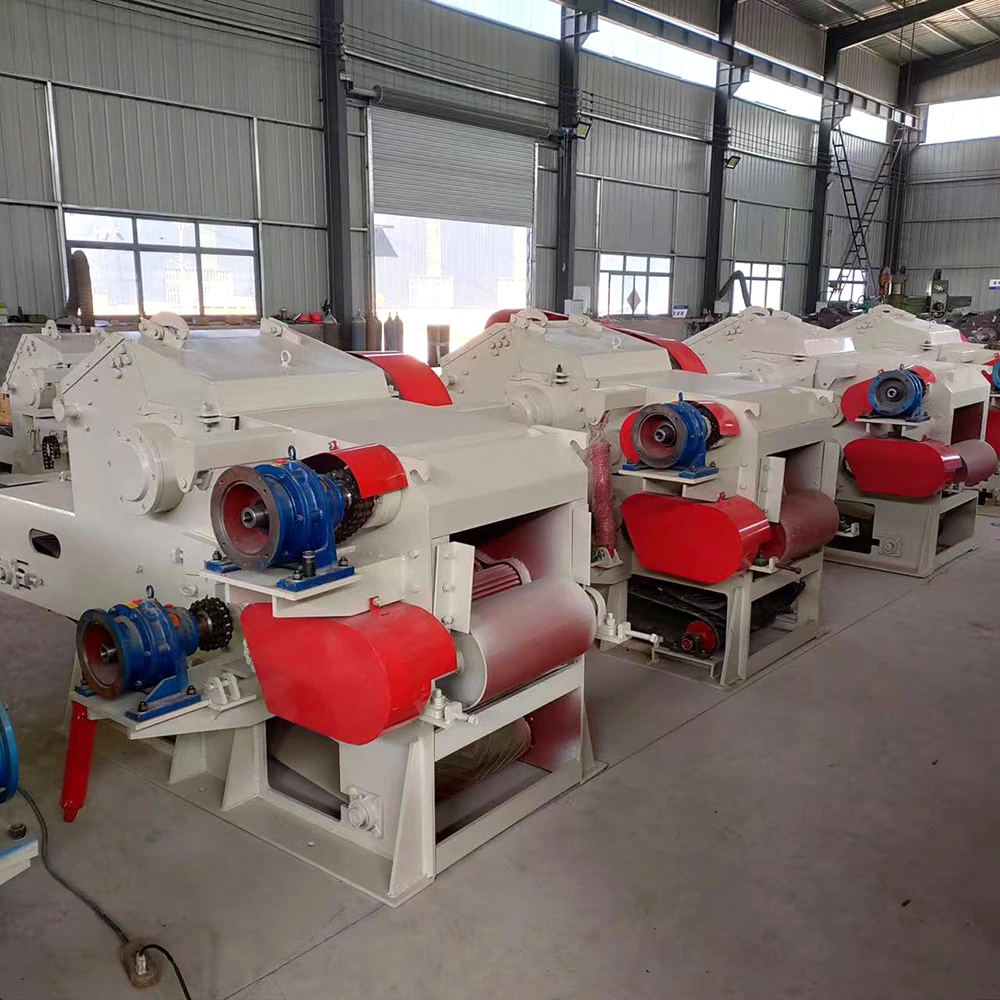
The cost-per-pallet conversation that never quite ends at the press
On a presswood pallet line the conversation about cost per pallet usually lands on the press. The mold, the cycle time, the glue spread, the hot-press energy. Those matter. But the rotary drum chipper at the front of the line sets a floor under all of them, because every kilogram that goes through the press first came through the chipper as either a uniform chip, an oversized chunk, a fines-rich pulp, or a sliver. A press cannot redeem what the chipper did to the feedstock. It can only compound it.
This article is written for plant owners who already know the press numbers and now want to look upstream: at the rotary drum chipper that lives between the raw wood pile and the hammer mill. The question we walk through is what the chipping section actually controls on the per-pallet ledger, what it does not, and where the maintenance-access design of the chipper decides the second-biggest cost on that ledger: the line stop you did not plan.
Where this gets decided when every dollar per pallet matters
In our experience the rotary drum chipper is one of three places on a presswood line where a fractional change compounds into a per-pallet number that buyers actually feel. The other two are the dryer and the press itself. This article stays on the chipper, but the framing applies to any continuous upstream stage.
The three drivers buyers forget the chipping section controls
- Chip uniformity feeding the hammer mill. The hammer mill downstream sees whatever the chipper hands it. Oversized chunks make the mill re-circulate; slivers and fines overload the screen and ride the air stream to the cyclone instead of into the pallet. Both raise specific energy per ton of finished pallet.
- Specific energy per ton of finished chip. A continuous-cutting drum geometry cuts rather than impacts. Cutting takes less kWh per ton than impact-shredding the same feedstock. The exact figure depends on species and moisture, which is why we do not quote a single number in this article, but the direction is consistent across our X-215 / X-216 / X-218 line.
- Scrap rate on the press. When the press sees non-uniform feedstock the glue spread varies, the mat density varies, and the reject bin fills. A reject pallet is the most expensive pallet on the floor – all the upstream cost is in it, and there is no sale to recover it. The chipping section is upstream of that reject decision.
Why a rotary drum chipper is shaped differently for presswood lines
The geometry that shows up in a presswood line is not the geometry you see on a forestry yard. A presswood line is fixed, indoors, electrically driven, and fed by a hydraulic loader. The chipper that lives at its head has been adapted to that environment.
Continuous cutting, not percussive shredding
Inside the housing the chipping drum carries a row of fly knives turning past a stationary counter knife (bed knife). Each pass shears a slice from the wood. The slice length is set by the feed-roller advance per revolution, which is adjustable – 30 to 35 millimetres is the typical setting on our 6-8 t/h and 8-12 t/h configurations. Compare this to a hammer mill or a disc chipper, which impacts or shears-and-throws. Continuous cutting consumes less power per ton than impact on the same feedstock because the cutting force is spread across the knife pass rather than concentrated in a hammer strike.
Knife geometry and discharge screen do the work
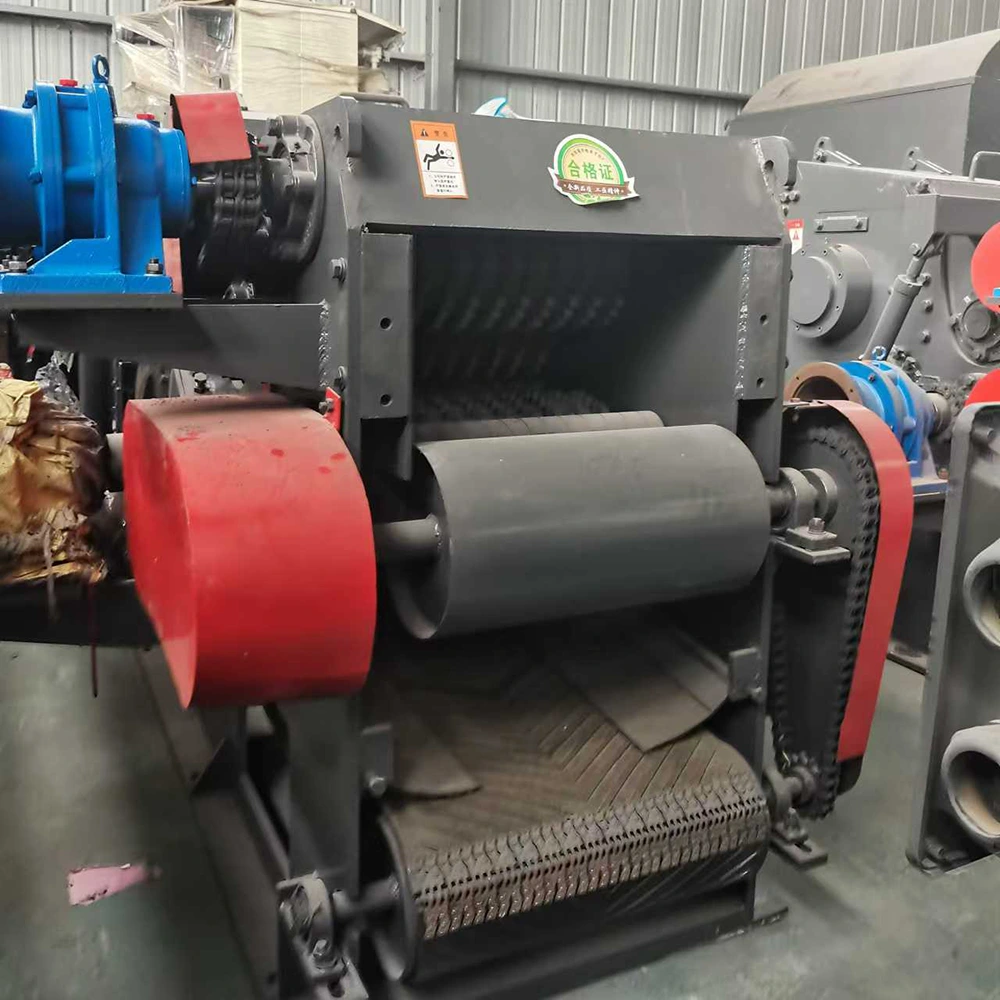
The pieces that determine chip uniformity on a rotary drum chipper are visible from this angle. The horizontal feed rollers pull the log or slab in at a controlled rate. The drum above shears each slice off. Below the drum sits the discharge screen: only chips that pass the screen aperture fall through to the conveyor. Anything oversized stays inside until the next knife pass reduces it. This is the mechanism behind the “uniform chip size output” you see in the product spec – it is not a guarantee, it is a screen.
This is also why a rotary drum chipper fits the presswood use case specifically. The press needs chips in a tight size band so the hammer mill, the dryer and the glue blender all behave predictably. A drum-and-screen geometry delivers that band by physics, not by operator skill.
Maintenance accessibility: the day the line stops is also a cost-per-pallet day
The other half of per-pallet cost is the day the line is not running. A presswood line that runs one shift a day, five days a week, is running about 40 percent of calendar hours. The remaining 60 percent is downtime – planned or unplanned. The rotary drum chipper is a wear-part machine: fly knives, counter knives, the discharge screen, and the bearings are all on a replacement clock. The question is not whether they wear out; it is how many pallets the line produces between the wear event and the recovery.
What the side-access covers tell you
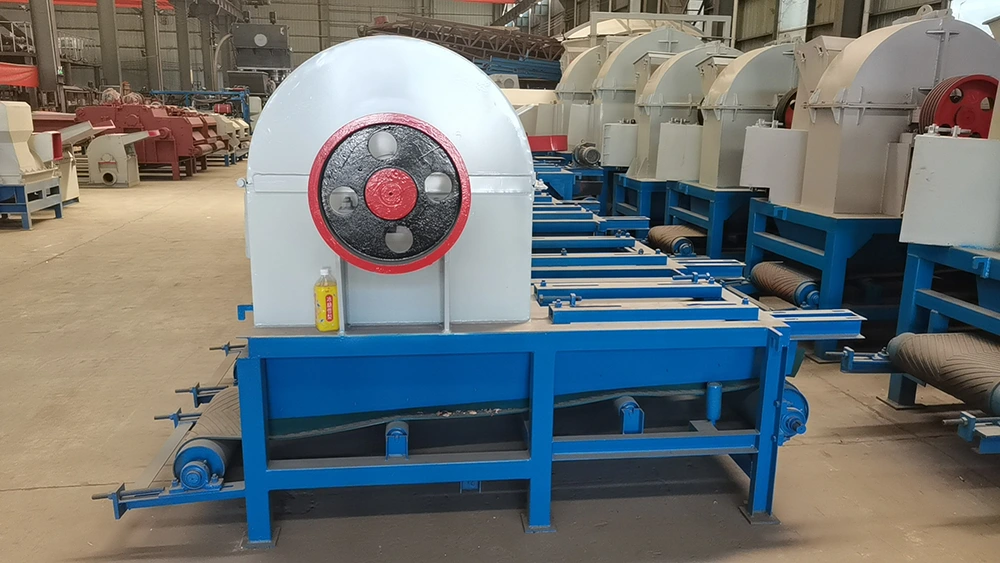
On our X-215, X-216 and X-218 the knife-drum housing is split: a large side cover gives direct access to the fly knives and the counter knife without lifting the drum out of the frame. A fly knife change is a remove-the-bolts-and-replace job, not a remove-the-drum job. Two technicians, basic hand tools, a half-shift. That is the design intent of the welded steel housing on this product line.
What the discharge-end access tells you
The discharge end of the chipper is where the screen lives. Screens wear in two ways: holes stretch, or the screen plate cracks near the support rails. Both are visible from the discharge side without dismantling the housing. A routine inspection – sight through the discharge, swap the screen if the holes are oval instead of round – is a morning’s work. Skipping it is the path to oversized chips reaching the hammer mill and the per-pallet cost quietly climbing for weeks before anyone notices.
Spare parts are the third leg. We stock and ship the wear parts that fail first – the fly knife set, the counter knife, the discharge screen for the screen size you are running, and the matching bearing set. Lead time is the variable; for plants outside China the lead-time question is real, and it is part of the per-pallet cost you should ask about before you place the order, not after.
What this means for your per-pallet math
The per-pallet cost you can defend in a buyer meeting is the one that traces back to physics and a service contract. The numbers that cannot be defended should not appear in the deck. We separate the two below.
Three honest numbers we can give
- Power and capacity, per model. The X-215 is 45 kW at 4-5 t/h, the X-216 is 55 kW at 6-8 t/h, the X-218 is 110 kW at 8-12 t/h. These are the numbers on the nameplate; they do not change with the feedstock.
- Chip length setting. Adjustable between roughly 20 and 40 mm depending on the feed-roller advance, with 30-35 mm as the typical band for presswood lines. Visible to the operator; no guesswork.
- Wear parts on the shelf. Fly knife sets, counter knife, discharge screen, bearings. Stocked; lead time stated before order. This is the variable that decides how many pallets you produce between a wear event and a recovery.
Two numbers we deliberately do not quote
- Specific kWh per ton. This number depends on species (pine, eucalyptus, poplar, mixed demolition wood), moisture content, chip length, and screen aperture. We will calculate it for your feedstock and your tariff before you commit, but we do not publish a single figure that would be wrong for everyone.
- “One operator” headcount claim. The hydraulic feed removes the manual feeding step at the inlet. Whether the line as a whole runs with one operator or two depends on the upstream loader, the downstream conveyor arrangement and the local labour context. We will not put a number on this in a brochure.
Where this article stops
This piece is the per-pallet one in our rotary drum chipper series for presswood lines. The other angles we have published on the same product line are written for different buying decisions:
- First plant vs tenth plant sizing. If your question is whether to buy a 45 kW, a 55 kW or a 110 kW machine first, see our write-up on capex right-sizing for new presswood pallet plants.
- In-house chipping vs outsourced chips. If your question is whether to keep buying chips or to chip in-house, the comparison piece walks through the make-or-buy decision.
- Export documentation and the 2027 EU machinery switch. If your market is the EU and you are planning for the 2006/42/EC to (EU) 2023/1230 transition, the export-compliance piece lists what we can and cannot sign for you.
- Chip consistency under the buyer load test. If your concern is a load-test rejection on the finished pallet and you want to trace it back to upstream chip size, the consistency piece walks through that path.
Send us your feedstock, capacity target and tariff. We will calculate the chipping-section cost per pallet against your numbers, not a brochure.