
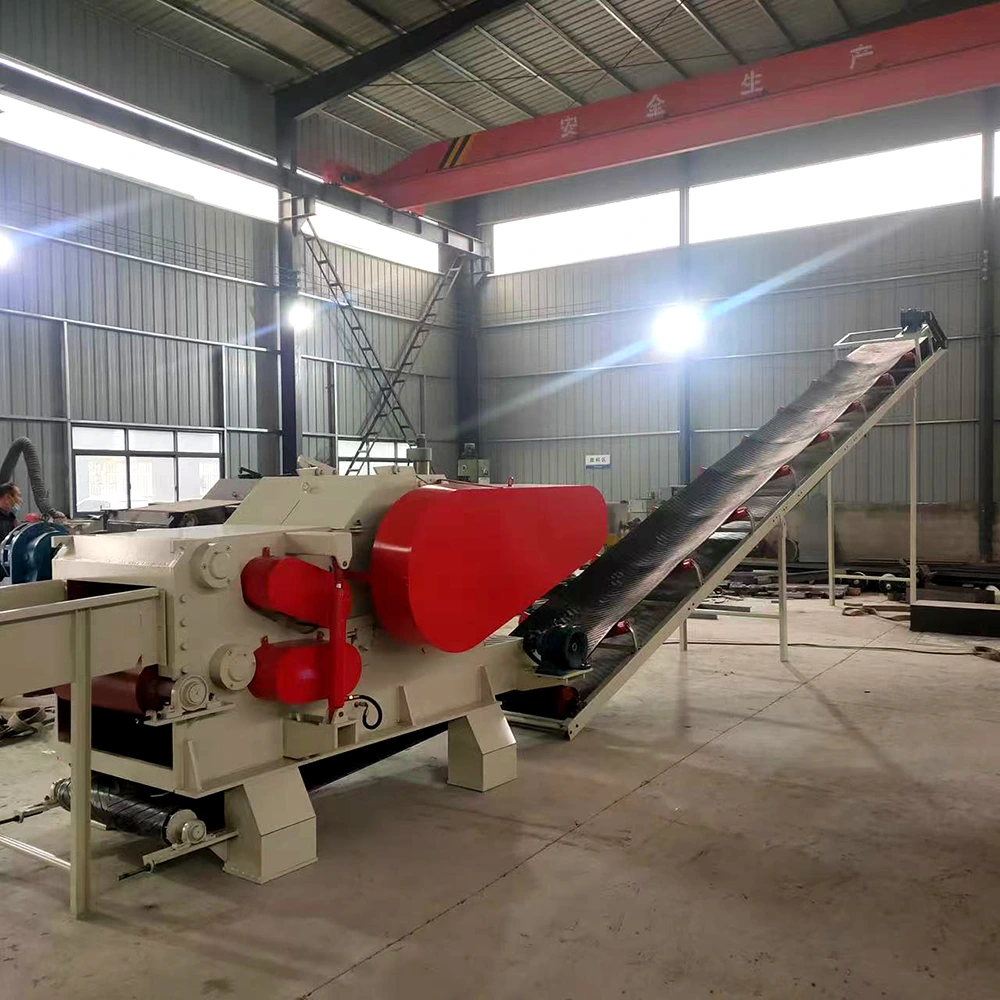
The product is named for logs, but a wood recycler’s infeed is not logs
A wood log chipper machine is, by its name, sized for round wood. A wood recycler’s infeed is not round wood. The recycler’s raw material is whatever society threw away last week – construction wood waste, demolition timber, used pallets, plywood offcuts, particle board, MDF, and engineered wood offcuts. Many recyclers publish their own process flow, and a typical flow lists a step before size reduction labelled “removal of nails, hardware, and contaminants”. That step exists because the feedstock reliably contains nails and metal. The wood log chipper machine at the head of the size-reduction line has to work with whatever the upstream steps pass through.
This article is written for the wood recycler or the recycler-facing pellet/particleboard/MDF buyer who is specifying the chipper side of a size-reduction line. We walk through why a drum wood log chipper machine fits this duty better than a hammer mill or a disc chipper, where the metal boundary actually sits, and what we can and cannot quote about wear-part life on contaminated infeed. The article is written for the line-design stage, before the infeed conveyor is ordered.
Why a wood recycler reaches for a drum chipper, not a hammer mill or a disc chipper
The size-reduction machines that a recycler compares are three: a hammer mill (or wood crusher), a disc chipper, and a drum wood chipper. They are not interchangeable, and the recycler’s feedstock usually decides between them before any price comparison starts.
Drum geometry tolerates irregular, knotted, mixed feedstock
A drum chipper – which is what the Shred wood log chipper machine is – carries a row of fly knives turning past a stationary counter knife inside a horizontal cylindrical housing. Each pass shears a slice off whatever the feed rollers push in. The geometry handles irregular cross-sections, knots, branches, and bark because the cutting force is applied at the knife pass, not at a single impact point. The drum does not need a perfectly square infeed to keep cutting.
A disc chipper, by contrast, throws the log against a spinning disc. Disc chippers work well on uniform roundwood but they can be unforgiving on demolition timber – knots deflect the log off the disc edge and produce oversized chunks rather than slices. A hammer mill is even less selective: it impacts whatever enters the chamber, which is the right behaviour for the second-stage size reduction but the wrong behaviour for the first cut, because oversized pieces re-circulate and waste kWh.
What a chipper does for the line that a hammer mill alone cannot
- It cuts first, rather than impacts first. The hammer mill then sees a uniform intermediate and does less work.
- It defines chip length by the feed-roller advance per revolution, adjustable between roughly 20 and 40 mm. The 30-35 mm band is typical for a downstream hammer mill or for direct sale as fuel-chip.
- It sets the upper bound on what reaches the next stage. The discharge screen below the drum is what enforces that bound, not operator judgement.
The metal boundary that the name of the machine will not tell you
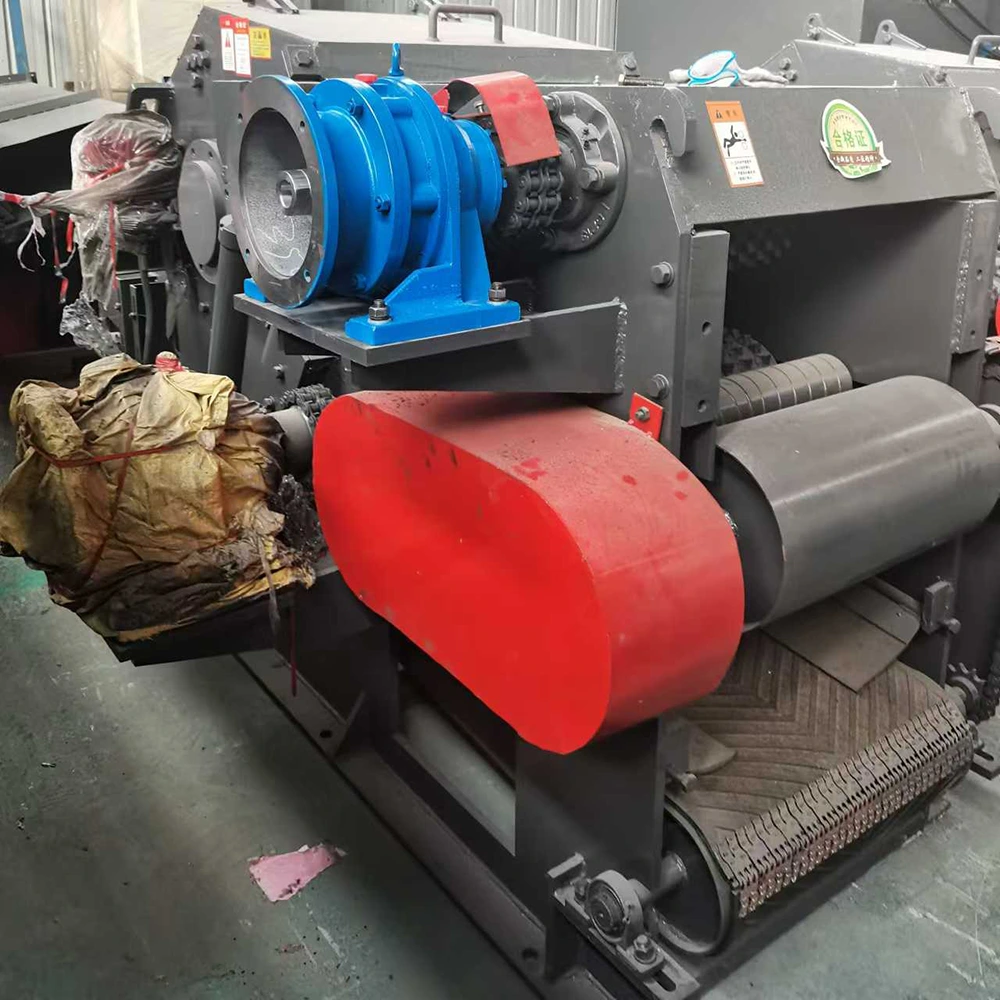
The wood log chipper machine does not ship with a inline ferrous-detection step inside the infeed. This is a boundary we state explicitly on every quote, because the boundary matters more to a recycler than to a pallet plant. The chipper is a mechanical machine with cutting geometry; it is not a sorting machine. If a nail, a piece of rebar, or a stone enters the cutting chamber, it will be struck by the fly knives. That strike will not be absorbed gracefully.
What the chipper does NOT do
- It does not detect ferrous contamination. No inline inline ferrous-detection step is fitted between the feed rollers and the drum.
- It does not protect its fly knives from impact damage. A nail between the drum and the counter knife will chip or crack a knife edge; a hard impact from a stone or a piece of embedded metal will break a fly knife.
- It does not sort the infeed. The chipper cuts whatever the upstream conveyor hands it.
What needs to happen before the chipper
For a wood recycler whose infeed routinely carries ferrous and non-ferrous contamination, the metal boundary is an upstream line item, not an option. The standard layout is:
- A loading area or platform infeed where oversized contamination (rebar, fence post fragments, concrete chunks) is hand-picked before the material goes onto the feed conveyor.
- An over-band magnetic separator mounted on the infeed conveyor or above the feed chute, sized for the conveyor width and the material depth. This removes ferrous contamination (nails, staples, small hardware) before the chipper sees it.
- An eddy-current separator downstream of the chipper and ahead of the hammer mill, sized for non-ferrous removal (aluminium fragments from window frames, copper from electrical offcuts). This is the position to recover value from non-ferrous, not the position to protect the chipper.
Where the magnetic separator sits in the layout
The magnetic separator sits on the infeed, ahead of the feed rollers. The Shred wood log chipper machine is offered together with an upstream over-band magnet in our standard recycler package; the magnet is sourced separately and is not part of the chipper price. We will quote the magnet against your conveyor width and material depth at the same time as the chipper; we do not ship a chipper to a recycler site without that conversation, because a chipper without the upstream magnet is a chipper waiting to fail.
The recycler’s feedstock taxonomy mapped to what the chipper handles
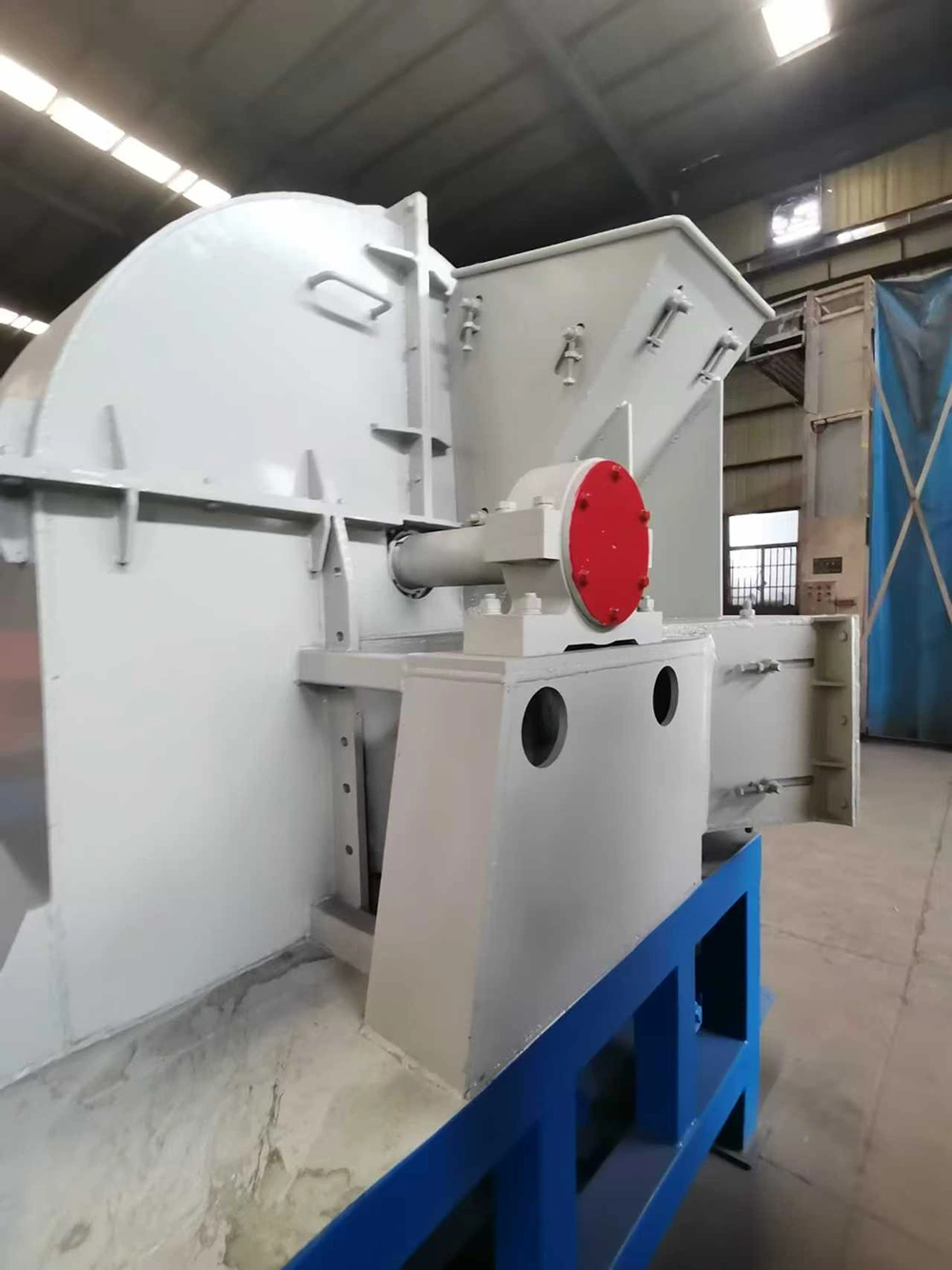
A typical recycler infeed is not one material; it is a changing mix. Here is how the Shred wood log chipper machine handles each stream a the wood recycler typically sees, with the pre-treatment that each stream requires.
- Used pallets (nail-bearing). The drum tolerates the irregular geometry. Nails must be removed upstream by over-band magnet; pallets with broken nails embedded in the wood face will pass nails through to the chipper regardless of magnet efficiency. Manual inspection of the pallet deck is the practical control.
- Construction formwork (plywood + nails + concrete residue). The drum handles the geometry. Concrete chunks must be picked out upstream; magnet removes nails. The remaining plywood + resin glue cuts without issue, though the resin will load the screen faster than solid wood – plan a screen-inspection interval accordingly.
- Demolition timber (mixed hardwood, nails, embedded metal). The drum handles the irregular cross-section. Magnets must be sized for the largest expected nail; non-ferrous metal (aluminium joist hangers, copper pipe fragments) is a downstream eddy-current question, not a chipper question.
- MDF and particleboard (resin-bound). The drum cuts the boards. Resin and adhesive in the mat accelerate wear on the cutting edge relative to solid wood of the same moisture. Screen apertures load with fines faster. The chipper handles the stream; the wear-part budget does not look like solid wood.
- Engineered wood offcuts (glulam, LVL, I-joist offcuts). Geometry is regular and clean. The drum cuts without special consideration. This is the easiest stream on the recycler’s list and is the right stream to commission the chipper on before turning it loose on demolition timber.
What this means for the wear-parts budget on the chipping side
The honest framing of a chipper on recycler infeed is: the chipper can handle it, but the wear-parts budget is not the same as a pallet plant. We separate what we can put in writing from what we deliberately do not.
Numbers we can give
- Power and capacity per model on clean infeed: X-215 45 kW at 4-5 t/h, X-216 55 kW at 6-8 t/h, X-218 110 kW at 8-12 t/h. These are nameplate numbers and do not move with feedstock.
- Chip length range: adjustable between roughly 20 and 40 mm depending on the feed-roller advance, with 30-35 mm as the typical band for downstream hammer milling or for direct chip sale.
- The fly knife set, counter knife, discharge screen (aperture for the chip size you are running), and bearings as the four wear parts that fail first, with the spare-parts kit quoted against the shipping window.
Numbers we deliberately do not quote
- Fly knife life in hours per ton on contaminated infeed. The number depends on the contamination profile – how often nails get past the magnet, how often concrete residue gets past the inspection, what species and moisture are in the mix. We give a calculation for your feedstock stream against your magnet efficiency, not a brochure number.
- “No scheduled metal-induced knife event” or any uptime percentage. With proper upstream magnet and inspection, most plants run without a metal-induced knife event; we do not put a percentage on it, because the magnet is your decision and your maintenance.
- “Hammer-mill replacement” as a benefit of the chipper. The drum wood log chipper machine is the first stage; the hammer mill is the second stage. They are paired equipment, not alternatives.
Where this article stops
This piece is the recycler side of our wood log chipper machine series. The other angles in the same series look at different buyers and different decisions:
- Mixed feedstock for presswood pallet lines. If your stream is branches, plantation logs, slabs and bark rather than society’s waste wood, that piece walks through what fits a pallet plant’s infeed.
- Capex right-sizing for new plants. If the question is whether to buy a 45 kW, 55 kW or 110 kW machine first, that piece covers the matching.
- Cost per pallet ledger. If your question is where on the per-pallet ledger the chipping section sets the floor, the cost-per-pallet article walks through that.
- Skilled labour on the chipping section. If the constraint is what a small crew can run and fix, the labour piece covers commissioning scope and the spare-parts kit list.
- Compliance documentation and the 2027 EU machinery switch. If the market is the EU and you are planning for the 2006/42/EC to (EU) 2023/1230 transition, the export-compliance piece lists what we can and cannot sign.
Send us your infeed stream and your magnet layout. We will size the wood log chipper machine against your contamination profile, not against a clean-wood brochure.