
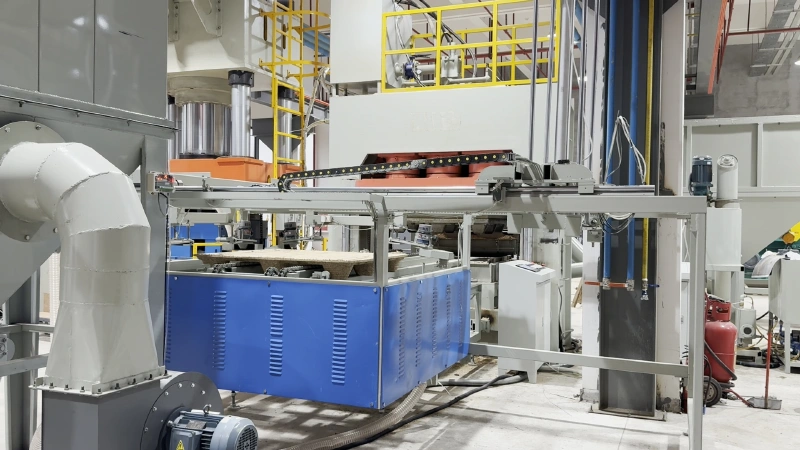
What a Press Assumes Before It Ever Closes
A hydraulic press is specified around a mould, a temperature, a pressure and a cycle. It does not specify where the material comes from. When it closes, it expects a charge of blended fibre of the correct weight, distributed across the mould, with a moisture content inside a workable band. Every one of those conditions has to be produced by something upstream.
It also expects something downstream. A formed pallet leaves a hot mould and has to be removed and stacked at the same pace the press runs. If that step is undefined at the time of purchase, it gets defined later by whoever is standing next to the machine.
The Interfaces That Appear After Delivery
Companies that buy single units from several sources usually discover the coordination work after the equipment is on site. The recurring items are physical and procedural at the same time.
- Material transfer: how dried fibre moves into the blending stage, and from there into the spreading unit, without segregation or moisture pickup.
- Metering responsibility: who defines the charge weight per pallet and how that setting is held across batches.
- Binder handling: dosing equipment, ratio control, and the cleaning and mould-release consequences of the chosen glue system.
- Control handshakes: the signal that says a charge is in place, the signal that releases the press, and the signal that permits take-out.
- Cycle matching: a press cycle only becomes a line output when upstream preparation and downstream removal hold the same beat.
- Layout and services: floor space, ceiling height, dust extraction, power and the safety zones around a hot mould.
None of these are exotic engineering problems, but each one needs an owner. When the press, mixer, spreader and take-out unit come from separate scopes, the owner is the customer by default.
What a Modular Line Means in Practice
AutoML is positioned as a configurable, modular molded pallet production system rather than a single press. Read that literally: the configuration is built by walking the process chain and deciding, stage by stage, which units are needed and which the customer already has. It is not a fixed package that must be bought in full.
The chain runs from size reduction and drying through metered glue blending, weighed spreading, hot pressing and take-out stacking. A project with a reliable supply of prepared fibre may legitimately begin downstream of the drying stage. A project with limited capital may keep manual take-out and omit the robot. The semi-automatic line and fully automatic line pages describe the two ends of that range; most real projects sit somewhere between them.
The advantage of discussing it as a line is that the interfaces are designed once. A spreading unit that is matched to the mould, a conveyor that actually reaches the mixer, and a take-out method that fits the press opening are decided at the layout stage rather than improvised during commissioning.
A Practical Way to Scope the Discussion
A useful exercise before requesting a quotation is to write the process chain as a single line of stages and mark, against each one, three things: whether it exists today, who will supply it, and what has to pass between it and the next stage. That last column is where integration work lives.
The same exercise exposes the assumptions hidden in a machine-only quote. If the upstream column says the customer will handle fibre preparation, then the customer’s preparation has to be specified to the same standard as the press input. If the downstream column says manual removal, then the quoted output figure is a press cycle, not a sustained line rate. Two pages of this kind of table will prevent more misunderstandings than any amount of specification comparison.
Where the Limits Are
Integration reduces the coordination burden; it does not remove the need for technical decisions. Interface points, control boundaries, site services and acceptance conditions still have to be agreed for each project. A modular line can be configured in many combinations, and the fact that two units appear in the same process description does not mean both are in a given delivery.
The actual delivery scope is defined by the proposal and contract confirmed between both parties. Any description of stages on this page is a framework for discussion, not a statement of what is included.
Next Step
If you are comparing a single-machine quote with a line proposal, put both against the same stage list. The comparison then becomes about which interfaces are covered and who owns the rest, which is the question that determines how the plant actually runs.
FAQ
Can we buy the press now and add the other stages later?
It is possible, but the layout, services and control provision need to allow for the later stages at the outset. Retrofitting material handling into a fixed bay usually costs more than reserving the space and connections in the first place.
Does integration mean we must buy every machine from one supplier?
It means the interfaces between supplied and existing equipment are defined. Some customers keep their own crushers or dryers. What matters is that their output meets the input requirements of the next stage and that the transfer between them is designed.
What is the most commonly overlooked interface?
Charge preparation. A press quote normally states a cycle, but the finished pallet depends on the weight, distribution and moisture of the material placed in the mould. If that preparation is manual, the quoted rate is not a sustained production rate.
Who handles PLC and control coordination?
It has to be assigned explicitly. Where units come from different scopes, the signal handshakes between blending, spreading, pressing and take-out need one owner, otherwise commissioning becomes a series of field decisions.
Is a semi-automatic line a compromise to be avoided?
No. Where budgets are constrained or labour costs are low, it can be the correct first configuration. The honest caveats are greater dependence on operator consistency and a lower ceiling on repeatability over time.