
Why Sawdust Stays Cheap
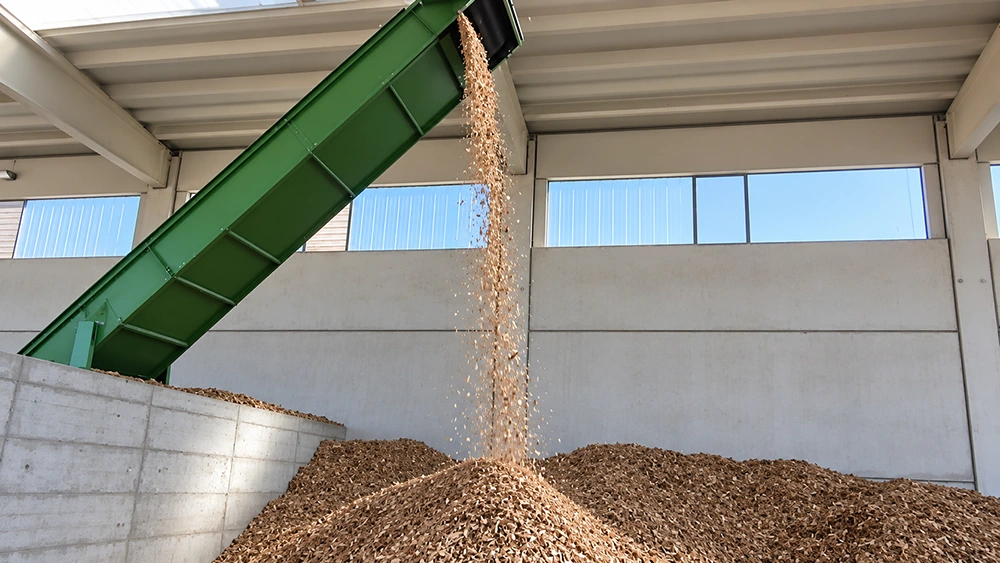
Sawdust is priced as a residue, not as a specified input. It arrives in mixed particle sizes, its moisture changes with the weather and with how long it has been stored, and it is bulky relative to its value, so the distance it can economically travel is short. A buyer of loose fibre has many alternative sources and no reason to pay for consistency the seller has not measured.
That price is not a judgement on the material. It is a judgement on its predictability. A process that can tolerate variation pays little; a process that needs a defined input pays more. Molding a pallet belongs in the second category, and the work of getting there is what changes the economics.
What Has to Change Before the Material Can Be Pressed
Hot pressing sets hard requirements on the fibre. Particle geometry has to sit in a workable range so the mould fills evenly and the finished ribs are sound. Moisture has to be brought into a narrow band before the charge reaches the mould, because water left in the fibre becomes steam during the cycle and affects both the surface and the internal bond.
In practical terms the line is built around fibre in the range of roughly 5 to 30 mm in length and 2 to 5 mm in thickness, dried to about 6 to 10 percent moisture before moulding. Those figures are process windows used during technical discussion, not a guarantee that a given residue already meets them. Whether a particular sawdust stream does is a sampling question.
The Route Through the Line
Once the input is characterised, the conversion follows a defined order. Size reduction brings oversized material into range. A dryer removes moisture to the target band. Metered dosing introduces binder and blending distributes it through the fibre. A spreading station weighs each charge, distributes it across the mould and levels it. The heated press then forms the one-piece pallet, and a take-out stage removes and stacks it.
Two parts of that sequence are easy to underestimate. Drying is not simply a heating step; it is the control point that decides how the material behaves in the mould, and it is why the sawdust dryer is usually discussed alongside the press rather than as an accessory. Blending is similarly a control point: the binder ratio has to be repeatable, because a variation there shows up across the whole batch rather than in one part.
The output of the chain is a stack of identical pressed pallets. That is a different commercial object from a pile of residue: it has a specification, it can be counted, and it can be quoted against a delivery schedule. Relevant downstream pages include molded wood pallets and glue mixing equipment.
What to Verify Before Committing
The equipment path exists, but it does not by itself establish a business. Three things have to be checked independently of the machinery:
- The actual specification of the residue: particle size distribution, moisture range across the week, and contamination.
- The volume available on a sustained basis, including the low season, against the consumption of the line being considered.
- The outlet for the finished pallets: which specification local buyers order, in what quantity, and at what delivered price.
A mill that has steady fibre but no verified buyer is taking on a manufacturing operation with an open sales question. A mill with orders but seasonal fibre is taking on a supply question. Both are solvable, but neither is solved by equipment.
Where the Limits Are
Raw material specification, available volume and the sales route for finished pallets all need to be verified before a project is sized. Residues containing metal, stone, paint, treated timber or a high proportion of fines may need additional separation, or may not be suitable at all. The finished pallet’s performance also depends on tooling, binder choice and process settings, not only on the fibre.
Equipment capability should not be read as a promise of profitability. Investment, operating cost and the ability to sell the output have to be calculated separately for the local market.
Next Step
The most useful first document is a characterisation of your own residue rather than an equipment list. Once particle size, moisture variation and weekly volume are known, the process stages that are actually needed become much easier to specify.
FAQ
Can we use sawdust straight from the sawmill?
Usually not without preparation. Fresh sawdust has a variable moisture content and mixed particle sizes, while the mould needs a defined charge. Drying and size classification are part of the line for that reason.
Does the type of wood matter?
Fibre behaviour differs between species and between fresh timber and recovered wood. It affects drying, binder demand and finished part properties. Sampling and trial runs are the normal way to establish whether a specific stream is workable.
What if our volume is seasonal?
Then the line has to be sized against the sustainable supply rather than the peak, or the project needs a storage and sourcing plan. A press rated above the available fibre does not produce pallets during the low season.
Is the finished pallet automatically export-acceptable?
Pressed wood pallets are commonly discussed in the context of ISPM-15 exemption, but compliance depends on the product and its documented treatment status, not on the machine alone. See the ISPM-15 compliance page for the boundary.
Can we start with a smaller configuration?
A semi-automatic configuration that keeps the core press and blending stage is a common starting point where capital is limited. It leaves more work to operators, so output consistency and long-term labour demand should be part of the decision.