
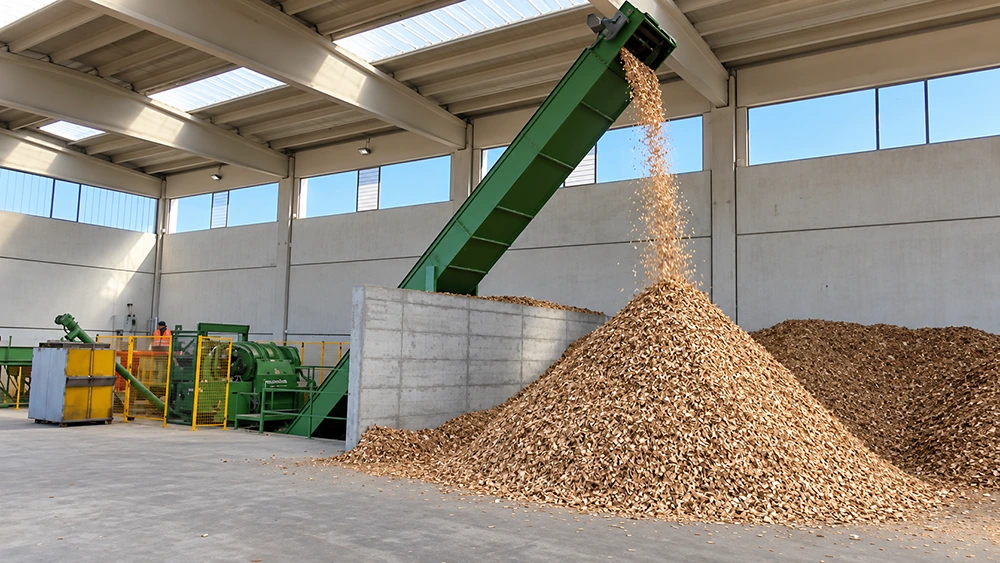
What a Stockpile Actually Costs
Waste wood is rarely stationary in an accounting sense. It occupies ground that could be used for production or storage, it is moved more than once, and it has to be taken away when the pile outgrows the yard. Outdoor storage adds another problem: rain changes the moisture of the material, so the same pile is a different input in different weeks. A disposal route that charges by load gives the operation an incentive to move material quickly rather than to understand it.
A closed-loop idea starts from a narrower question than ‘how do we get rid of this’. It asks what fraction of the pile could meet a defined fibre specification, and what it would take to get it there consistently.
The Front-End Stages That Make Material Usable
Mixed waste wood cannot be tipped into a mould. The front end of a line does four separate jobs, and each one removes a specific kind of variability.
Size reduction
Crushing or chipping converts boards, offcuts and irregular pieces into a fibre geometry that can be metered. The wood crusher stage is where a pile of mixed shapes becomes a stream with a defined size distribution.
Tramp metal and contaminant separation
Nails, screws, staples and stone are common in recovered wood. Magnetic separation and screening protect downstream equipment and keep foreign material out of the mould. This stage decides how much of an incoming load is actually eligible for the process rather than being rejected.
Drying and buffering
Drying brings the fibre into the moisture band the pressing stage needs. A buffer silo then decouples the variable arrival of material from the steady consumption of the press, so a wet delivery or a short interruption does not immediately change what happens in the mould.
Blending and forming
Metered binder is mixed into the prepared fibre, a spreading unit weighs and distributes each charge, and the heated press forms the pallet. From this point the material is no longer waste; it is a product with a specification. See the auxiliary equipment range for how these stages are typically grouped.
Where the Loop Closes — and Where It Does Not
A closed loop is a material-flow statement, not a claim that everything in the yard can be used. The usable fraction is the material that survives size reduction, separation and drying within the required specification. Rejects still need a route out. Treated timber, painted or laminated board, plastic-laminated material and heavily contaminated loads are typical examples of material that has to be excluded or handled separately.
It is also worth being clear about the direction of the benefit. Converting part of a waste stream reduces the volume that has to be stored and transported away. It does not eliminate the yard, and it replaces a disposal cost with a processing cost. Whether that is an improvement depends on the local disposal rate, the usable fraction and the value of the finished pallets.
Conditions That Have to Be Confirmed by Test
The ability to handle nailed wood, contaminated material or mixed loads is configuration-dependent. Magnetic separation, screening and the design of the crushing stage all change what can be accepted. Sample testing and technical confirmation against the actual incoming stream are the only reliable basis for stating an acceptance limit.
For the same reason, no general statement about throughput, moisture or finished pallet performance should be carried over from a different site. The process windows used in a proposal are tied to the material that was sampled.
Next Step
Start by splitting the pile into categories rather than weighing it as a single mass. Once the usable fraction and its contamination profile are known, the front-end configuration and the size of the moulding stage can be discussed on evidence rather than on an assumed tonnage.
FAQ
Can nailed or screwed timber go through the line?
Not without an appropriate separation stage. Magnetic removal and screening are specified for this, and the acceptable level of residual metal is a technical question answered by sample testing. It should never be assumed for every load.
What happens to the material that is rejected?
It still needs a disposal or alternative outlet. A closed-loop route reduces that volume; it rarely removes it entirely. Reject handling belongs in the layout from the start.
Does outdoor storage ruin the material?
It changes the moisture content, which the drying stage then has to correct. A covered buffer and a defined residence time make the input more predictable and reduce the load on the dryer.
Is the disposal saving enough to justify a line?
That depends on local disposal rates, the usable fraction, energy cost and the outlet for finished pallets. The investment, operating cost and sales side have to be calculated separately rather than inferred from equipment capability.
Can we add front-end processing later?
Physically it is usually possible, but the layout, dust extraction and power provision should reserve for it. Deciding the material acceptance criteria after the press is installed tends to constrain what can be added.