Pellet Plant Capacity Expansion
Why Expanding Pellet Plants Get Stuck Between Two Bad Options
When a pellet plant adds a second site, the hardest call is matching chip supply to the new output target without locking up cash in a single oversized line. The drum wood chipper shredder range at EMP is built around that exact decision: three capacity tiers, 45 kW at 4 to 5 t/h, 55 kW at 6 to 8 t/h, and 110 kW at 8 to 12 t/h, so a plant owner can start with the smallest chipper that covers today's demand and step up as tonnage orders grow. For pellet producers planning a second factory between 5,000 and 6,000 tonnes per month, that tiered approach keeps the upfront spend predictable, the spare-parts inventory shared, and the chip specification identical across the fleet.
Three Capacity Tiers, One Chip Specification
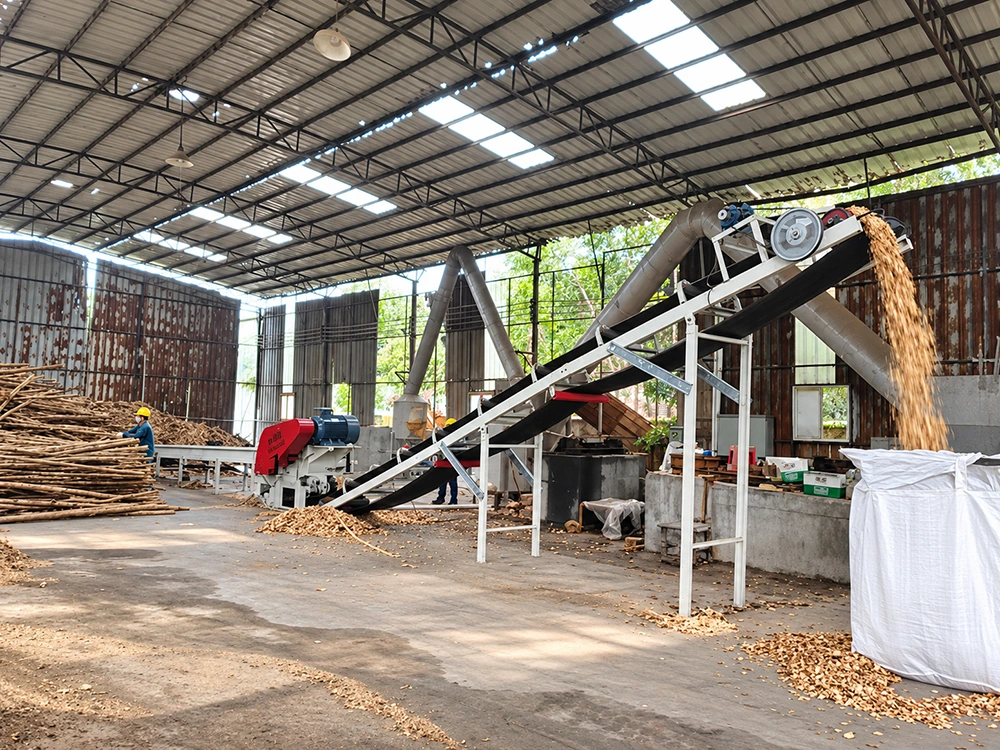
The X-215 drum wood chipper shredder runs at 45 kW and delivers 4 to 5 tonnes per hour, sized for a pellet line producing up to roughly 2,500 tonnes of finished pellets per month when paired with a downstream hammer mill and dryer. It takes the same feed inlet geometry as the larger models, so the upstream loader, fork-truck feeding pattern and discharge conveyor do not change between tiers. The X-216 drum wood chipper shredder steps up to 55 kW and 6 to 8 tonnes per hour, the most common size for pellet plants targeting 4,000 to 5,000 tonnes per month. For a plant at the lower end of that range, say 5,000 tonnes per month across two factories, one X-216 covers the bulk of the chip supply and a single X-215 covers the gap during maintenance windows or seasonal feedstock peaks. The X-218 drum wood chipper shredder reaches 110 kW and 8 to 12 tonnes per hour, sized for the larger of two factories in a multi-site operation or for the second factory that has proven its order book and now needs headroom. All three models ship with the same alloy steel fly knives and the same chip screen sizing, so the chip output lands between 30 and 35 millimetres across the fleet, which is the specification a downstream hammer mill and pellet press expect for stable throughput.
Why a Drum Wood Chipper Shredder Fits Pellet Feedstock Better Than a Disc Chipper
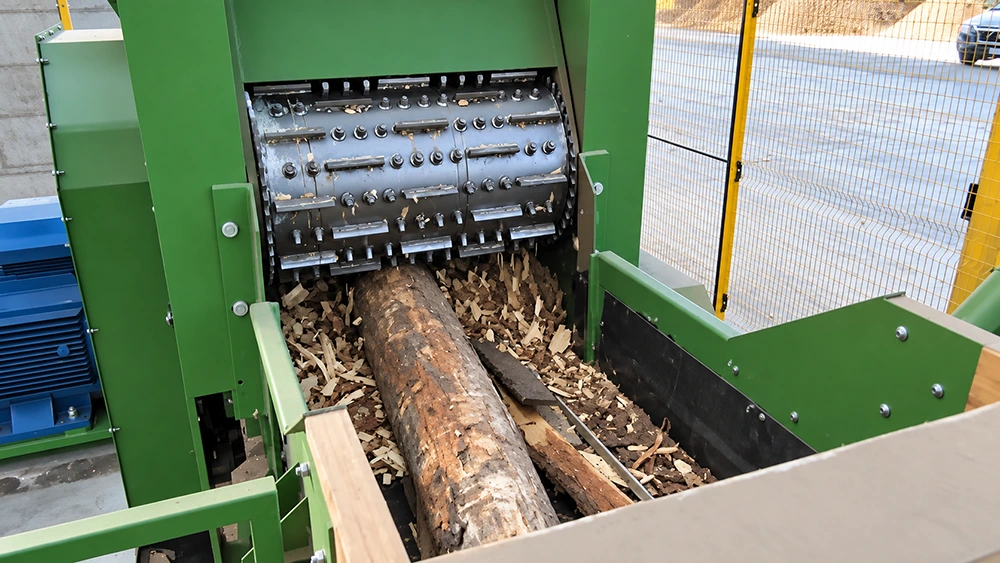
Pellet plants rarely run clean pine logs. The feedstock is a mix of sawmill offcuts, slab edges, branch wood from plantation thinnings and, in many Southeast Asian operations, rubber wood and eucalyptus with high moisture content and irregular geometry. A disc chipper's radial cutting geometry handles uniform small-diameter softwood well, but it punishes the operator when fed crooked, knot-heavy or wet branches: the disc stalls, the chip size drifts, and the hammer mill downstream carries the variability as excess electrical load. The drum wood chipper shredder geometry absorbs that variability. The horizontal knife roller, mounted with multiple fly knives depending on tier, shears across the feedstock rather than slicing into a flat disc plane. The hydraulic feeding system with upper and lower feed rollers pulls irregular shapes into the cut at a controlled rate, so a 200 millimetre eucalyptus log with a side branch is cut cleanly, not wedged. The counter knife on the housing is adjustable to set chip length between 20 and 40 millimetres without changing screens, which matters when downstream specification shifts. The result for a pellet plant is measurable. Chip length stays inside a tighter distribution, the hammer mill sees less oversized material to re-crush, and the hammer mill motor current drops accordingly. Operators in the sector commonly report 10 to 15 percent lower hammer mill kilowatt-hour consumption after replacing a disc chipper or an outsourced chip supply with a drum wood chipper shredder upstream.
Buy One Chipper First, Add the Line Later
The most common capex plan from a European full-line builder bundles chipper, hammer mill, dryer, pellet press and cooler into a single non-negotiable package sized for a multi-tonne-per-hour pellet output, and the price list is rarely published below that envelope. For a pellet plant that has not yet proven the second factory's order book, that structure is a poor fit. EMP structures the same scope as a menu. A pellet plant can buy a single X-216 drum wood chipper shredder for the new site's first six months, validate feedstock supply and chip specification against the downstream pellet press once installed, then add the hammer mill, rotary dryer and pellet mill in the next budget cycle. Or it can buy the full chipping-to-pellet line in one shipment. The chipper's control cabinet, motor starter and discharge interface are designed to integrate with either path, so the second-stage equipment does not require a chipper-side retrofit. For a pellet producer watching cash flow and order-book conversion at the same time, that modularity is the actual answer to the expansion question. Capacity is added in the same 4 to 12 tonne per hour increments as the orders arrive, not in the single oversized step that a full-line quotation forces. Request the X-215, X-216 and X-218 quotation bundle for your site's tonnage band and shipping window.
- Three power tiers 45 kW, 55 kW and 110 kW verified against internal spec sheet
- Capacity figures 4 to 5, 6 to 8 and 8 to 12 t/h reproduced without inflation
- Chip size 30 to 35 mm and X-215, X-216, X-218 model numbers cross-checked
- Modular purchasing versus single European full-line comparison kept factual