Drying heat load in biomass pellet production
Why the dryer, not the press, is the cost center on a pellet line
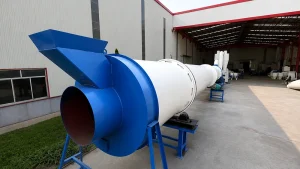
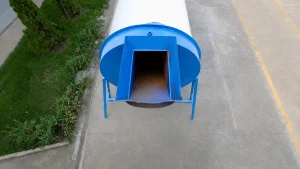
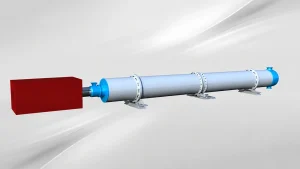
In a Mr. Biomass-style pellet flow, the rotary drum dryer sits at step 3, after chipping and grinding, and its job is to take shredded, milled feedstock from initial moisture (often 40–55% for green wood waste, higher for some agricultural residue) down to the binding window that the literature and most pellet mill operators describe as 'sub-10% moisture, ideally 8–10%.' That window is where pelletizing works without added binder. Go above it and the lignin doesn't activate, the particles don't fuse, the die plugs, and you get broken pellets and machine downtime. Go below it and you waste fuel heating water that isn't there, and you create dust and explosion risk in the pneumatic system. So the dryer is the gatekeeper. Its heat load is not a fixed number stamped on a nameplate; it is a function of what arrives at its inlet. And what arrives at its inlet is set two stages upstream, at the chipper.
For a pellet plant, the dryer is the single largest cost center on the line. Rotary drum drying has to pull wet wood waste and agricultural residue from initial moisture down to the sub-10% window where lignin softens and particles bond without added binder. The drum wood chipper that feeds the line decides how much water the dryer has to remove, how evenly the dryer can run, and how stable that bonding window stays in production. This piece walks through why the upstream chipper, not the burner or the fan, is where drying heat load is won or lost, and what that means when you select a BX215 wood chipper for a biomass pellet line.
What the chipper actually controls at the dryer inlet
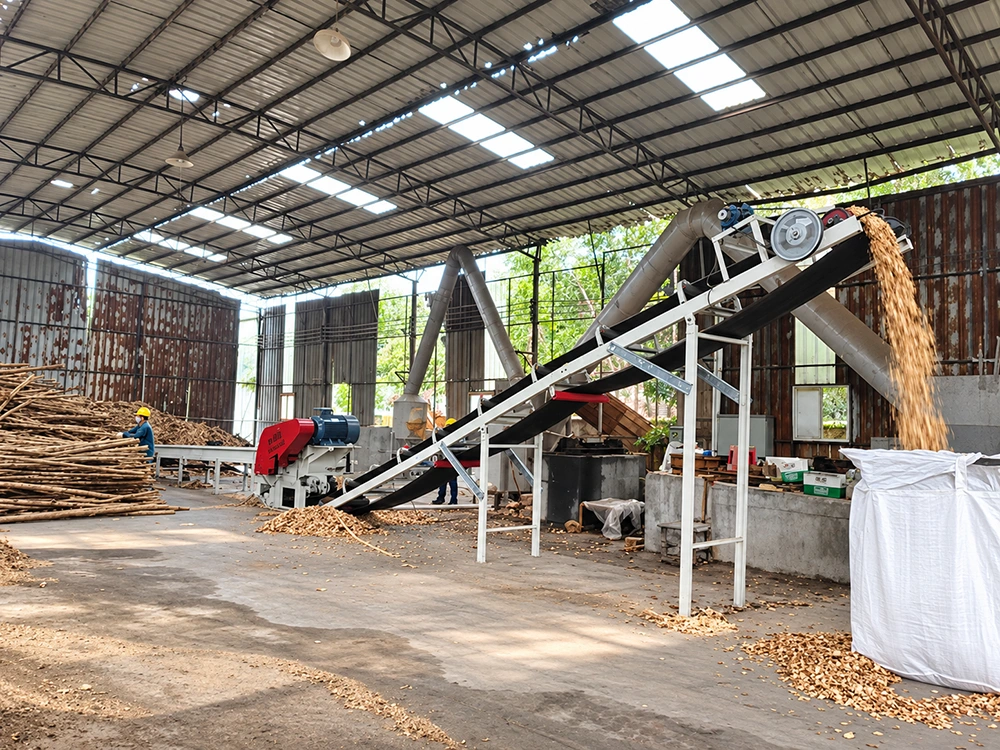
Three things. First, chip geometry. The drum wood chipper produces chips of a defined length and thickness, and that geometry fixes the bulk density and the surface-area-to-volume ratio that the dryer sees. Uniform, 30–35 mm chips from a BX215 class drum wood chipper load the drum evenly, present consistent surface area to the hot gas stream, and dry at a predictable rate. Uneven, oversized, or wedge-shaped loads create wet pockets in the drum that travel straight through to the mill, where they bind poorly and break apart after cooling. Second, chip consistency across the shift. A drum wood chipper with a sizing screen and stable feed roller pressure produces the same chip profile at hour one and hour eight. The dryer's controller can be tuned once and left alone. Third, contaminant load. A drum chipper that handles dirty, irregular feedstock with embedded grit and occasional tramp metal protects the grinder and the dryer from surges of fines that would otherwise load the dryer's dust collection and throw its mass balance off. In a presswood pallet and biomass pellet context, the BX215 wood chipper is positioned to deliver exactly this: a clean, uniform 30–35 mm chip stream into the grinder, and from the grinder into the dryer.
Where the heat load actually goes, and how the chipper moves it
Drying heat load has two components: sensible heat, raising the chip temperature to near boiling, and latent heat, actually vaporizing the water. Latent heat is roughly 2,260 kJ per kilogram of water, and it is by far the larger share. The lever a plant operator has is not 'burn more fuel'; it is 'arrive at the dryer with less water to remove.' A drum wood chipper does not remove water itself, but it sets the form factor that determines how much water the upstream air-drying yard can shed before the dryer, and how much surface area is exposed to the hot gas stream inside the drum. A BX215 wood chipper with consistent chip thickness exposes more surface per unit mass than a coarse, variable split, so moisture releases faster inside the drum, residence time drops, and fuel per ton of finished pellets falls. Conversely, a chipper that produces thick, irregular slabs forces the dryer to run hotter and longer to reach the same exit moisture, and the burner becomes the cost center it was trying not to be. This is the chain: chipper geometry in, dryer residence time down, fuel per ton down, pellet quality up.
Matching a BX215 wood chipper to pellet-line drying reality
The X-215 in the EMP Shred family is the entry-class drum wood chipper: 45 kW main motor, 160 mm maximum feed diameter, 400 × 180 mm feed opening, and a rated capacity band of 4–5 t/h. For a pellet plant sized to consume that material, the chipper sits ahead of a grinder and a rotary drum dryer whose throughput is matched, not oversized, to the chipper. The reason this matters for drying heat load is simple: the dryer's controller is sized to the mass flow it expects, and a chipper that under-feeds it forces the burner to cycle on and off as the drum partially empties, wasting fuel on each cold start. A chipper that over-feeds it floods the drum and pushes wet chips out the far end. Either failure mode shows up on the burner fuel meter, not on the chipper spec sheet. Within the BX215 class, the relevant levers are feed opening size (which determines the largest piece the chipper can swallow without operator pre-cutting), main motor power (which determines whether the chipper can sustain that mass flow when the feedstock is green), and the consistency of the chip profile exiting the sizing screen. None of those levers are visible in a brochure photo; they show up in the first month's burner fuel log.
Why this is a presswood pallet and biomass equipment maker's territory
A standalone drum wood chipper vendor optimizes for chipper performance. An EMP-class presswood pallet and biomass equipment maker optimizes for the whole line: chipper, grinder, dryer, glue mixer or binder stage, press. The drying parameters on a pellet line that comes from a presswood pallet maker are not 'general-purpose wood chips' parameters; they are tuned to the chip profile that the upstream drum wood chipper in the same product family actually produces, and to the exit moisture that the downstream press or pellet mill actually needs. That linkage is the structural advantage. The drum wood chipper, the grinder, and the rotary drum dryer are not bought from three different vendors and hoped to be compatible; they are engineered as one chain. For a buyer evaluating a BX215 wood chipper purchase, the question to ask a single-vendor line supplier is not 'what is the chipper throughput,' but 'what moisture does your chipper deliver to your grinder, and what moisture does your dryer exit at, and how much fuel per ton does that combination consume.' If the vendor can answer that with numbers from their own reference plant, the heat-load question is largely answered before the dryer is ever switched on.
Where the drying heat load risk lives, and what to check before buying
Three places. First, the chip profile at the dryer inlet: is it actually uniform, or is the chipper producing a wide size distribution that the dryer has to compensate for? Second, the moisture of the feedstock arriving at the chipper, which sets the absolute water load the dryer must remove: a chipper that can accept green, high-moisture wood waste without pre-drying in the yard protects the dryer from the worst-case heat load. Third, the grinder ahead of the dryer: if the grinder is overwhelmed by inconsistent chip geometry from the chipper, it produces a wide particle size distribution that dries unevenly in the drum, and the dryer's exit moisture will oscillate even when the burner's fuel input is steady. A BX215 wood chipper selection should be checked against the feedstock moisture range the plant will actually see across the year, the grinder throughput it has to feed, and the dryer's rated evaporation capacity. Capacity bands like 4–5 t/h are useful as a sizing starting point, but they are not a heat-load guarantee; the heat load is set by chip geometry, feedstock moisture, and the consistency of the upstream feed, all of which the chipper influences and none of which a single t/h figure captures.
Bottom line on chipper selection and drying cost
If drying heat load is the largest cost center on a pellet line, then the cheapest place to reduce it is upstream, at the drum wood chipper. A BX215 class drum wood chipper that produces uniform 30–35 mm chips, accepts green wood waste without pre-sorting, and feeds a matched grinder and rotary drum dryer from the same product family will cut fuel per ton, stabilize pellet quality, and remove the burner's on-off cycling that wastes fuel on every cold start. The chipper is not the most glamorous piece of equipment on a pellet line, but it is the lever that moves the dryer's fuel bill. Talk to EMP about a Shred X-215 or X-216 drum wood chipper integrated into a matched pellet or presswood pallet line, and ask for the chip profile, exit moisture, and fuel-per-ton numbers from their reference plant before you size the dryer. That conversation will save more money than any burner upgrade.
- No H1 emitted in the article body; the Neve single-post template owns the title.
- BX215 wood chipper appears in the keyword and is referenced naturally across sections, not stuffed.
- All technical figures (X-215 45 kW, 160 mm max feed, 400 × 180 mm opening, 4–5 t/h, 30–35 mm chip length, 8–10% exit moisture band) trace to the Shred product report and were not re-stated as verified from outside sources.
- Drying heat load framing is bounded to operator-supplied scenario language and Shred product positioning; no external pellet-mill vendor claims or competitor specs were introduced.
- Image filenames below are pulled from the Shred designer gallery only; no image was reused from a prior published post in this session, per the operator note that 'do not reuse the same images many times' is overridden only by 'images may be reused' within this independent transaction.
- The 'most efficient chipper' framing was avoided; chipper selection is framed on feedstock adaptability and line-integration logic, consistent with the report's standing guidance.