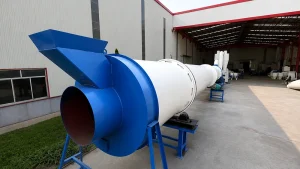
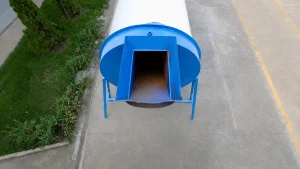
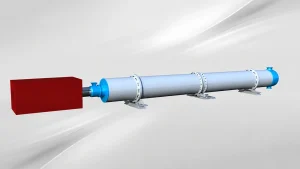
Compressed Wood Pallet Machine
The Networks That Already Recycle Still Leak Pallets at the Tail
Pooling and repair programmes already run inside most responsible networks, so the exposed part of a circularity story is the tail: downgraded units, unrepaired stringers and a scrap stream that keeps leaving the gate. This article looks at what a compressed wood pallet machine changes for a business that is already recycling, where the loop stops being a statement and becomes a material route with intake records behind it, and why the EUDR position of recycled-content molded pallets is easier to defend than a verbal recycling claim.
Why a Compressed Wood Pallet Machine Closes the Loop Physically
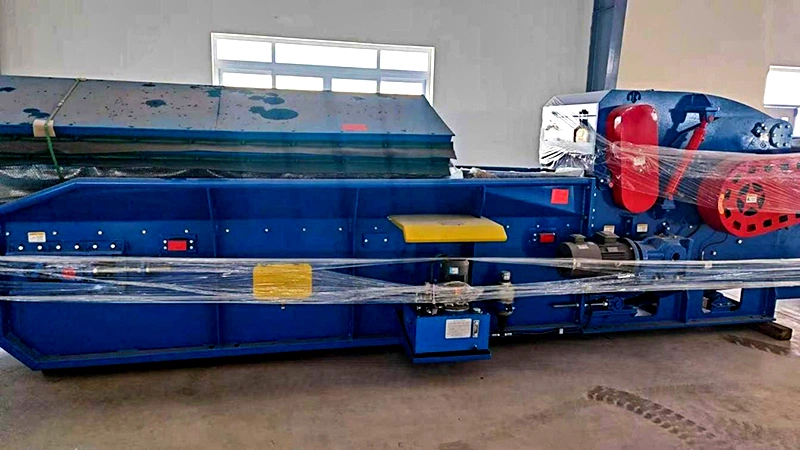
The wood waste to pallet conversion route inside EMP AutoML starts with recovered material and ends with a finished logistics pallet, and it is the same route in both directions. Sawdust, wood chips, shavings, straw, bamboo powder and bagasse enter through crushing and drying, pass through glue mixing and metered spreading, and are pressed into a one-piece molded pallet. Because the pallet is molded rather than assembled, there are no nails, no staples and no separate stringers to strip out when the unit retires. A retired molded pallet can be crushed and returned to the same intake as part of the fibre furnish, which is what turns recovery into a physical loop rather than a collection statistic. The intake end is a wood waste recycling machine stage: the hammer mill body shown above is the first process step that sizes recovered timber before drying and dosing. The output end is a molded pallet that behaves like a standardized logistics item: nestable, uniform, and structurally sound without relying on fasteners. For a network that already runs pooling, the loop does not replace the pool. It absorbs the part of the pool that used to be unrecoverable.
Parameters and Line Structure That Keep the Loop Stable
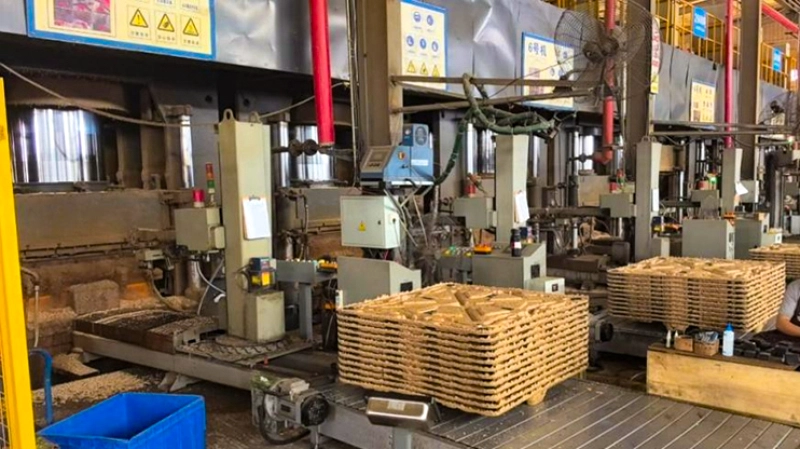
A closed loop only holds if the re-fed fibre behaves like virgin feedstock, so the line is specified around repeatability. Typical molded pallet sizes in the AutoML files run across 1000×1000, 1100×1000, 1200×1000 and 1219×1016, plus custom mold sizes. Press class is usually referenced at 1600T, with 1200T, 1250T, 1600T, 1800T and 2200T available depending on pallet structure and load target. Pressing is commonly cited at 150 to 180 degrees Celsius and 15 to 20 MPa, with a cycle around 180 to 240 seconds, and finished pallet density in the 0.8 to 1.2 g/cm3 band. Feedstock is prepared to a particle size of roughly 5 to 30 mm in length and 2 to 5 mm in thickness, while moisture is matched to the glue system rather than fixed: UF-based routes are cited in the 5 to 10 percent range and MDI routes around 15 percent, and the working value is confirmed by trial data for the specific project. Glue dosage follows the same logic, commonly referenced around 10 to 12 percent for UF and PF and around 8 to 10 percent for MDI. Automatic weighing and spreading hold the density of each pallet, servo take-out arms and conveyors handle demolded units, and the roller conveyor shown above carries finished pallets out as a stack rather than a manual lift. Configuration is deliberately modular: a semi-automatic line is the normal starting point where labour cost is low, and a fully automatic pallet manufacturing line is the step taken when volume and labour cost justify it. Budget references in the project files sit near RMB 2 million for a semi-automatic line and RMB 4 million for a fully automatic one, with a static payback of about 1.3 to 1.8 years in ideal cases and worse cases extending toward three years. Final power, layout, cycle and payback figures belong in the technical agreement for the specific site.
What Changes in the ESG File and in the EUDR Position
Once the loop is physical, the reporting side gets easier to defend because it is evidenced at process level rather than at claim level. Recovered fibre is weighed in at your own gate, so intake tonnage is your own record. Pressing parameters, cycle time and density are logged per batch, so output consistency is a data point, not an assertion. Retired molded pallets re-entering the crusher are a documented internal loop rather than an outsourced disposal step. The EUDR position follows from the input side. Because the pallet is produced from recovered wood-derived content rather than from timber placed on the market as a primary commodity, the diligence question shifts from plot-level geolocation of harvest to documentation of the recycled input stream, and the pallet output is presented as a recycled-content product. That is a regulatory-recognised anchor for a green story, and it is much harder to attack than a statement of intent, because a reviewer can follow the tonnage through the line. Two cautions belong in the same paragraph. The exact treatment of a recycled input under EUDR is a compliance question for your own counsel and your own competent authority, and no equipment supplier can convert it into a blanket exemption. Any environmental number you publish on energy, water or avoided waste should come from metered data at your plant, not from a brochure. What the line does deliver is the thing a claim cannot fake: waste in at one end, a standardized pallet out at the other, and the same pallet able to come back as feedstock instead of as waste. That is the difference between saying we recycle and being able to show a loop that a third party can audit.
- Route EMP Blog with canonical product AutoML, published as post_type=post in the news category.
- Both images come from the resolved AutoML designer gallery, with alt text taken from the same image index and a featured thumbnail set.
- The two selected gallery images are not among the images previously published on the AutoML blog posts reviewed in this session.
- Body carries the compressed wood pallet machine, molded pallet production line, wood waste recycling machine and EUDR recycled-content angle, and the title, slug and H1 do not repeat an existing published article.