TIMBER COST VOLATILITY | ESG PRESSURE | RECYCLED-FIBER PALLET PRODUCTION
When Timber Price Volatility Becomes Both a Cost and an ESG Problem
For pallet pool operators and industrial packaging producers, timber price volatility and ESG pressure now hit the same margin line. AutoML uses a presswood pallet machine and molded pallet production line to convert sawdust, straw, bamboo powder, and other plant-fiber residues into nail-free pallets, reducing virgin-timber exposure while creating a documented route for recycled-content and circularity reporting. MDI can support selected food, pharmaceutical, and export applications, but its higher cost and mold-sticking risk must be managed with a working automatic release-agent spray system.
Why the Traditional Nailing Route Does Not Solve the Exposure
A Traditional Pallet Nailing Machine or Wooden Stringer Pallet Equipment still depends on purchased boards, stringers, and blocks. When virgin timber rises, the finished pallet price follows; when material quality varies, the nailing station adds labor and repair work rather than removing the root cause. Scrap boards and retired pallets usually leave through a low-value outlet instead of returning to the same product loop. A plastic pallet injection machine can reduce timber exposure, but it changes the capital, energy, tooling, and end-of-life equation rather than creating a waste-fiber route. Buying a used pallet press machine also does not solve feedstock control, glue selection, mold release, or evidence collection. The problem is not simply choosing another pallet shape. It is choosing a production route that converts available residue into a controlled, saleable pallet without hiding its operating costs.
Why AutoML Fits a Recovered-Fiber Pallet Cost Strategy
AutoML is a project-configured presswood pallet production line rather than a single standalone press. Its process chain can include crushing, drying, adhesive mixing, weighing, spreading, hot pressing, demolding, and stacking. That makes it suitable for wood waste to pallet conversion using sawdust, wood chips, shavings, straw, bamboo powder, bagasse, and other qualified lignocellulosic residues. A Sawdust pallet Making Machine or Agricultural Waste Pallet Line can therefore be sized around the local feedstock supply, plant layout, utility capacity, labor plan, and target output. Retired molded pallets can be crushed and returned to the feed route when the material and adhesive system are approved for reprocessing. For food, pharmaceutical, or export-grade requirements, an MDI pallet adhesive route can provide no-formaldehyde, water-resistant, high-strength output for the selected specification. The honest trade-off is that MDI costs more and can stick to the tooling. An automatic release-agent spray system must be installed, correctly dosed, and kept operating; if it is bypassed or neglected, mold damage can erase the expected return.
Process Evidence, Practical Parameters, and the Result for the Plant
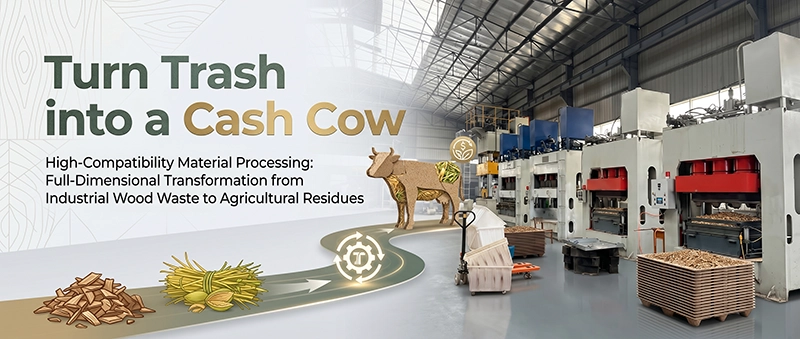
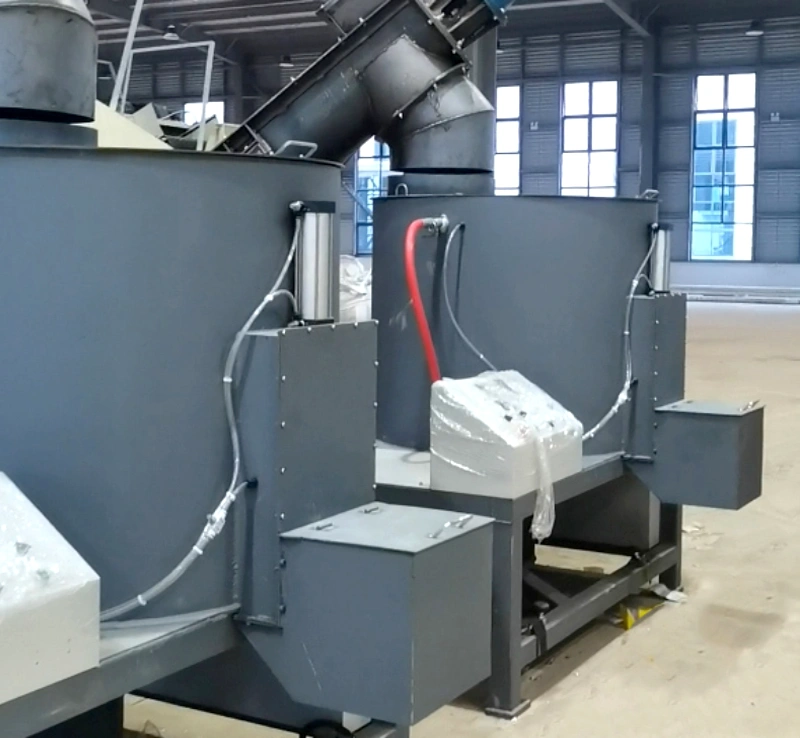
The material route is visible in the selected AutoML evidence: the process graphic shows wood waste and agricultural residues moving toward molded pallet output, while the adhesive blender image shows the dosing and mixing stage that sits before pressing. In a typical project, particle geometry is matched to the recipe, with a common reference of 5 to 30 mm length and 2 to 5 mm thickness. Moisture is not a universal fixed number; it must be matched to the MDI or UF/PF system and verified in trials. MDI dosage is commonly referenced around 8 to 10 percent, also subject to the project recipe. A 1600T-class industrial pallet press machine may run around 150 to 180 degrees Celsius, 15 to 20 MPa, and a 180 to 240 second cycle, with density references around 0.8 to 1.2 grams per cubic centimeter. The final configuration may be semi-automatic or an automated pallet manufacturing line, and the mold can be selected for a one-piece, nail-free, nestable pallet. The result is not a promise that every site has the same cost or payback. It is a more controllable material base, a high ROI pallet production setup that can be tested against local numbers, and a circular input-to-pallet-to-reprocessing route that gives ESG reporting physical evidence. For export applications, the molded processed-wood output can support an ISPM-15 exempt pallet equipment or fumigation-free pallet machine route, subject to destination rules and the agreed product specification.
- The customer and scenario lead the article: timber price volatility, pallet COGS exposure, ESG pressure, and zero-deforestation questions are stated before the equipment case.
- The old solution problem is explicit: traditional pallet nailing and virgin-timber purchasing leave cost, waste, and circularity exposed.
- The AutoML product fit and the MDI trade-off are explicit, including the required automatic release-agent spray system to control mold sticking.
- The evidence and result chain is explicit: recycled-fiber preparation, 1600T-class pressing, process windows, image evidence, more predictable material cost, and a documented circular route.