Sawdust Dryer Sizing Guide
The moisture problem under tropical, monsoon and East Africa rainy-season conditions
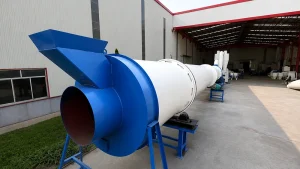
A tropical or monsoon pellet line does not run on the same drum spec as a temperate climate plant. When the truck delivers pine or eucalyptus residues at 50 to 60 percent moisture and the ambient humidity sits at 80 to 95 percent RH, a fixed-spec drum sized for a 40 percent input can no longer hold output moisture inside the 10 percent binding window. Sawdust dryer sizing under tropical and monsoon climates is therefore a climate-driven engineering decision, not a catalog number. DRYR rotary drum dryer covers 0.8 to 2 t per hour across four models and scales drum length up to 17 to 18 m plus matching heat exchange area, after testing the customer raw material moisture and ambient humidity at site.
Why fixed-spec catalog sourcing fails and what changes when drum length becomes a variable
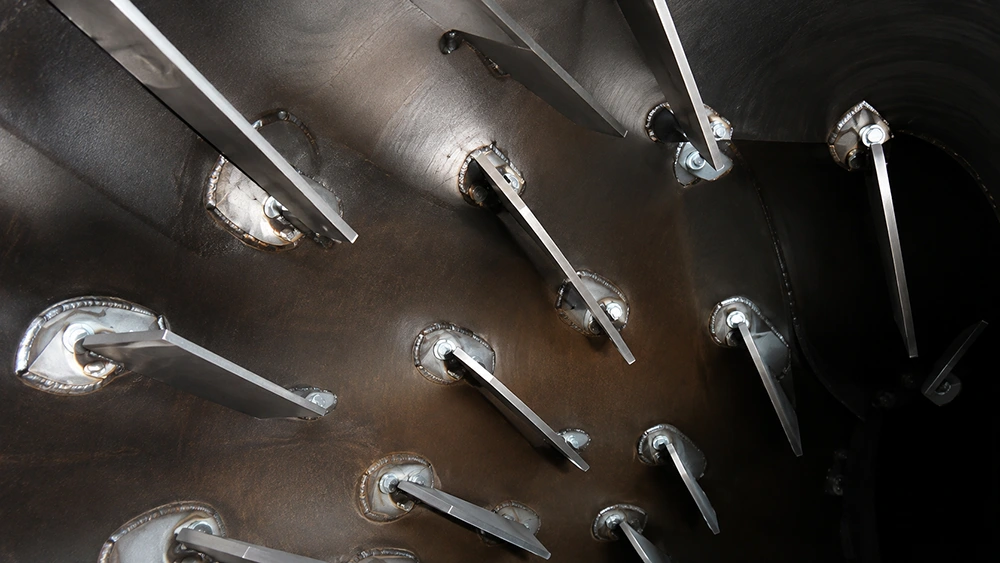
Most catalog specs quote a 1 ton per hour sawdust dryer against a 40 percent input and a 10 percent output, on a temperate climate assumption. That spec does not survive a tropical site. The drum has to do more revolutions at higher ambient humidity, which means the residence time inside the drum must be longer, the lifters must throw the material into the hot air stream more often, and the heat exchange area has to scale with the larger water load per ton. None of those variables are exposed on a fixed-spec catalog page. The lifters, the drum length, the furnace chamber, the cyclone dust collector and the residence time are the only levers that move output moisture at high ambient humidity. A one-size-fits-all spec holds the 10 percent binding window at temperate RH; it cannot hold it at tropical RH without those levers being pulled. That is exactly why a quote that reads 1 ton per hour sawdust dryer without a climate clause tends to leave a wet discharge during the rainy season and a throttled pellet mill behind it.
How DRYR sizes to climate and raw material: pre-sales moisture test plus custom drum up to 17 to 18 m
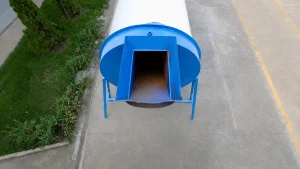
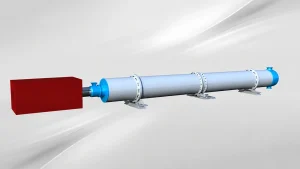
Before quoting, the DRYR engineering team tests the customer raw material on site — initial moisture, particle size distribution, bulk density, and ambient humidity at peak rainy season. The four-model 0.8 to 2 t per hour range — H-1010, H-1212, H-1512, H-1815 with drum diameters 1000, 1200, 1500 and 1800 mm — gives the right starting point. For tropical and monsoon sites where input moisture runs 50 to 60 percent and ambient RH sits at 80 to 95 percent, drum length is custom-extended from the standard 12 m up to 17 to 18 m and the heat exchange area is scaled to match. The internal paddle bars and lifting plates are what carry out the longer residence time, and the multi-fuel hot air furnace — coal, oil, natural gas, biomass powder or electric — matches the local fuel chain. A sawdust dryer with cyclone dust collector plus optional baghouse filter handles the humid-air dust load. PLC control with seal monitoring holds the output moisture inside the binding window across the rainy season and the dry season, without operator attention per shift. Split shipment and on-site installation and commissioning apply when the 17 to 18 m drum exceeds container limits — exactly the configuration a fixed-spec catalog cannot serve.
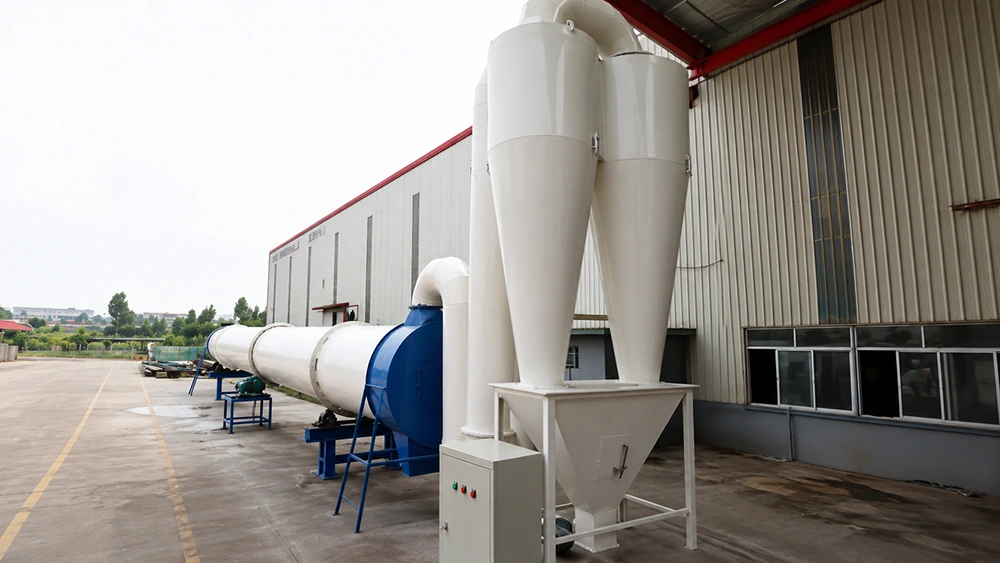
What the project gets: output moisture inside the binder window, no press throttling, continuous supply through the East Africa rainy season
Output moisture is held inside the 10 percent binding window at the rated 0.8 to 2 t per hour throughput even when the truck delivers 55 percent pine at 6 a.m. and the ambient is at 90 percent RH. The hot press downstream stops throttling on bad-weather days; the pellet mill keeps its nameplate output; the dryer runs on the local fuel chain — coal in the Indonesian plant, biomass powder in the East Africa pine line, natural gas in the Brazilian eucalyptus line. A sawdust dryer with cyclone dust collector plus baghouse filter holds emission inside permit. Split shipment plus on-site installation and commissioning apply because the upsized 17 to 18 m drum exceeds container limits, which is exactly the configuration where a fixed-spec one-size-fits-all spec breaks and a custom drum is the only path. This is the engineering route DRYR takes when the customer raw material moisture plus ambient humidity plus target throughput point to a drum length the catalog does not print — and the result is a continuous sawdust dryer for pellet production that keeps the binding window closed through the worst week of the rainy season.
- Tropical, monsoon and East Africa rainy-season moisture context established with measurable figures
- Fixed-spec catalog failure mode explained via residence time, lifters and heat exchange area levers
- DRYR pre-sales moisture test plus custom 17 to 18 m drum plus multi-fuel plus cyclone configuration documented
- Project outcome: 10 percent binding window held at 90 percent RH plus split shipment and on-site commissioning path