Per-press take-out headcount on a multi-press presswood line
Multi-press presswood pallet plant: the layout where labor scales by the press, not by the line
On a presswood pallet plant floor that already runs two 1250 to 1600 ton hydraulic presses, the next question is rarely whether to add a third or fourth press. It is who stands at the take-out station of the new press at 80 degrees Celsius. AutoG is the automatic pallet take-out robot from EMP that pairs one six-axis arm with two presses, so a four-press layout runs on two AutoG cells instead of four take-out operators per shift and the per-press labor cost curve stops being a straight line.
Why conventional offloading scales linearly with press count
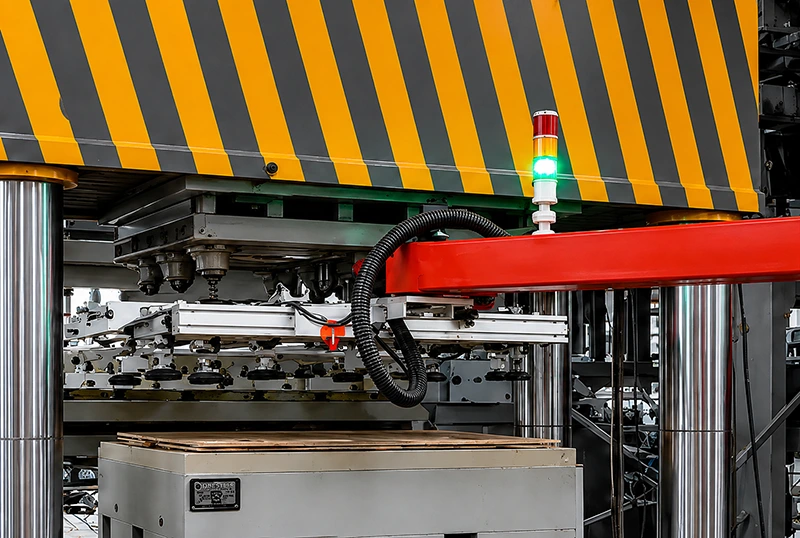
On a conventional presswood pallet line, the take-out post is bolted to the press, so each new 1250 to 1600 ton hydraulic press added to the floor brings one new take-out operator per shift. Two presses mean two operators per shift, three presses mean three, four presses mean four, and the payroll line on the budget tracks the press count almost one to one. The take-out post is also the hardest post on the roster: the freshly pressed pallet lands near 80 degrees Celsius, the MDI binder off-gas rides out on the same press-open signal, and any press misfire during the open-die transfer is a severe crush or shear hazard on the operator reaching in. Multi-press plants that run two shifts and need 24-hour output double that headcount again, so a four-press floor can carry eight take-out operators across two shifts before the packing and stacking stations are counted. The capital cost of the presses is approved once. The labor cost scales every shift, every quarter, and every time a new press is commissioned.
One AutoG arm per two presses: where the per-press headcount curve breaks
AutoG is the automatic pallet take-out robot from EMP that is engineered specifically for the press exit side of a 1250 to 1600 ton presswood press. It is a six-axis articulated arm with a multi-suction-cup vacuum gripper that lifts the freshly pressed pallet straight out of the open mold at about 80 degrees Celsius and transfers it to the stacking position with no secondary manual lift. The integration point that changes the per-press headcount curve is that one AutoG arm is paired with two presses: the arm waits through the press cycle, takes the pallet on the press open signal, then swings to the second press and runs the same cycle on the next 4 to 5 minute takt. A four-press floor that would have needed four take-out operators per shift on conventional offloading now runs on two AutoG cells, each covering a press pair, and the per-press headcount on the take-out station falls from one operator to half an operator per press. On a 24-hour two-shift schedule, that is eight take-out operators replaced by two AutoG cells.
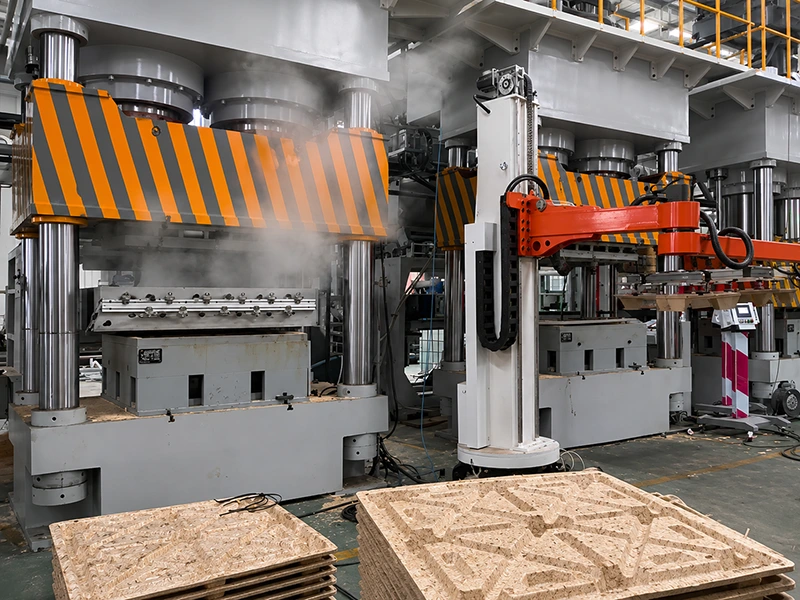
Capital efficiency per press: 1 robot equals 2 presses equals 2 operators
The capital efficiency argument is the one direct competitors do not state the same way. Each AutoG cell is procured once, installed once, and maintained once, and replaces the recurring shift cost of two take-out operators on two presses for the life of the cell. On a four-press floor the recurring shift-roster line item that used to track one operator per press is now two AutoG cells covering four presses, so the capital deployed per press served drops by half and the per-press labor exposure on the press side of the line goes to zero on the take-out station. The PLC handshake runs through the line PLC, so the press open signal hands the pallet to the AutoG cell and the AutoG cell hands the empty press back to the press on the same takt, with no operator in the press open-to-close window. For a multi-press plant, the result is a presswood line whose headcount stops tracking the press count on the floor and a take-out station that is no longer the bottleneck that decides how many presses the plant can run.
- dual-press tending holds per-press take-out headcount flat on a multi-press presswood pallet line
- one AutoG arm serves two 1250 to 1600 ton presses, two AutoG cells cover four presses
- capital efficiency per press improves because one robot replaces two operators
- consult EMP on AutoG integration for a multi-press presswood line layout