Organic Fertilizer Pellet Storage
Why finished organic fertilizer pellets mold in the bag warehouse
On a 0.8 to 2 t/h organic fertilizer pellet line, the moisture that decides whether a finished lot ships clean or ships moldy is the moisture reading at the dryer discharge, not at the granulator. A DRYR rotary sawdust dryer stabilizes that number under 10 percent and pairs it with continuous drum plus blower ducting, so finished pellets land inside the industry 10 to 15 percent safe-storage band and the bag warehouse stops fighting clumping and mold two to three weeks after packing.
Where natural sun drying, flash drying, and hand-welded drums fall short
Natural sun drying depends on ambient RH, floor area, and a clear weather window. One rainy week breaks the schedule, the bagging line behind it stalls, and finished pellets already in inventory start to absorb humidity back from the warehouse air. Manual or open-air drying on a concrete apron can drop input moisture, but it never drives the finished-pellet moisture under 10 percent on a continuous 0.8 to 2 t/h schedule. Low-cost airflow flash dryers strip surface moisture from the granulator feed but leave the pellet core wet, which is exactly where bag-storage migration starts. A hand-welded low-end rotary drum looks like a sawdust dryer on the outside, yet the lifting flights are uneven, the shell drifts out of round, and the operator has no real moisture or temperature feedback. Output swings between 8 and 18 percent across shifts, so half the lot leaves the dryer already inside the 10 to 15 percent band and the other half leaves it above, with no way to tell which bag holds which.
How DRYR holds output moisture under 10 percent and cools the pellet before bagging
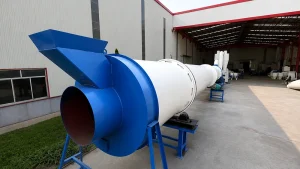
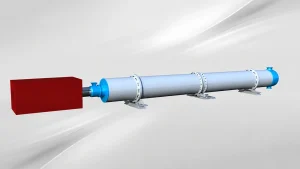
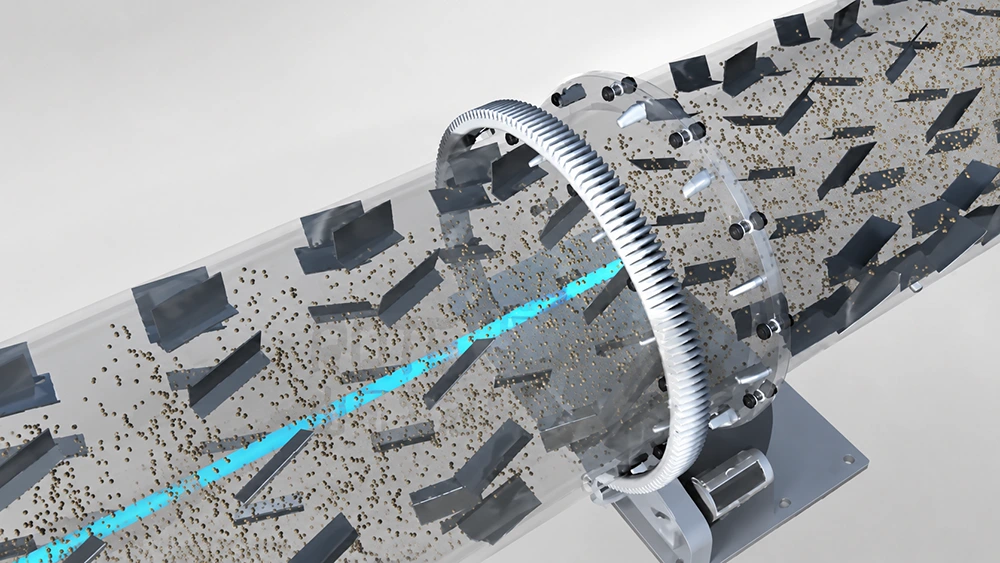
DRYR is a rotary sawdust dryer on a four-model 0.8 to 2 t/h platform: H-1010, H-1212, H-1512, and H-1815, with drum diameters from 1000 to 1800 mm, main drives from 4 to 11 kW, and induced-draft blowers from 7.5 to 15 kW. Rated output moisture is under 10 percent, which lands finished pellets inside the 10 to 15 percent safe-storage band with a margin instead of skating the upper edge. The continuous drum is fed by a screw or belt conveyor and lifted by staggered lifting flights that expose granular material to hot air across the full drum length, so the moisture number is held at the discharge end rather than chased at the bagging line. A multi-fuel hot-air furnace accepts coal, oil, natural gas, biomass powder, or electric heat, so an organic fertilizer plant picks the cheapest available fuel without changing the moisture outcome. The induced-draft blower and cyclone or baghouse train keep pulling warm moist air off the pellet bed, so each ton of finished pellets drops in surface temperature before it reaches the bagging hopper. That continuous cooling is what closes the migration window; without it, even a 10 percent pellet can migrate past 15 percent inside a sealed bag once it cools and re-distributes its moisture.
What the 0.8 to 2 t/h platform delivers on a finished-pellet line
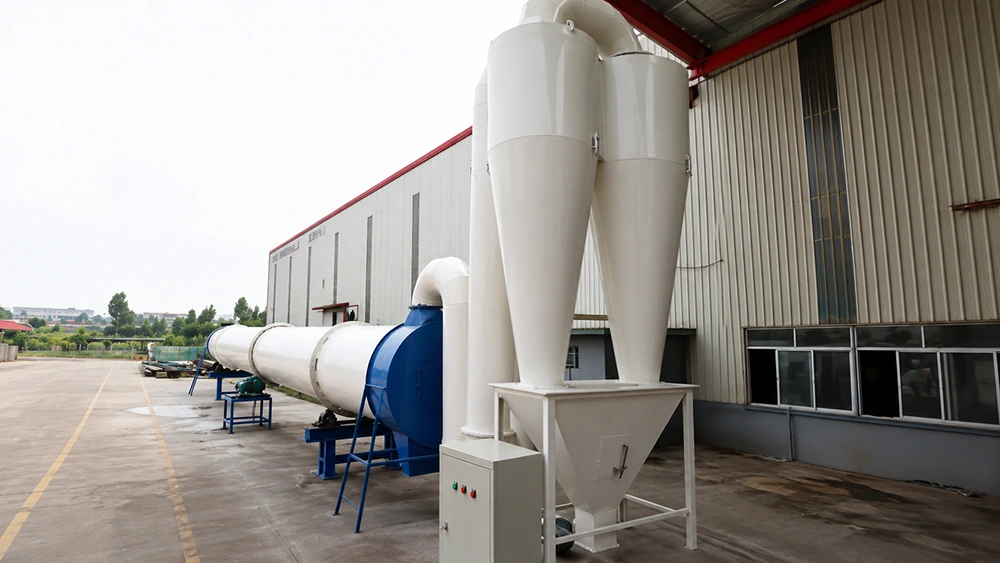
H-1010 covers 0.8 to 1 t/h at 1000 mm drum diameter, H-1212 reaches 1 to 1.2 t/h at 1200 mm, H-1512 delivers 1.2 to 1.5 t/h at 1500 mm, and H-1815 runs 1.5 to 2 t/h at 1800 mm, all on a common set of bolted-flange drum sections and standardized interfaces for the screw conveyor, hot-air furnace, and cyclone train. A 17 to 18 m drum ships in standard containers and reassembles on site through split shipment, so an inland fertilizer plant that needs to land the dryer next to an existing bagging warehouse is not held up by road or rail limits. PLC control with seal monitoring holds the moisture number steady across shift changes and across fuel swaps, so the bagging line runs on the moisture number the bag spec actually demands, instead of chasing it with rework and rejected lots. Reach out to compare your raw-material moisture, target output moisture, and current storage mold rate against the 0.8 to 2 t/h DRYR platform.
- Title uses DRYR and sawdust dryer keywords
- Body states output moisture under 10 percent
- Body references 10 to 15 percent organic fertilizer safe storage band
- Body names H-1010 through H-1815 capacity models