B2B Field Note · Sawdust Dryer Moisture Control on Emerging-Market Organic Fertilizer Lines
Emerging-Market Organic Fertilizer Lines and the Sawdust Drying Reality
On small and mid-scale organic fertilizer lines across India, Bangladesh, Vietnam and East Africa, the sawdust drying stage still rides on operator instinct: open-yard sun drying on clear days, a hand-welded low-end rotary drum on the days between, and output moisture checked by squeezing a handful of dried sawdust between two palms. A DRYR standardized rotary sawdust dryer replaces the by-feel stage with a bolted-flange assembled drum, an external girth gear and pinion drive, and PLC-logged output moisture, so 0.8 to 2 t/h output lands inside the binding window the granulator downstream is calibrated for.
What Hand-Squeezed Moisture Sampling and Hand-Welded Drums Cost the Line
Hand-squeeze moisture sampling reads one handful at one moment of one shift. A handful five minutes later, in a different spot on the discharge conveyor, can swing several percentage points. That swing is what the granulator downstream absorbs as variable yield, weaker granule hardness and extra re-feed tonnage. The hand-welded low-end rotary drum running upstream is on the same trajectory. Drum roundness and lifting plate orientation are set by the welder on the day of fabrication, not on a jig. The first season in operation the drum starts to run slightly oval; the lifting plates wear off-pattern; hot air takes the path of least resistance instead of staying inside the wet stream; the seal around the inlet and the discharge loosens. By the second year the operator throttles the infeed screw to keep output moisture on target, output tonnage drifts down by 10 to 25 percent, and unplanned downtime accumulates around bearing, drive shaft and weld repair. Drum roundness drift is the structural half of the same problem hand-squeeze sampling is the operator half of.
How DRYR Bolted-Flange Drum Construction and PLC-Logged Output Reshape the Stage
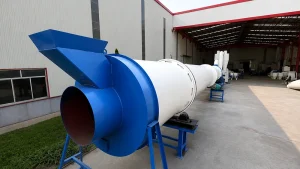
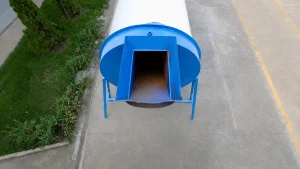
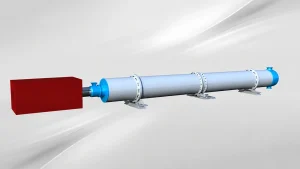
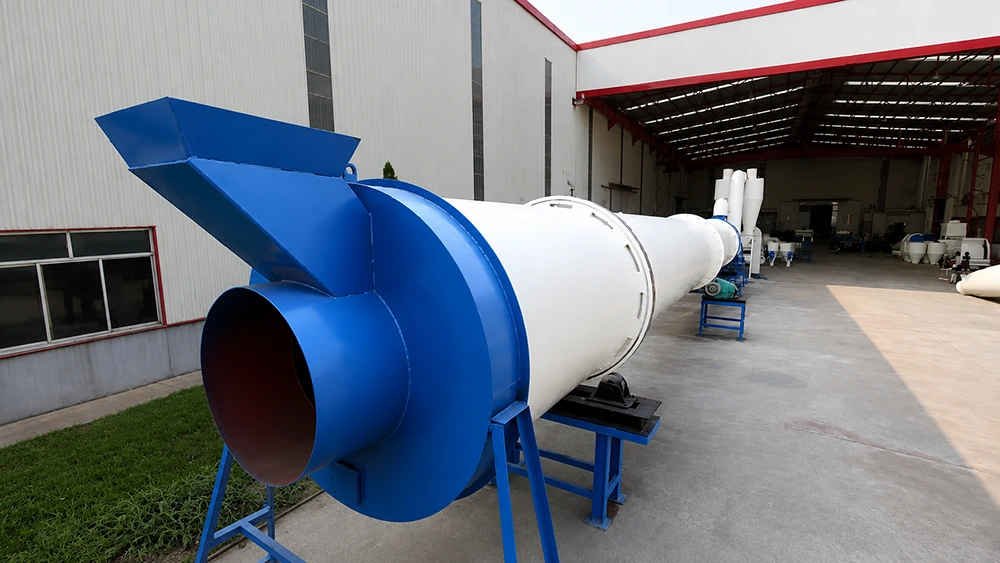
A DRYR sawdust dryer is built around a horizontal rotary drum with four spec tiers. The H-1010 runs a 1000 mm drum on a 4 kW main motor and 7.5 kW induced-draft fan at 0.8 to 1 t/h. The H-1212 scales to 1200 mm, 5.5 kW main motor and the same 7.5 kW fan at 1 to 1.2 t/h. The H-1512 goes to 1500 mm, 7.5 kW main motor and 11 kW fan at 1.2 to 1.5 t/h. The H-1815 tops the range at 1800 mm, 11 kW main motor and 15 kW fan at 1.5 to 2 t/h. The drum body is delivered in bolted-flange sections rather than a single welded shell, with flange interfaces that take field assembly out of the welding equation and let the dryer reach remote or inland sites inside standard 40HQ containers. The drive train runs an external girth gear with a pinion, gearbox and electric motor mounted on a steel sub-frame, the same drive geometry used on cement and mineral dryers, instead of the improvised friction or chain drive found on hand-welded low-end drums. Inside the drum, combined lifting plates lift the sawdust into the hot-air stream and drop it through, with welded mounting plates and bolted hubs that hold plate orientation fixed across seasons. A multi-fuel hot-air furnace (coal, oil, natural gas, biomass powder or selected on-site residue) feeds hot air through an inlet wind box, with the induced-draft fan pulling it across the drum. A PLC continuously logs inlet temperature, drum-outlet temperature and discharge moisture, and adjusts the feed screw and induced-draft fan speed against the log instead of the operator's eye. Cyclone dust collection and an optional baghouse sit at the discharge end with seal monitoring on the drum bearings, so the dryer envelope stays closed through the shift.
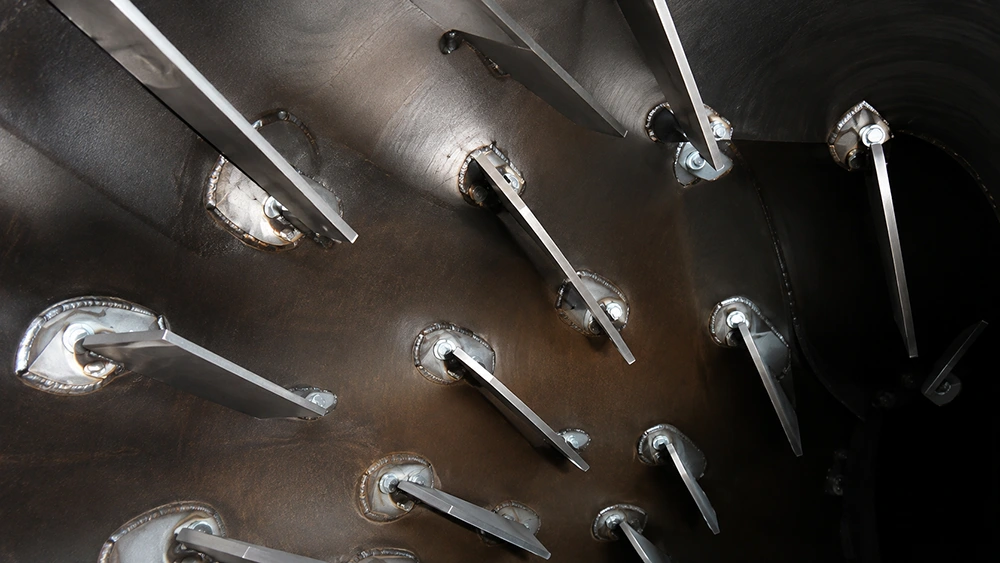
What a 0.8 to 2 t/h Organic Fertilizer Line Sees After the Switch
Field reports from organic fertilizer sites that have replaced hand-welded low-end drums with a DRYR rotary sawdust dryer describe three operational shifts. First, output moisture stops drifting with the shift. With PLC-logged output control and a continuous temperature curve, the dryer holds output moisture inside the 8 to 10 percent window the granulator downstream needs, instead of swinging 4 to 6 percentage points between batches the way by-feel hand-squeeze sampling does. Second, unplanned downtime drops off the maintenance calendar. Bolted-flange drum sections keep the drum round inside tolerance across seasons instead of drifting oval; the external girth gear and pinion drive run at a defined motor current; and lifting plate replacement becomes a scheduled bolt-on swap rather than an emergency weld repair. Third, the line becomes shippable into remote and inland sites. The drum travels as modular sections in 40HQ containers, is reassembled by the DRYR commissioning crew on site, and runs from a footprint that fits a smaller civil pad and a shorter inland truck queue. For an emerging-market organic fertilizer plant operating at 0.8 to 2 t/h, this is the step that takes the sawdust drying stage off the operator's hands and puts it on a PLC, without giving up the option to scale drum length up to 17 to 18 m on sites that need extra residence time for high initial moisture or tropical ambient humidity.
- Title and slug are unique against the existing DRYR blogs on presswoodpallet.com
- image_1 and image_2 each come from /data/hot/vault/设计师图片库/Dryr with alt text from the image index
- Four sections, each in plain text only with no HTML tags, attributes, Markdown, or angle brackets
- Body follows client/scenario, old-scheme problem, DRYR fit, structural/parameter/image evidence, final result