DRYR Sawdust Dryer | OEM Drying Module for EPC Lines
The drying stage an integrator has to quote but does not want to design
An integrator that signs a molded pallet, pellet or briquette line anywhere from 1 t/h to 20 t/h carries one drying stage across every project, and quoting it as a new design each time is the cost nobody prices. This page follows the DRYR sawdust dryer as a repeatable OEM drying module rather than a bespoke drum: four tiers from H-1010 to H-1815 at 0.8 to 2 t/h on 1000, 1200, 1500 and 1800 mm drums with 4, 5.5, 7.5 and 11 kW main motors and 7.5, 7.5, 11 and 15 kW induced draft fans, an assembled structure that lands on a defined foundation and ties into ducting the plant already has, and drums extendable to 17 to 18 m in bolted flange sections where residence time rather than heat is the constraint. It is written as a complementary drying module beside an integrator's own machine, not a replacement for it. Limits are stated plainly: the published figures carry no published test conditions, and tonnage, final moisture, section count and foundation loads are confirmed per project.
Why an assembled structure is what makes a drying module repeatable
The DRYR sawdust dryer is built on an assembled structure: the shell is assembled and machined in the works, the drum runs on steel roller supports on a steel frame, and a long drum is built as bolted flange sections that re-assemble to the works geometry on site. That is what lets the same unit be specified twice. The layout engineer gets a fixed envelope, a defined set of connection points for the feed chute, the hot air duct, the exhaust duct and the control cabinet, and a machine that does not need a new drawing each time the line behind it changes. Four tiers share one interface: H-1010 on a 1000 mm drum at 0.8 to 1 t/h, H-1212 on 1200 mm at 1 to 1.2 t/h, H-1512 on 1500 mm at 1.2 to 1.5 t/h and H-1815 on 1800 mm at 1.5 to 2 t/h, with 4, 5.5, 7.5 and 11 kW main motors and 7.5, 7.5, 11 and 15 kW induced draft fans. Drum length is the second dial, taken out to 17 to 18 m in bolted flange sections where the wet season pushes residence time out.
What the published data and the two site images actually show
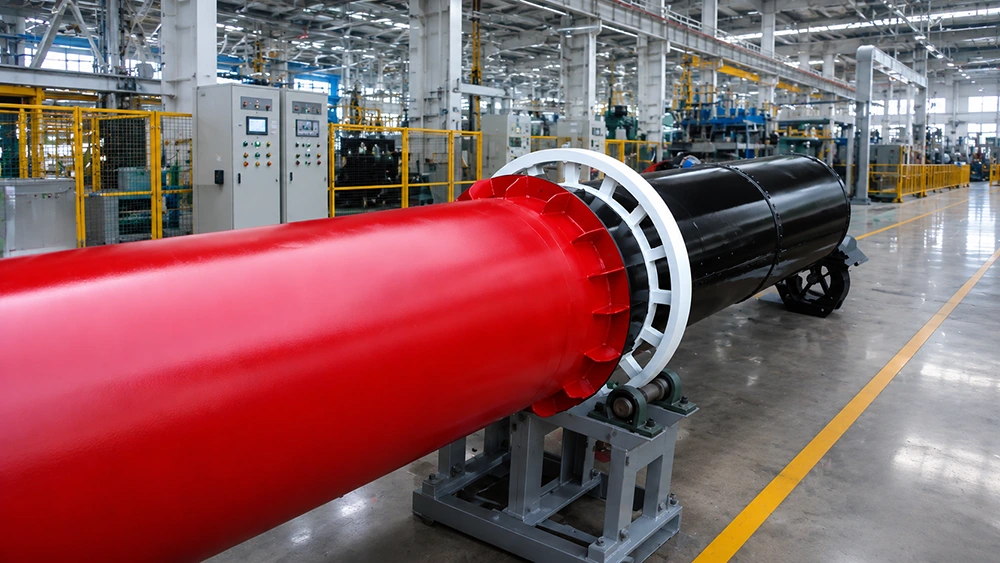
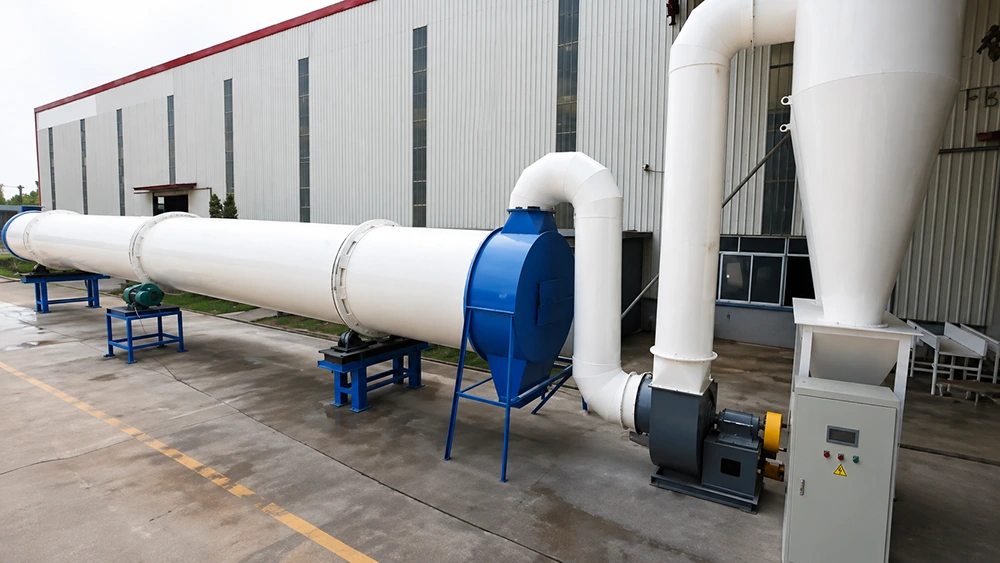
Drum internal hot air is quoted at 200 to 500 degrees Celsius, output moisture is stated below 10 percent, self-insulation is quoted above 80 percent thermal efficiency with under 8 kg of coal per tonne of material dried, and the hot air furnace is refractory brick lined and runs on coal, oil, gas or the plant's own dry biomass in solid, granular or powder form. Combined lifting plates lift the wet feed into a curtain for full heat exchange and temperature sensing monitors the drum; the drum and inlet chute are sealed with seal condition monitored, exhaust is routed to a cyclone dust collector with a baghouse filter where the project asks for one, and PLC control puts feed rate, furnace and induced draft fan on one signal chain. The first image is a site photograph of a segmented drum on steel roller supports inside a production hall, with the flanged connection rings, the support rollers and the control cabinet in frame. The second is a system view: white shell on roller supports, blue end housing, elbow ducting into a vertical cyclone separator, centrifugal blower and control cabinet, which is the connection set an integrator actually has to tie into.
Parallel banks, and the boundary of what this module does and does not replace
Scaling past 2 t/h does not require a bigger drum. Modules are banked: two units carry roughly 1.6 to 4 t/h, and a bank of two to four carries a 4 to 20 t/h line, each with its own furnace, induced draft fan and control cabinet. A bank also changes the maintenance story, because one module can be taken out for lifting plate or roller work while the rest keep feeding the mill, and turndown follows the order book instead of the machine. The boundary matters as much as the fit. This is a complementary drying module beside an integrator's own drum, not a replacement for it: it is quoted where that drum's capacity is booked, where the client specifies a multi-fuel furnace, or where a long shipping route and the integrator's own installation crew favour a bolted section machine. The result is one line item with a defined interface, a defined electrical load and a defined spare parts list. Those figures carry no published test conditions, so tonnage and final moisture move with species, initial moisture, particle size, fuel and climate, and section count, foundation loads and the electrical schedule are confirmed per project.
- Headline and slug differ from every Dryr publication checked in the live index
- Body follows scenario and old-scheme problem, then product fit, then structure and parameter and image evidence, then the resulting line item
- Both images come from the Dryr designer gallery as site photographs and are not presented as test evidence
- Every headline figure is paired with the limits that are confirmed per project



