Binder chemistry, VOC and REACH questions in pharma and personal care export
The question arrives as one line item in a supplier sustainability assessment
A specialty chemical, pharmaceutical or personal care shipper does not meet the pallet question in the warehouse, it meets it inside a sealed 40 foot container on a humid sea freight lane and inside a customer supplier assessment that asks what binder sits under the drum. This page follows one line item through that assessment: a low cost molded pallet bonded with urea formaldehyde against a formaldehyde-free presswood pallet bonded with MDI polyisocyanate and held to a CARB-NAF no added formaldehyde position, and what the shipper can actually put in writing about VOCs, REACH duties and a binder named on the material sheet.
Why a UF-bonded pressed pallet leaves the answer blank
The cheap molded pallet on the market is bonded with urea formaldehyde, and that single sentence is the problem. Free formaldehyde in a UF bond is not locked away: it releases faster as humidity and temperature rise, which is exactly the condition inside a sealed container, and a UF bonded board also swells once it takes water, so a wet handling day changes the deck geometry as well as the emission profile. Behind the pallet sits a REACH restriction on formaldehyde and a CARB limit on composite wood products, so a shipper answering a customer assessment is being asked to defend a binder it did not choose and cannot certify. Heat treated solid wood does not close the gap either: it keeps an ISPM 15 stamp, a treatment booking and certificate custody attached to every consignment, and it answers a phytosanitary question rather than a binder question. Neither route lets a supplier write the sentence the reviewer is looking for, which is a named adhesive chemistry with a named no added formaldehyde position behind it. Saying that no customer has ever complained is not that sentence.
What an MDI binder changes in the written answer
Ampallet presswood pallets are bonded with MDI, a polyisocyanate adhesive that is named on the material sheet, and the product carries a CARB-NAF no added formaldehyde position, the no added formaldehyde route under the California composite wood rule. The distinction is not marketing language, it is chemistry: there is no formaldehyde in the binder to off-gas in the first place, and the MDI cure is moisture driven, so humid heat is part of the reaction rather than a weakness in it. That is the point a VOC and REACH reviewer is testing, because a formaldehyde-free presswood pallet removes the emission path instead of asking the shipper to manage it. The same body is pressed in one piece from wood fibre at roughly 150 to 180 degrees Celsius on a 1600 ton hydraulic press, with deck, reinforcing ribs and support feet molded as a single unit, finished moisture near 9 percent or below and deck flatness held to about plus or minus 2 mm. No nail, no board joint and no separate foot also means no metal to rust and no split timber to wick a spilled reagent sideways into a drum chime.
Structure, parameters and the result that lands in the audit file
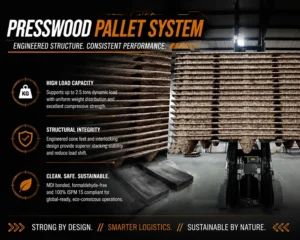
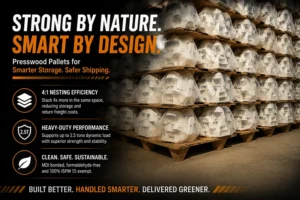
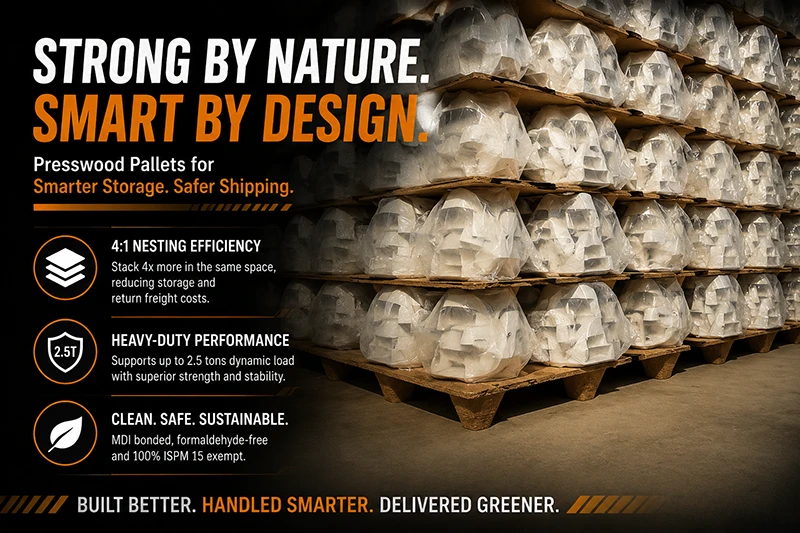
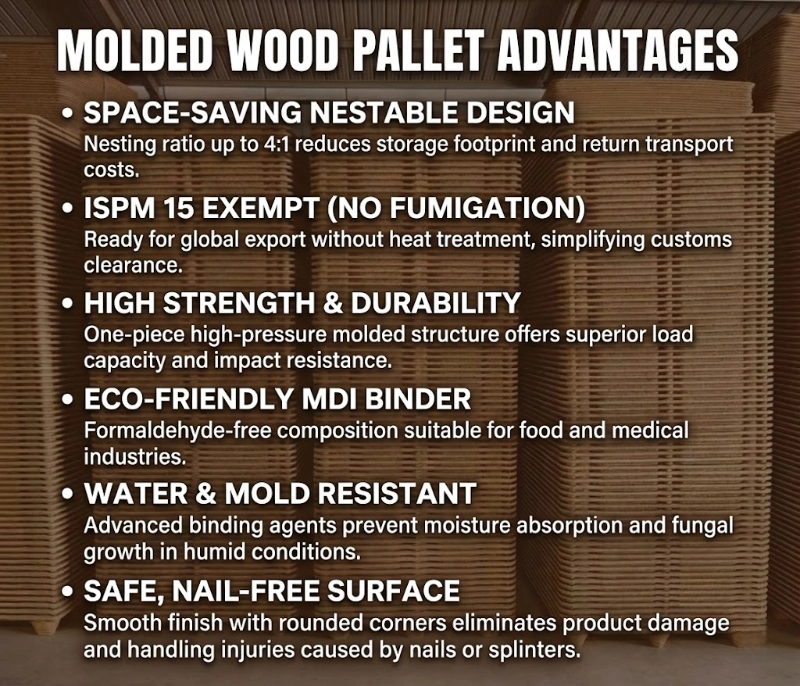
The product page carries two pieces of visual evidence a reviewer can read. The first is the one piece molded deck: a fiber surface with a molded rib pattern and chamfered edges, which is the physical proof that deck, ribs and feet come out of one mold rather than off a re-boarding bench. The second is a stack of nested units in a warehouse, with the MDI binder, moisture resistance, nail free surface and ISPM 15 exemption shown as product positions rather than promises. The numbers behind them are the ones a specification sheet answers: the 1140 x 1140 x 135 mm nine leg drum unit at about 17 kg with 2500 kg dynamic and 7000 kg static load and 96 plus or minus 3 mm fork entry; the 1200 x 800 x 125 mm nine leg at 13 to 14 kg with 2000 kg dynamic and 6000 kg static load, four way entry, guide slots and roughly a 4 to 1 nesting ratio; the 800 x 600 x 125 mm six leg at about 6 kg for lighter lanes. The result in the assessment file is narrower than a certificate for the whole plant and more useful than a brochure: a named binder, a CARB-NAF position supplied per product and per plant, a one piece nail free body, and a processed wood reading that supports a fumigation free ISPM 15 position. Limits belong in the same paragraph. The pallet does not replace the shipper's own REACH registration and SDS duties, and it does not answer for the cargo inside the liner. Certification is supplied per product and per plant rather than as a blanket company claim. The nestable single face unit is not a long term racking pallet. And a fumigation free reading stays a destination rule and a forwarder question, which is the buyer's call and not the pallet's.
- Binder chemistry stated as MDI polyisocyanate named on the material sheet, not urea formaldehyde
- Formaldehyde position stated as CARB-NAF no added formaldehyde, supplied per product and per plant
- REACH registration and SDS duties explicitly left with the shipper rather than claimed by the pallet
- Two designer gallery images selected with keyword bearing alt text for the deck structure and the nested MDI build