ISPM-15 program cost / export pallet plant
Who actually pays for the ISPM-15 program
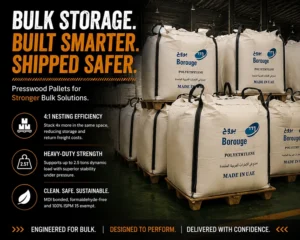
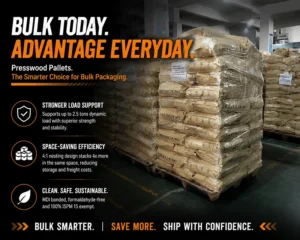
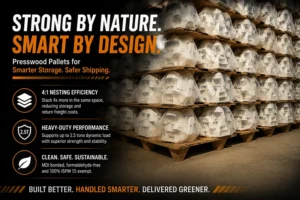
Every pallet that leaves on a solid wood stringer carries a treatment program behind it: heat chamber hours, segregation lanes, stamp custody and an audit file that has to survive a customer review in another country. A molded pallet hydraulic press machine removes that program instead of optimizing it. This page follows an export pallet supplier and a pool operator running 1219 x 1016 mm and 1200 x 1000 mm pallets into US, EU and AU lanes, where a presswood pallet press machine pressing wood waste and sawdust with MDI adhesive at 150 to 180 C puts the finished pallet into the IPPC processed wood material category, so there is no treatment cycle to book, no stamp to defend and no segregated stack on the floor, and where the nestable pallet geometry lifts the 40ft container load far above the 21 units the incumbent export pallet carries.
Where the old fleet leaks compliance: the repair bench
A pooled block pallet comes back after several trips with a broken deck board or a cracked stringer, and the repair bench is the point where a compliant fleet quietly stops being compliant. New lumber goes on a marked pallet and nobody can say from the finished unit whether that board was heat treated, whether the mark still reads after the repair, or whether the pallet now needs to be re-treated and re-marked before it can leave again. Meanwhile the load it was meant to carry has to be pulled out of a segregated stack, re-slotted, and re-papered at the dock. A forklift pallet that fails that check costs more than the board: it costs a shipping window. The same exposure repeats on warehouse pallet and racking pallet fleets operating inside a distribution centre, where a mixed stack of marked and repaired units is a question the operator cannot answer from the shop floor, and on every fumigation-free export pallet claim written into a customer contract. That is the real weight of the program: it is a documentation tax charged on volume that keeps growing.
Why a presswood pallet press machine sits outside the program
The exemption is a material definition, not a process discount. ISPM-15 governs raw wood packaging and places processed wood material outside its scope, and a molded pallet formed from wood fibre and adhesive belongs on the processed side of that line. That single sentence removes all four standing costs at once: no chamber hours to book, no stamp to apply or defend, no segregation lane between treated and untreated stock, and no treatment audit trail to maintain. It also removes the repair question, because a one-piece molded pallet has no deck board to replace and no nail to pull, so the unit either still carries the load or goes back to the crusher as wood waste. The process behind that status is not a claim about a warm press. On the three-beam four-column hydraulic press the material is formed in a hot press molding window of 150 to 180 C under platen pressure, so the whole board mass is taken past the 56 C for 30 minutes threshold that the heat treatment schedule is built around, and the same cycle sets the shape, the entry mouths and the nesting geometry. International molded pallet producers have sold on this basis for decades. What we do not do is promise it on the buyer's behalf: acceptance of a processed wood pallet at destination stays a question for the buyer's specification and the receiving NPPO, and it is answered from documents, not from a brochure.
Structure, tooling and the 40ft container arithmetic
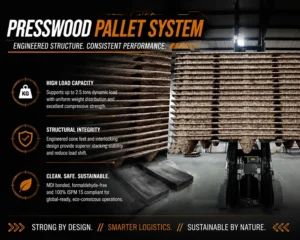
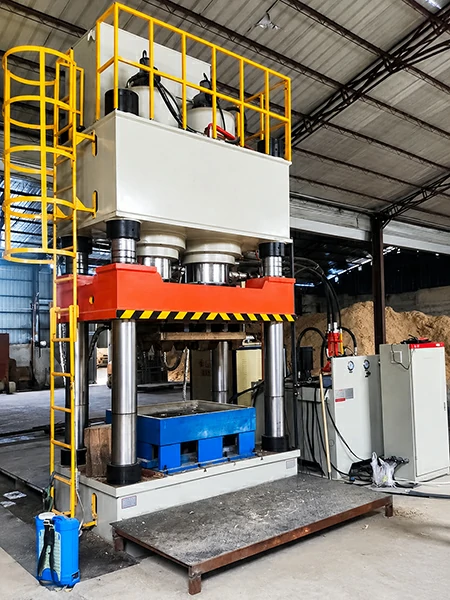
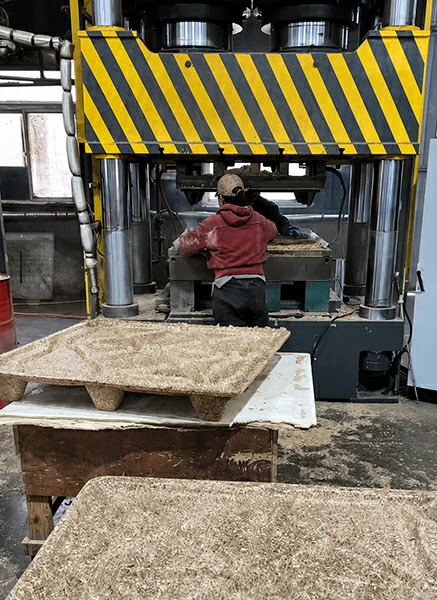
The frame that carries this duty is the three-beam four-column hydraulic press: top beam, slide and worktable carried on four solid columns, with the tonnage ladder running from the 1250 ton hydraulic press up to the 2500 ton hydraulic press and platens up to 2500 x 1700 mm, in single station or double station layout. The workshop photograph on this page shows the machine as it is installed: four-column frame and guide pillars with safety railings, a mould platen at the working height, and the hydraulic power unit and control cabinet standing separately so the press bay stays clear. The second view is the forming station itself, the guard down over the platen while a molded pallet body is pressed. The point of that size range is tooling, not tonnage for its own sake. Because EMP supplies both the machine and the pallet, the mould can be cut to the specification the buyer already ships on, 1219 x 1016 mm and 1200 x 1000 mm included, instead of forcing an export operation onto a stock pallet size and re-engineering its racking, its pallet pool and its customer approvals around it. Then there is the freight line that no heat treatment program can touch. Molded pallets nest into one another in the empty state, so a 40ft container that carries 21 of the incumbent export pallets carries far more of these, with the exact count set by pallet height and the customer's own specification rather than by a marketing figure. Add the four removed costs to the container arithmetic and the result is not a cheaper pallet, it is a different cost structure: fibre intake and press hours on one side, no treatment program, no repair bench and fewer containers on the other. Tonnage, platen size, tooling and container count are confirmed per project, and the upstream stages have to be in place before the press forms anything: crush the fibre to a consistent band, dry it to the forming moisture and mix the MDI adhesive evenly. Ready to price a line against your own export pallet specification? Send the size, the target output per shift and the destination markets, and we will set the tonnage tier and tooling from there.
- Claims held to the three-beam four-column Y32 ladder from 1250 ton to 2500 ton with platens up to 2500 x 1700 mm, single or double station, and a 150 to 180 C molding window
- ISPM-15 position stated as the IPPC processed wood material category, with destination NPPO and buyer specification acceptance confirmed per project
- 40ft container load stated as far above the 21 units of the incumbent export pallet, with the exact count left to pallet height and customer specification
- No certification claim and no invented test report; crush, dry and MDI mixing named as upstream prerequisites and tooling confirmed per project