Repair cost and idle pallet inventory
Where the money actually sits: a repair bench and a surplus yard
A pallet operation carries two standing costs that never appear on a pallet price: the repair bench, where nailed units are sorted, de-nailed and re-decked, and the yard, where surplus and idle pallets wait to be needed again. This page follows both costs onto a molded pallet hydraulic press machine, where recovered wood waste, sawdust and MDI adhesive are hot press molded at 150 to 180 C on a Y32 three-beam four-column frame from 1250 to 2500 ton with a platen up to 2500 x 1700 mm, producing a one-piece, nail-free molded pallet that is crushed back to fibre when it is worn rather than repaired, and that nests about four to one when it is empty.
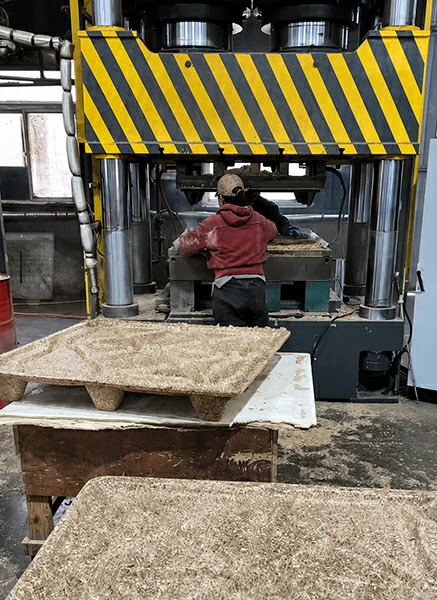
Why the nailed pallet keeps paying for the same failure twice
A traditional nailed wooden pallet has two dominant failure modes and both are joints: a loose or withdrawn nail, and a broken deckboard beside it. Neither is a material failure, so the unit is not scrap, and neither is a design failure, so the unit is not recalled. It simply needs labour, and the labour is manual, at a bench, on a unit worth very little. The unit that passes repair goes back into service and fails again on the next rotation. The unit that fails repair is downgraded or sold as scrap by the ton, which means the operator pays twice: once for the boards it bought and once to move the wreck out of the gate. Then there is the storage side, because a nailed pallet stacks flat and only flat, so 400,000 surplus units is a warehouse decision, not a stacking decision. The repair centre is doing exactly what it was designed to do, and it is still a fixed cost that scales with volume.
The molded pallet removes the joint, so the failure mode disappears
A molded pallet is formed in one heated pressing from wood fibre and MDI adhesive, so there is no nail to withdraw and no deckboard to break away from a stringer. The failure modes the repair bench exists to fix are not improved, they are absent. What remains is wear: a cracked deck on a heavily used unit, a broken block after a bad forklift entry. That damage is not repaired, it is re-processed. The worn unit goes to a crusher, comes out as fibre at about 5 mm, is dried to 8 to 12 percent moisture, is re-glued and is pressed again into a new pallet. The repair stage is replaced by a regeneration stage, and nothing leaves the site as downgraded waste. The same geometry answers the second cost: a molded pallet nests, about four units into the height of one, because the feet of one pallet sit inside the deck of the pallet below. For a fixed number of empty units, the floor area a yard needs falls by roughly 60 to 80 percent, which is the difference between treating surplus stock as a storage problem and treating it as ordinary buffer stock.
What the machine has to be to carry that loop
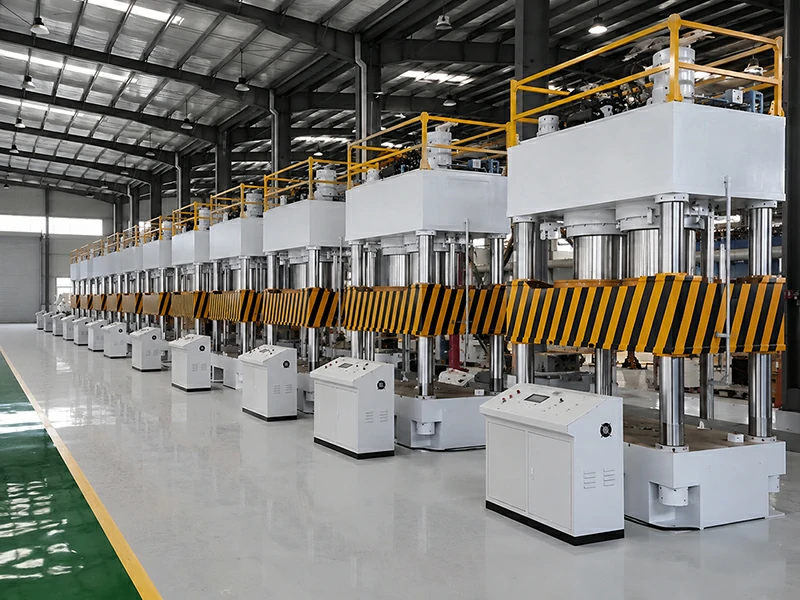
The image above shows the forming station doing the only step that cannot be outsourced: one heated pressing that turns prepared fibre into a finished pallet. The press platform is a Y32 three-beam four-column machine, with the top beam, slide and worktable carried on four solid columns, in tonnage tiers from Y-1250 to Y-2500 as 1250, 1600, 2000 and 2500 ton, with platens up to 2500 x 1700 mm, in single or double station layout, forming at 150 to 180 C with a short molding cycle and an ejector at the top. Around it sits the rest of the loop that makes regeneration possible: crusher, dryer, glue mixer, hot press, with the conveyor tying the stages together. That is why the press is not sold as a stand-alone machine. About 5 mm particle size, drying to 8 to 12 percent moisture and even MDI mixing all have to be in place before the press forms anything, and the pallet nests, ships and exports only if the tooling is cut to the buyer's own footprint, whether that is 1219 x 1016 mm, 1200 x 1000 mm or another spec. Two limits are stated plainly: tonnage, platen and tooling are confirmed per project against the customer's pallet size and required output, and where a molded pallet is offered as a fumigation-free export pallet, destination acceptance remains a buyer and NPPC question rather than something the machine settles. Get those right and the depot ends up with one production asset instead of a repair bay, a scrap contract and a rented surplus yard: worn pallets become raw material, empty pallets take a quarter of the height, and the pallet that used to be repaired twice is now re-pressed.
- All process figures limited to the published window: 150 to 180 C forming, 8 to 12 percent moisture, about 5 mm particle, Y-1250 to Y-2500 ton, platen up to 2500 x 1700 mm
- Nestable ratio and the 60 to 80 percent footprint reduction are stated as design geometry applied to a fixed unit count, not as a measured customer result
- Upstream boundary stated: crush, dry and MDI mixing must be in place, and the press is not sold as a stand-alone machine; tonnage and tooling are confirmed per project
- Export acceptance stated as a buyer and NPPC question, not as a machine guarantee



