First-time industrial pallet makers · buyer audit file
The buyer question a fibre owner cannot answer with an environmental story
An agricultural cooperative or biomass processor that already owns the fibre usually reaches the same wall in year two: the buyer believes the environmental story and still asks for proof of 500,000 pallets at one specification and one delivery date. This page follows that audit onto a molded pallet hydraulic press machine, from the sample pallet and the brochure sheet that cannot answer it, through a Y32 three-beam four-column line from Y-1250 to Y-2500 ton with platens up to 2500 x 1700 mm in single or double station layout, molding at 150 to 180 C in a steel mold that holds length, width and deck plane to about plus or minus 1 mm, to the evidence package a visiting buyer or investor actually walks through in a working factory.
Why a good sample and a bare press fail the same audit
The usual first answer is a sample pallet, a spec sheet and a factory video, and the usual second answer is to buy a general four-column hydraulic press and work the process out on site. Both answers break at the same point. A sample is one unit made by the most experienced person in the building, measured once, and a nailed wooden pallet alternative carries its own visible inconsistency: a repair bench, a heat treatment program and stamp custody behind every export unit. A bare press has the opposite problem, because a press is only one stage of a line, and the toner of a pallet is decided upstream by crush size, moisture spread and adhesive mixing, and downstream by mold condition and pressing curve. Where those are invented locally, the first thousand pallets look acceptable and the tenth thousand does not, dimensional drift appears between cavities and shifts, and the buyer's incoming inspection starts rejecting lots that the plant cannot explain. That is the moment a new category loses a contract it had already won on price.
What the line delivers as evidence instead of as a promise
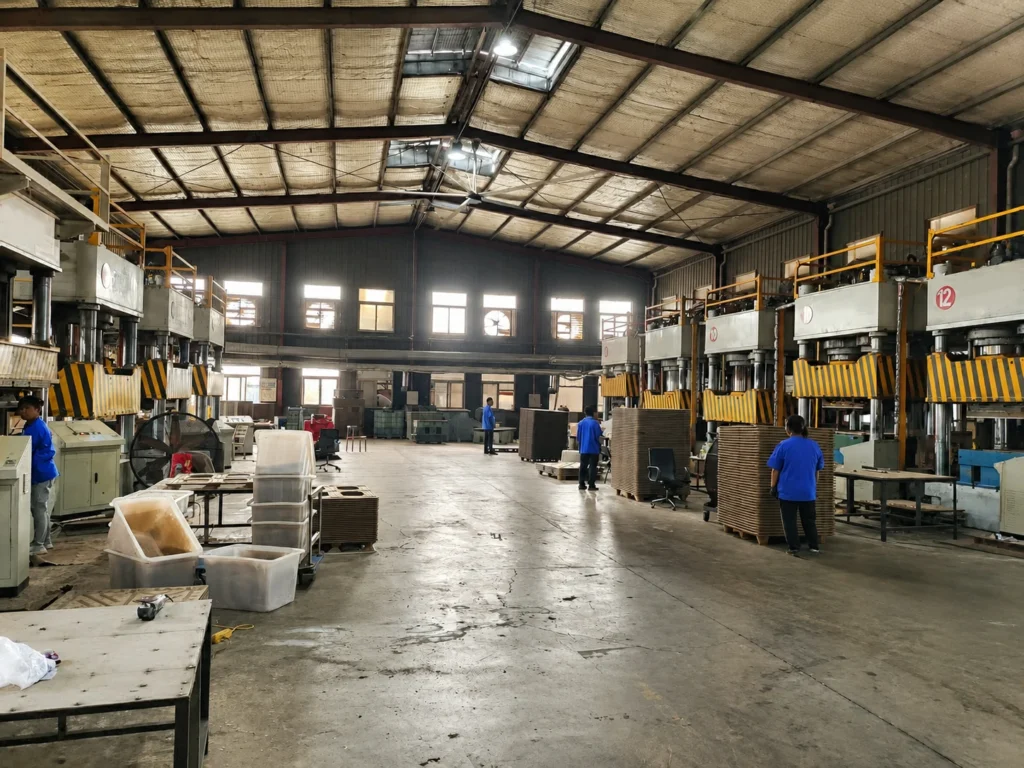
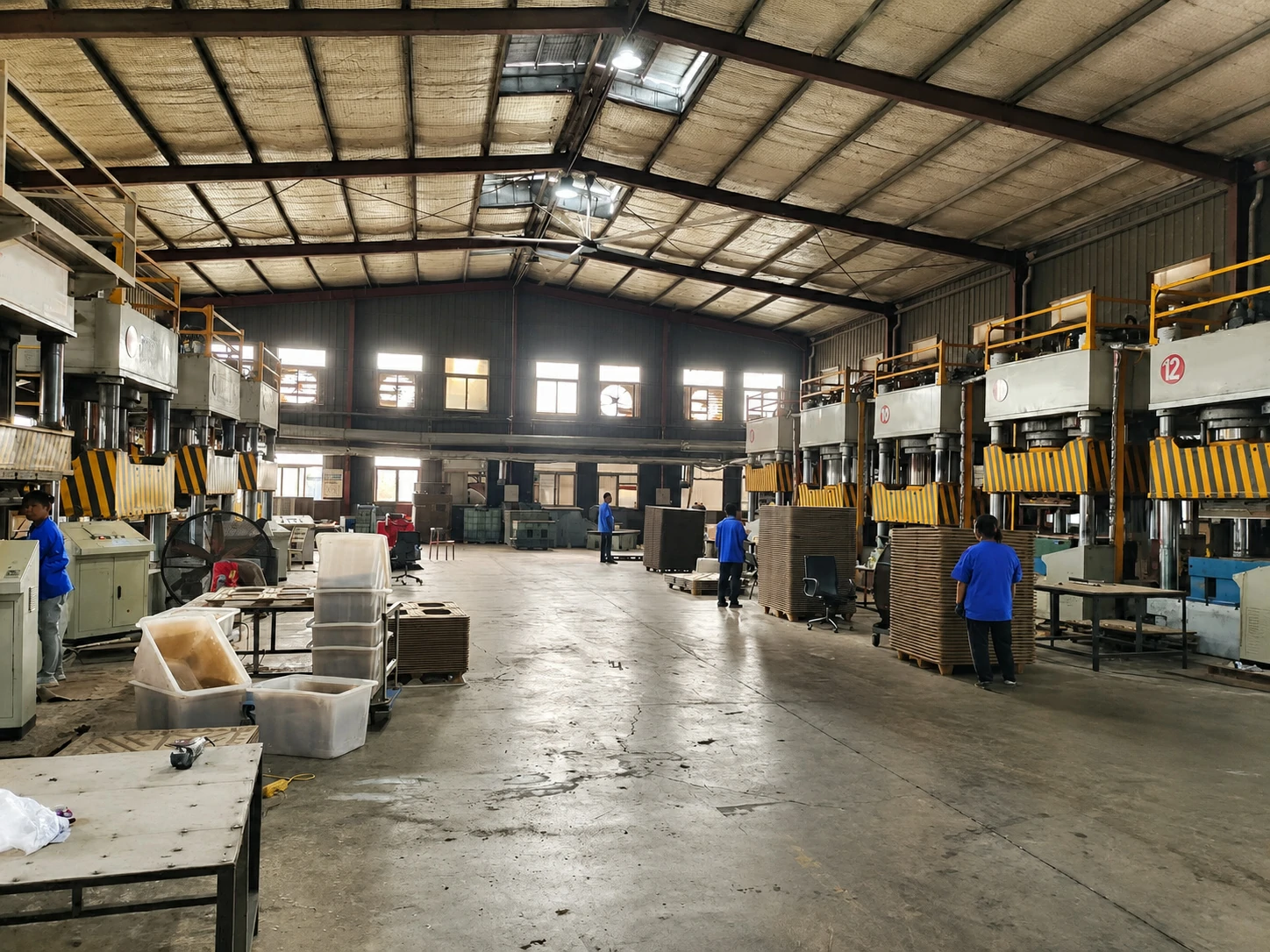
The answer is a standardized line delivered as a scope, not as a machine. Pallet geometry is set by the steel mold, so length, width and deck plane repeat to roughly plus or minus 1 mm from tooling rather than from a repair bench or an operator's eye, and that tolerance is what a palletizer, an AGV lane or a racking buyer inspects. Pressing is done by a Y32 three-beam four-column frame in four tonnage tiers from Y-1250 to Y-2500, with platens up to 2500 x 1700 mm and single or double station layout, hot press molding at 150 to 180 C, and the frame's solid column design holds the load path that keeps a deck flat across the cycle. Each mold ships with its temperature and pressing curve parameters, and the line ships with an operating SOP, so the parameter set is a document the plant can hand to an auditor instead of knowledge that leaves with one supervisor. The workshop view above shows the shape of that evidence: parallel stations, guarded pressing zones, independent control cabinets and stacked molded parts, which is what a visiting buyer photographs. Two configuration tiers, semi-automatic and fully automatic, let a new maker install the version its first customer audit accepts and step up when the order book, not the brochure, calls for it.
The factory visit that shortens the trust cycle, and the numbers a machine seller cannot supply
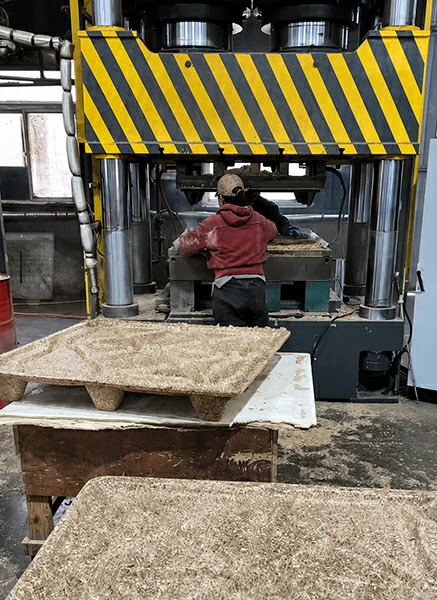
Trust cost falls fastest when the buyer stops reading and starts walking. EMP runs its own pallet production, which means a customer, a retail panel or an investor can stand beside a comparable line at full load, watch a cycle, pull a pallet off the stack, measure it and ask the operator how moisture and adhesive are checked. That same dual identity, machine builder and pallet producer, is why the delivered file can carry measured capacity, yield and energy consumption from real running shifts rather than sample-book figures, and why yield loss and energy per pallet can be discussed as operating numbers instead of claims. The result is an audit package a first-time industrial maker can put in front of a large buyer: mold tolerance, tonnage and platen against the pallet spec, the parameter and SOP set, running data from a line already in production, and a live reference the buyer can visit. Limits are stated plainly, because they will be asked about anyway: crush size, drying and adhesive mixing still decide what the press can press, density, thickness tolerance and molding cycle are confirmed per project on the customer's own fibre and moisture, tonnage, mold and station count follow the pallet footprint, and destination acceptance of a fumigation-free pallet remains a buyer and plant protection authority question.
- Title, slug, H1 and first-screen summary carry molded pallet hydraulic press machine with a first-time industrial maker and buyer-audit angle, distinct from all nine existing MldP posts
- Every body block is plain text with no tags, attributes or markdown, so the fixed renderer owns the paragraph markup and the required emp-section, emp-btn-primary and /contact/ markers
- Both image source paths sit inside the resolved MldP designer gallery and their alt text names the molded pallet hydraulic press machine and the forming station
- Structure, tonnage, platen, station, mold tolerance and the stated limits are consistent with the MldP traffic profile and product data, with no invented specification