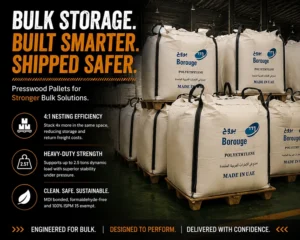
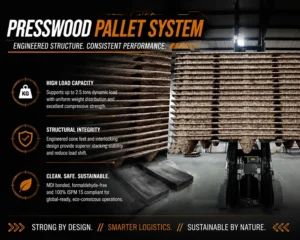
Pallet repair bay and surplus yard
The repair bay and the surplus yard are the same bill in two currencies
A pallet operation pays for damage twice: once at the repair bay, where a nailed wooden pallet is sorted, de-nailed and re-boarded by hand, and once at the surplus yard, where empty units that do not nest hold floor area as if they were loaded. This page follows both costs onto a molded pallet hydraulic press machine, where one-piece nail-free pallets are hot press molded from recovered wood fibre and, when worn, are crushed back to fibre and pressed again instead of repaired, while an empty unit nests about four to one and takes roughly 60 to 80 percent less storage footprint for the same count.
A nailed stringer or block pallet cannot be repaired out of the problem
A traditional nailed wooden pallet fails in the places a repair bench can only chase. Pulled nail heads and loose nails, a broken deck board, a split stringer end, a block that has taken a forklift entry: each is a separate judgement by a person with a pry bar, and each judgement is repeated thousands of times a year. Repair is manual, so its cost follows the wage rate and its quality follows who was on shift. Units past repair are downgraded or scrapped, which writes off the original purchase and sends the timber out at scrap value less hauling. The surplus side is worse, because a stringer or block pallet does not nest, so an empty unit occupies nearly the floor area of a loaded one and the yard is sized on pallet count instead of throughput. A slow quarter then turns that space into a fixed cost with no output, and a pallet pool that has cut its pallet purchase still carries the bench and the yard as permanent overhead.
A molded pallet changes the failure mode instead of the repair policy
A molded pallet removes the failure modes rather than managing them. It is a one-piece molded shape pressed from recovered wood fibre and MDI adhesive in a steel mold, so there is no nail to pull, no deck board to replace and no stringer end to split. The damage patterns the bench is built around do not exist in the product, and the uniform load surface keeps goods from shifting without a nail head standing proud of it. What is left is wear, and wear is handled by a different department: a lightly damaged unit goes to the crusher, not to the bench. Crushed to about 5 mm, dried to 8 to 12 percent moisture, mixed with MDI adhesive and hot press molded again, the worn pallet becomes 100 percent of the raw material for the next one, so the repair stage is replaced by a regeneration stage and the scrap pile stops being a write-off. On the space side, a nestable pallet stacks about four to one when empty, so the same empty count holds roughly 60 to 80 percent less footprint: a programme sitting on four million surplus pallets and a nestable category would shrink that storage footprint several times over, and the same geometry is what makes an empty return lane cheap.
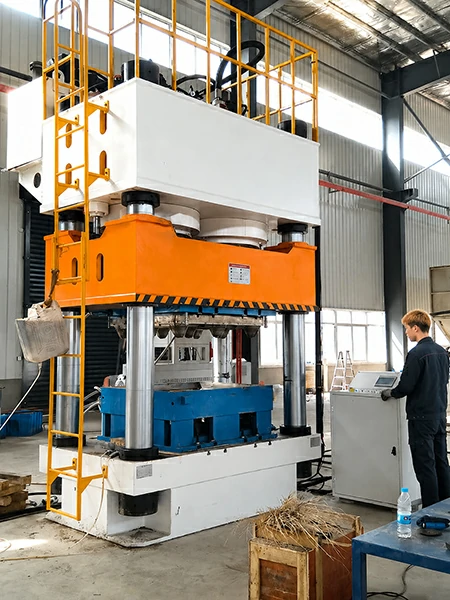
The forming stage behind the loop: Y32 three-beam four-column from Y-1250 to Y-2500
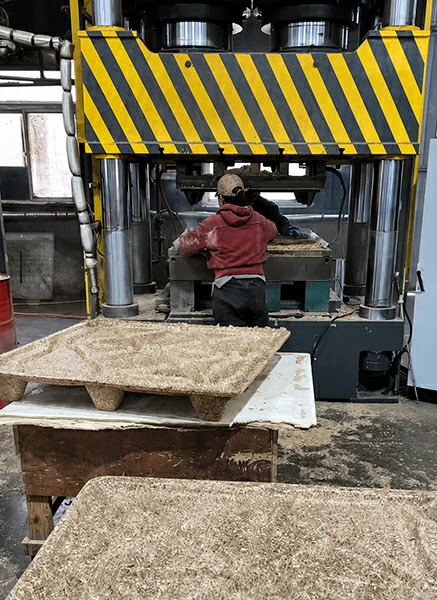
The press that carries the loop is a pallet-tooled Y32 three-beam four-column hydraulic press: top beam, slide and worktable locked by four solid columns, two main cylinders over the top beam, a hydraulic power unit on the back, and T-slots on the platen and slide for the upper and lower mold halves. The tonnage ladder runs Y-1250, Y-1600, Y-2000 and Y-2500 at 12500, 16000, 20000 and 25000 kN, with platens from 1700 x 1400 mm to 2500 x 1700 mm, slide stroke from 700 to 900 mm, ejector force from 300 to 630 kN and ejector stroke from 200 to 300 mm, driven by a 55 to 75 kW servo main motor quoted at 25 to 55 percent energy saving, under 80 dB noise and an oil temperature rise below 25 degrees Celsius. Hot press molding runs at 150 to 180 degrees Celsius with MDI adhesive, one-press forming on a molding cycle quoted around 180 to 240 seconds, at a pallet density near 900 kg per cubic metre and roughly 8 to 12 kg per unit depending on footprint, with a reference 1200 x 1000 mm unit rated at about 1.5 to 2 t dynamic and 5 to 8 t static load. The two photographs on this page show the forming side of the loop rather than a rendering: a four-column press with its guard down over a pallet body in the mold, and a heavy four-column frame with its hydraulic power unit, control cabinet and access ladder, which is what a regeneration cell actually looks like when the bench is gone. The boundaries are stated plainly. The press is the forming stage, not the whole line: crushing to about 5 mm, drying to 8 to 12 percent moisture and an even MDI mix have to exist upstream, which is why EMP quotes the crusher, dryer, glue mixer and press as one in-plant scope and not as a stand-alone machine. Density, thickness tolerance and molding cycle are confirmed per project on the customer's own fibre, moisture and adhesive mix; tonnage, platen, mold and station count follow the pallet drawing and the shift target; the fumigation-free export position rests on the processed wood classification, while destination acceptance stays a buyer and plant protection question; and heavy beam racking keeps its block pallet as a complementary category rather than a replaced one. The decision a repair centre actually faces is therefore about pallet category and feedstock, not about a larger press, and the empty-pallet footprint follows the nesting ratio on the drawing rather than a warehouse aisles assumption.
- Body text is plain text only, with no HTML tags or angle brackets
- The keyword molded pallet hydraulic press machine is carried in the H1 scope, slug and first screen
- Tonnage, mold, moisture, molding cycle and destination acceptance are stated as project-confirmed limits
- Both images come from the resolved MldP designer gallery only