Pallet capex without lumber exposure
The buyer: a pool that reprices its next thousand pallets against a lumber index
A pallet pool that has just repriced a thousand pallets at 23 to 29 euro each is not looking at a machine problem, it is looking at a lumber problem: European sawn timber moved about 46 percent in 2021 and roughly 102 percent across the 2021 to 2022 peak, and the euro pallet that had been quoted near 9 euro went with it. This page follows that exposure onto a molded pallet hydraulic press machine, where the unit is formed from recovered wood waste, sawdust and the pool's own repair-shop rejects instead of a certified lumber grade, and sets out what the line actually does with that fibre: crushing to about 5 mm, drying to 8 to 12 percent moisture, MDI adhesive mixing, then hot press molding at 150 to 180 C on a Y32 three-beam four-column frame from Y-1250 to Y-2500 ton with platens up to 2500 x 1700 mm in single or double station layout. Limits are stated plainly: tonnage, mold and station count are confirmed per project, fibre blends follow joint trial data, and destination acceptance of a fumigation-free pallet stays a buyer and plant protection authority question.
Why the nailed and heat-treated route keeps the exposure open
A traditional nailed wooden pallet, a heat-treated wooden pallet, and a stringer or block wooden pallet all begin from one thing: a sawn timber grade that a sawmill chooses to allocate. The plant bids for that grade against construction, furniture, packaging and panel buyers, and it pays whatever the grade outturn then allows. Add the programme that arrives with the board, which means heat chamber hours, segregation lanes, stamp custody and a treatment audit file that has to hold up in another country, and add the repair bench, where broken boards are torn out and replaced with more purchased lumber. A plywood pallet keeps a panel mill in the chain, a plastic pallet swaps the lumber market for a resin market, and a wooden pallet nailing machine still nails boards. None of those routes touches the structural problem: capital cost per pallet stays set by a commodity the pallet producer buys at the wrong end of, and payback on a new press is re-underwritten every time that commodity moves.
Why molded pallet fibre is not in the same market as certified lumber
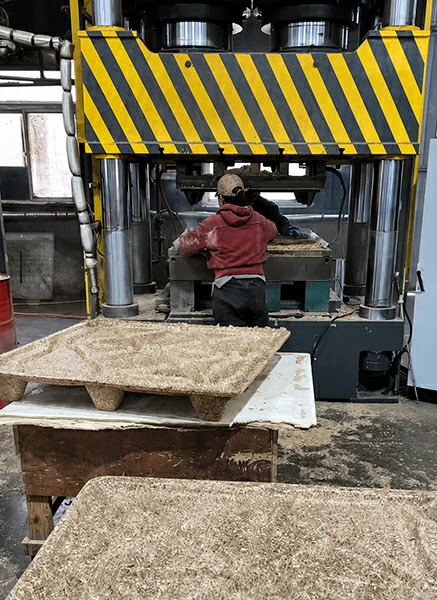
A molded pallet hydraulic press machine, or a molded wood pallet press machine in the older naming, does not buy a grade. Its feedstock is wood waste, sawdust, wood shavings, wood chip and recycled wood, plus what a pool already owns: board ends, broken blocks and pallet residue pulled off the repair line before it reaches landfill. None of that is a certified log allocation, no sawmill grades it and no panel mill bids for it, so its cost behaves nothing like a lumber index and a compression molding line fits the recycling claim a buyer is already writing into its tender. The advantage is scope rather than a press on its own. Our line carries the front end that makes mixed waste usable, a crusher and grinder holding roughly a 5 mm particle band, a dryer taking moisture to 8 to 12 percent, and MDI adhesive mixing as pre-treatment ahead of the mold. For a pool operator that means capacity for a new category at a procurement radius near zero, because its own repair-shop rejects become the feed. This is not a WPC pallet and not a particle board pallet: it is one-press forming on conditioned wood fibre.
The machine evidence: Y32 frame, tonnage ladder and a nail-free one-piece unit
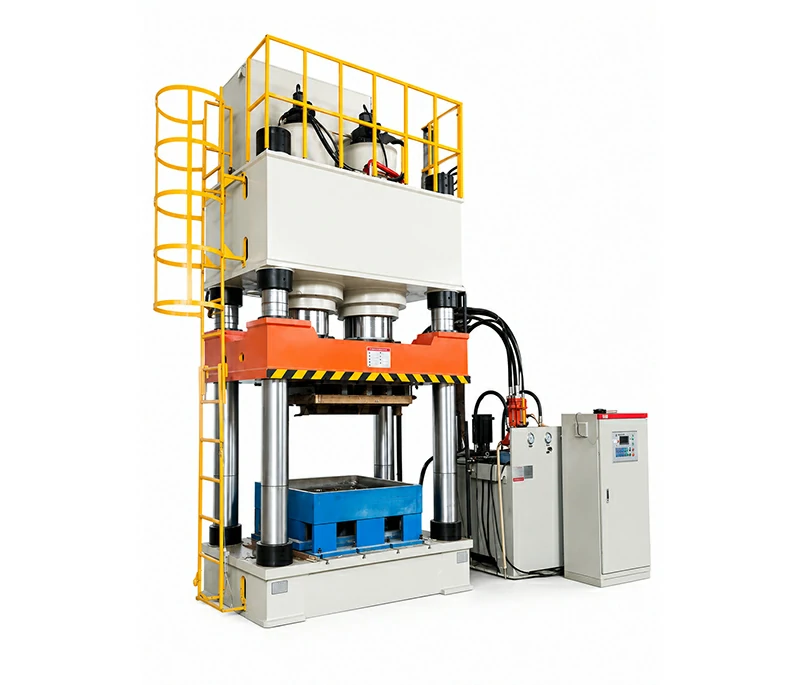
The frame is a Y32 type hydraulic press in the three-beam four-column hydraulic press layout, so top beam, slide and worktable are carried on four solid columns while the hydraulic cylinder and top eject work inside a steel mold. Tonnage runs from the Y-1250 hydraulic press through the Y-1600 hydraulic press and the Y-2000 hydraulic press to the Y-2500 hydraulic press, with platen size up to 2500 x 1700 mm, single station or double station pallet press layout, hot press molding at 150 to 180 C on a molding cycle that repeats to tooling instead of to a carpenter's hand. What leaves the mold is one piece of roughly 8 to 12 kg, with no nails and no splinters, a uniform load surface, nestable about four to one when empty, and positioned as a fumigation-free export pallet in the processed wood material category rather than under a heat treatment stamp. For the pool the result is the same number on a different base: the cost of the next thousand pallets is set by waste availability, tonnage and cycle, the repair bench turns from a cost centre into a feed point, and empty return volume drops. Tonnage, platen, mold and station count are confirmed per project, fibre blends follow joint trial data, and destination acceptance of a fumigation-free pallet remains a buyer and plant protection authority question.
- Feedstock is recovered wood waste, sawdust and the pool's own repair-shop rejects, not a certified lumber grade
- Crusher and grinder to about 5 mm, dryer to 8 to 12 percent moisture, MDI adhesive mixing done before the mold
- Y32 three-beam four-column frame, Y-1250 to Y-2500 ton, platen up to 2500 x 1700 mm, single or double station
- Tonnage, mold, station count, fibre blend and destination acceptance confirmed per project