Capacity Expansion for a Validated Molded Pallet Plant
The plant that validated the market and then ran out of press
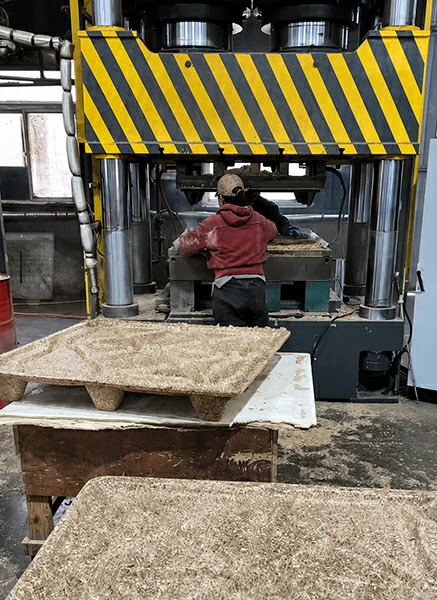
A molded pallet plant rarely stalls on demand. It stalls on the second line. One UK molded pallet maker publicly reports roughly 300,000 pallets a year while its units already sit in front of retail buyer panels and move through UK distribution, and a single mid-size European pallet user can ask for tens of thousands to hundreds of thousands of units a year on its own, while a US producer running more than sixty years across two plants shows the output a validated product eventually needs. This page follows that decision onto a molded pallet hydraulic press machine: recovered wood waste and sawdust crushed to about 5 mm, dried to 8 to 12 percent moisture, blended with MDI adhesive and hot press molded at 150 to 180 C on a Y32 three-beam four-column frame, in four tonnage tiers from Y-1250 to Y-2500 with platens up to 2500 x 1700 mm and single or double station layout, so line two and line three are sized on pallets per shift and installed beside the validated automatic line instead of replacing it. Cost is stated as a market reference rather than a quotation, and the boundaries are stated plainly at the end.
Why a European turnkey quote and one oversized bet both freeze the decision
Two familiar answers both stop a plant that is already producing. The first is the imported European turnkey proposal: technically strong, and priced and scheduled at a level that turns an expansion into a board-level financing project, with delivery windows long enough that the market moves before the press lands. The second is the opposite error, going straight for one large line to skip a step, which locks capital, commits the plant to a mold size and a footprint before the order book has confirmed either, and leaves no cheap way to correct a mistake. A third answer is to squeeze more out of the existing single press, and that runs into physics: cycle time is set by heat transfer into the mat at 150 to 180 C, densification is set by tonnage per square centimetre of platen, and one mold size caps the products the plant can quote. Push the existing press past its tonnage-matched mold and the deck goes soft on its densest section and uneven across the face. None of these three answers is about the pallet market at all. They are about how a second and third line get financed, delivered and started up.
Sizing the next line on pallets per shift with a four-tier tonnage ladder
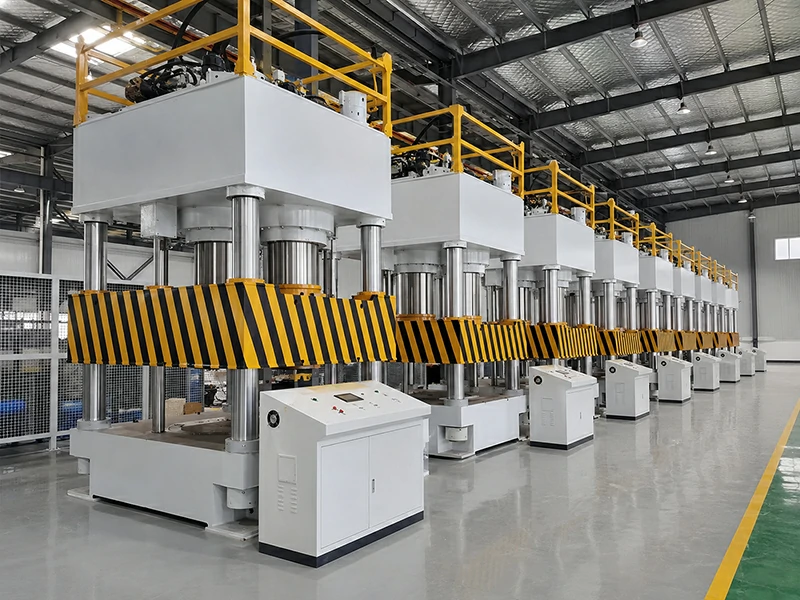
A molded pallet hydraulic press machine is sized from the output side backwards. The Y32 three-beam four-column platform carries top beam, slide and worktable on solid columns, and comes in four tonnage tiers, Y-1250, Y-1600, Y-2000 and Y-2500, with platens up to 2500 x 1700 mm and single or double station layout, so the tier follows the pallet footprint and the load grade the buyer asked for rather than the other way round. A 1200 x 800 euro mold in double station runs a different arithmetic from a 1219 x 1016 export pallet in single station, and the double station route is how one press head carries close to two units per cycle without a second machine room. Upstream of the press, the same scope covers crushing to about 5 mm, drying to 8 to 12 percent moisture, MDI glue mixing and hot press molding, which is where the real capacity ceiling usually sits. The reason this can be quantified instead of estimated is that EMP builds the equipment and also runs its own molded pallet production, so the selection is derived from measured pallets per shift, fiber and adhesive consumption and energy on a comparable line running at load, and the arithmetic on your own fiber, moisture and mold can be recomputed line by line in front of you.
Installing line two beside the validated line, and what the plant holds at the end
The delivery is a line, not a press in a crate: infeed, hot press, demolding and the handling between them, laid out in parallel with the automatic line already validated, so the existing process, its recipe and its customer approvals stay untouched and the new capacity starts earning while the old line keeps shipping. That parallel route is also a scheduling argument, because a second line commissioned beside a working one is trained on real production instead of on a trial batch. The financial argument sits on the same page, stated as a market reference and not as a quotation: public price anchors for comparable Chinese-built molded pallet lines have sat near USD 67,000 to 100,000 against far higher European turnkey proposals, and the difference is what turns a once-only capacity bet into a repeatable step that can be copied for line three. The end state is a plant that quotes racking pallets, export pallets and storage pallets from one fiber stream on two or three presses, holds delivery dates when a retail panel doubles an order, and repeats a proven line instead of gambling on one. The limits belong on the same page: tonnage, platen size, mold and station count are confirmed per project on the customer's own fiber and adhesive mix, crush, dry and glue stages must exist upstream before the press can hold its cycle, and destination acceptance of a fumigation-free molded pallet stays a buyer and plant protection authority question.
- Body content follows customer scenario, old-route limits, product fit, structure and parameter evidence, then the resulting plant position
- Only MldP gallery images are referenced, with keyword-bearing alt text on both
- Tonnage tiers, platen size, hot press temperature band and upstream moisture figures match the MldP product data
- The USD 67,000 to 100,000 figure is framed as a public market reference, not a quotation