Chemical Drum and IBC Double-Stacking
The Real Load Shape of a Two-Tier 200 L Drum Stack
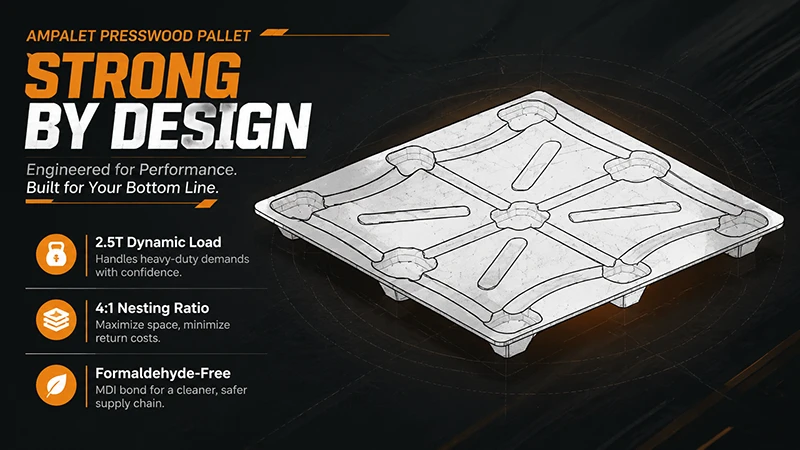
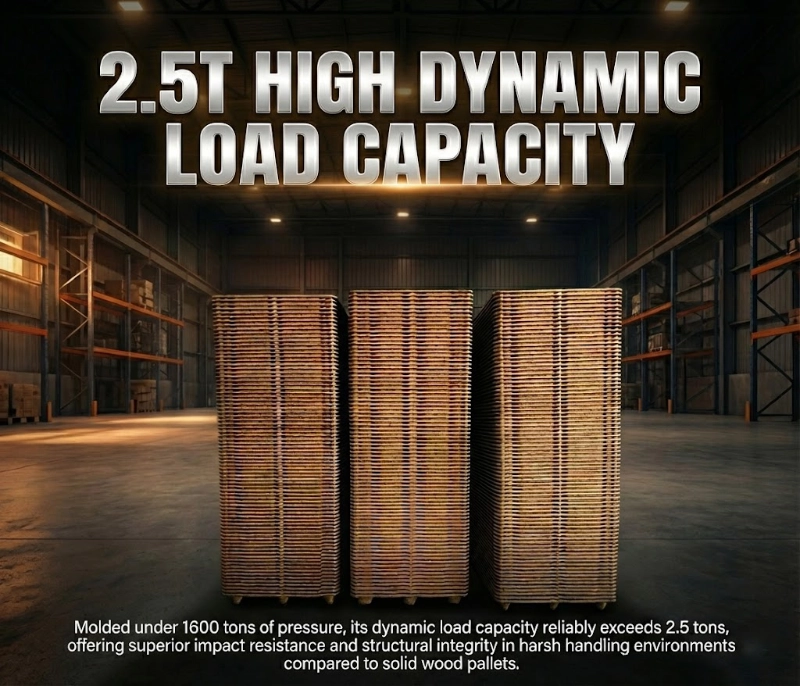
A 200 L steel drum full of chemical runs about 250 to 300 kg. Four drums to a layer, two layers on one pallet, and the deck is carrying roughly 2 to 2.4 tonnes through four narrow chime rings instead of across a continuous face. Ampallet is a pressed wood pallet molded in one piece from recovered wood fibre and an MDI binder on a 1600 ton press, deck flatness held within ±2 mm, and the 1140 x 1140 mm double-face reinforced build is specified for 200 L drum and IBC double-stacking at 2.5 tonnes dynamic and 8 tonnes static. This is the lane where a heavy duty molded pallet is chosen for a load plane rather than for a headline load number.
Why the Nailed Solid Wood Pallet Bows Where the Chime Loads Land
A nailed solid wood pallet is an assembly of top boards, bearers, blocks and nails, and each board arrives with its own crown, cup and thickness spread. Under 2 to 2.4 tonnes the span between bearers deflects, the deck plane becomes a set of slightly different heights, and a drum standing on its chime ring tilts with it. A tilted drum is a chime point load, a lifted drum edge and a wet patch under the pallet, which on a glycol or polyurethane lane is a chemical leakage prevention problem that lands in an EHS log rather than in a cosmetic complaint column. The same deck also places nail heads and lifted board edges in a lane where a person still touches the platform by hand, every re-boarded unit resets the plane instead of holding it, and heat treated solid wood adds a treatment, an IPPC mark and a phytosanitary certificate to each consignment, with the inspection wait attached at the port gate.
One-Piece Molding, a 1600 Ton Press and an MDI Binder: Why the Fit Holds
Ampallet reaches the same duty by a different route. Recovered wood fibre is blended with an MDI polyisocyanate binder, densified on a 1600 ton hydraulic press under high temperature and high pressure, and the deck, the reinforcement ribs and the support feet leave the mold as a single body at about 9 percent finished moisture. There is no board joint to open, no nail to stand proud of the surface and no separate foot to work loose under a chime ring, so a drum bottom meets a continuous pressed face instead of a row of timber. The nail-free flat surface pallet also means no splinter and no metal in the hand-contact path, and because the unit is a processed wood product it sits in the material category ISPM 15 exempts, in the same reading as plywood and particleboard. That reading is still a destination rule and a forwarder question, so it is confirmed per lane rather than assumed, and the binder choice stays a material sheet item rather than a certification claim.
Structure, Numbers and the Result on a Working Drum Deck
The chemical drum configuration is a 1140 x 1140 mm double-face presswood pallet on a cross-base structure with a 15 mm particleboard strip and a bolt assembly for the reinforced layer, about 17 kg per unit, with four-way entry, guide slots and 92 to 96 mm fork entry. Deck flatness is held within ±2 mm and corner height difference at 3 mm or less, and the specification sheet places the reinforced double-face build at 2.5 tonnes dynamic and 8 tonnes static, so a 2 to 2.4 tonne two-tier drum stack sits inside the rating with margin left for a rough set-down. On the floor the deck plane stays a plane across both tiers, drums stand on their chimes instead of leaning onto one edge, forklift handling and container loading stop generating re-stacking work, and the one-piece body needs no board replacement or nail inspection between shipments. Load is confirmed against the specification sheet for the actual drum count and stacking height, the double-face unit is a bolt-assembled build rather than a nestable single-face pallet, and the ISPM 15 position remains a destination and forwarder decision.
- Deck flatness and the load plane claim are stated as specification-sheet values within ±2 mm, not as a measured test result on the customer load.
- The 2.5 tonne dynamic and 8 tonne static figures are attributed to the reinforced double-face build on the specification sheet, and the 2 to 2.4 tonne stack is described as inside that rating with load confirmed per drum count and stacking height.
- No customer name, certification number or incident statistic is invented; the ISPM 15 exemption is presented as a processed wood material-category reading subject to destination rule and forwarder confirmation.
- Both images and their alt text come from the resolved ampallet designer image index, and publication uses post type post with category news and the ampallet canonical product.



