Solid wood pallet replacement cost
The Lane: Drum and Jumbo Bag Export Where the Pallet Fails Before It Wears Out
A chemical exporter shipping drums, jumbo bags and bagged mineral cargo through long sea legs and humid bonded warehouses does not buy a pallet, it buys the next replacement. On one published customer case record (ADSON Packaging, Dow Europe division pallet switch) the solid wood pallet pool was being replaced at roughly 22 percent a year, and the move to a presswood pallet removed about USD 420,000 of annual replacement cost. Ampallet pressed wood pallets are molded in one piece from recovered wood fibre and an MDI binder on a 1600 ton press, with no nail, no board joint and no separate foot, so the three failure routes behind that replacement rate, moisture mold, board fracture and an ISPM 15 treatment gate, are designed out instead of repaired.
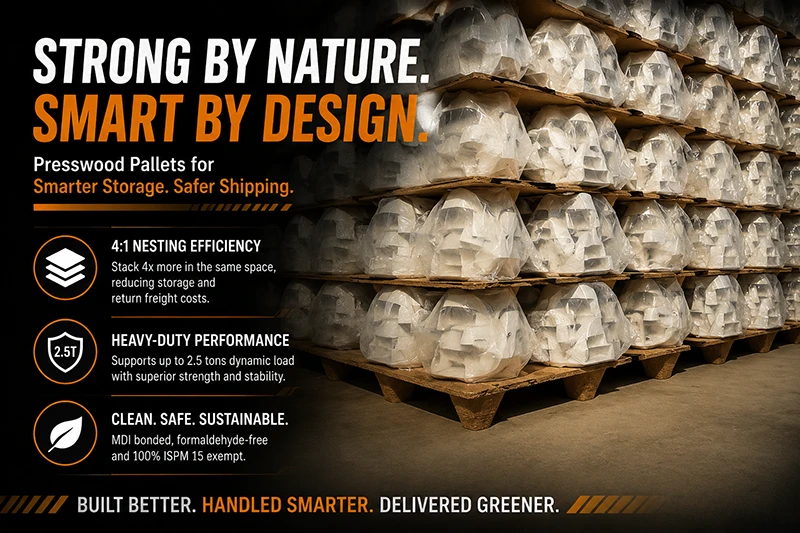
Why Sawn Solid Wood Comes Back: Mold, Fracture and the ISPM 15 Gate
A nailed solid wood pallet is an assembly of boards, bearers and fasteners, and each of those three elements fails on this lane for its own reason. Timber takes up moisture on a long sea leg and in humid warehousing, so top boards stain and mold against bagged and drummed cargo, and a unit that has been wet is refused by the next customer even when it still carries load. The deck plane is the sum of board crown, cup and thickness spread, so under a drum chime ring or a jumbo bag corner the load concentrates between bearers, the top board splits along a nail line and the pallet is drawn from service before its nominal life. Then there is the compliance gate: every solid wood pallet and crate has to be heat treated to 56 degrees Celsius core temperature for 30 minutes or fumigated with methyl bromide, marked with a compliant IPPC stamp and covered by a phytosanitary certificate, and a unit that is unmarked, mismarked or wet at inspection is a detention, a re-treatment or a return freight rather than a pallet. Every one of those events lands as cost on top of the pallet price, and because the standard answer is to re-board rather than to retire, the replacement rate stays a standing line in the budget instead of a one-off.
A Pressed Wood Pallet Replaces the Repair Loop With One Molded Body
Ampallet is a presswood pallet molded in one piece from recovered wood fibre and an MDI binder on a 1600 ton press at about 150 to 180 degrees Celsius, with finished moisture around 9 percent. The deck, the reinforcement ribs and the conical support feet come out of the mold as one body, which removes the three failure routes above at the level of construction rather than at the level of inspection: there is no fastener to withdraw and stand proud of the deck, no board joint to open and lift a splinter, and no separate foot to work loose. The MDI polyisocyanate binder is moisture curing rather than moisture sensitive and carries a CARB-NAF no added formaldehyde position, which is what keeps a wet unit from turning into a mold complaint against the cargo rather than against the pallet. On the compliance side the pallet ships in the processed wood material category that ISPM 15 itself exempts, the same category as plywood and particleboard, so the heat chamber booking, the methyl bromide route, the IPPC stamp custody and the treatment certificate come off the consignment. A one-piece unit is replaced when it is finally spent rather than re-boarded, and empty units nest about four to one, so the pallet that does come back takes a quarter of the return volume.
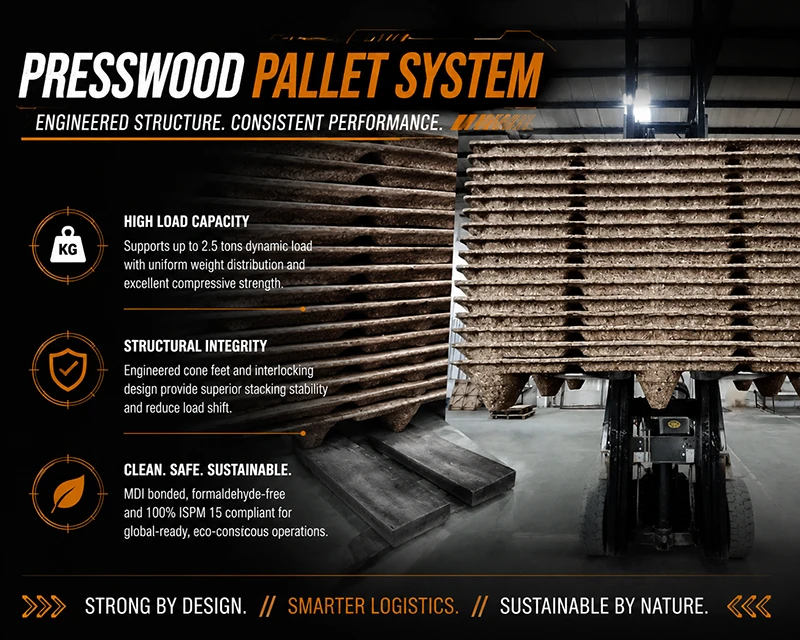
Parameters and Photo Evidence Behind the Replacement Figure
The specification sheet is what turns that argument into a purchase decision. The 1140 x 1140 x 135 mm drum unit runs about 17 kg with 2500 kg dynamic and 7000 kg static load and a 96 plus or minus 3 mm fork entry; the 1200 x 800 x 125 mm nine-leg unit runs about 14 kg with 2000 kg dynamic and 6000 kg static load; four-way entry with guide slots and deck flatness near plus or minus 2 mm hold the fork and racking interface steady, and the same tooling holds length and width so a load does not shift because the pallet underneath is 5 mm out. The image evidence matches the claim: the first photograph is the molded deck with its rib pattern running across a surface with no joint and no nail head anywhere in it, and the second is a loaded unit under shrink-wrapped bulk bags in warehouse racking with the molded support feet carrying the stack. Set against the 22 percent replacement rate, the arithmetic is not a cheaper pallet, it is a different cost profile: replacement moves from a run rate to a one-time purchase, the repair bench and the fumigation booking leave the flow, and the cost that was hidden in re-boarding, detention and resupply is no longer incurred. Limits stated plainly: the 22 percent and USD 420,000 figures come from that published customer case record and are not a forecast for another site; load, nesting ratio and flatness are confirmed against the specification for the actual drum count, bag weight and stacking height; the nestable single-face unit is not a long-term racking pallet; and a fumigation-free reading stays a destination rule, forwarder reading and plant protection authority decision.
- Body root, emp-btn-primary and the /contact/ CTA are owned by the fixed renderer; no H1 is added because the Neve post template holds it.
- All four section bodies are plain text with no HTML tags, attributes, Markdown or angle brackets.
- Both images are taken from the resolved ampallet designer gallery with the index ALT text carried into WordPress and into the body markup.
- Load, nesting, moisture and ISPM 15 statements stay inside the published Ampallet specification, and the 22 percent and USD 420,000 figures are attributed to the published customer case record rather than presented as a guarantee.



