REACH, CARB and Binder Chemistry
The Question Arrives With the Cargo, Not With the Pallet Invoice
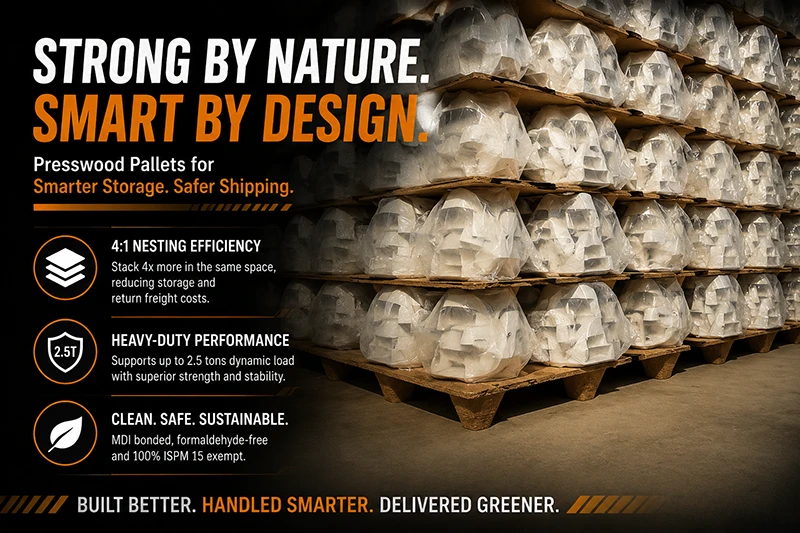
A specialty chemical, pharmaceutical or personal care shipper that answers a customer sustainability review is asked one packaging question it cannot route to the EHS team and forget: what binder is in the pallet under the drum. The cargo is high value and the failure mode is contamination, not breakage. A heat treated solid wood pallet keeps an ISPM 15 treatment, stamp and certificate custody attached to every consignment, while a low cost pressed pallet bonded with urea formaldehyde carries free formaldehyde that releases in humid heat and swells once it takes water, which is a contamination path with a REACH restriction and a CARB limit behind it. Ampallet is a formaldehyde-free presswood pallet: a molded wood pallet pressed in one piece from recovered wood fibre and an MDI binder, with a CARB-NAF no added formaldehyde position, offered with a material sheet that answers the review before it reaches the buyer's packaging spec.
Why the Old Pallet Reads as a Risk Line in That Review
Two pallets dominate the lane and both create work. The heat treated solid wood pallet keeps an ISPM 15 treatment, an IPPC stamp and a phytosanitary certificate attached to every shipment, so the buyer inherits a chamber booking, a mark to verify and a document to file, and the deck itself is an assembly of sawn boards and nails with a surface that lifts splinters and proud nail heads. The other common pressed pallet is cheaper and looks similar from a distance, but it is bonded with urea formaldehyde, and supplier literature for boards in that class quotes free formaldehyde in the tens of milligrams per 100 g together with swelling after a water soak. Under humid container heat that residual formaldehyde has a route into the headspace around the product, which is the point at which a packaging choice becomes a contamination question, a REACH restriction question and a line item in a customer audit at the same time.
MDI Changes the Chemistry, Not Just the Brochure Wording
Ampallet molded wood pallets are bonded with MDI, a polyisocyanate adhesive that is named openly on the material sheet rather than hidden behind the word glue. There is no formaldehyde in that binder chemistry, so there is no formaldehyde to off-gas into a container and no formaldehyde limit for a buyer to argue about at the pallet interface, and the company holds a CARB-NAF no added formaldehyde position under the California standard that is the strictest of its kind. The cure mechanism is the second half of the argument: an MDI binder reacts with moisture present in the fibre instead of drying off a formaldehyde resin, which is why the pallet is not moisture sensitive in the way a UF board is. The pallet is the packaging answer, not a substitute for the shipper's own REACH registration, safety data sheet and substance volume tracking, and certification is supplied per product and per plant rather than assumed across a catalogue.
Structure, Numbers and the Result on the Supplier File
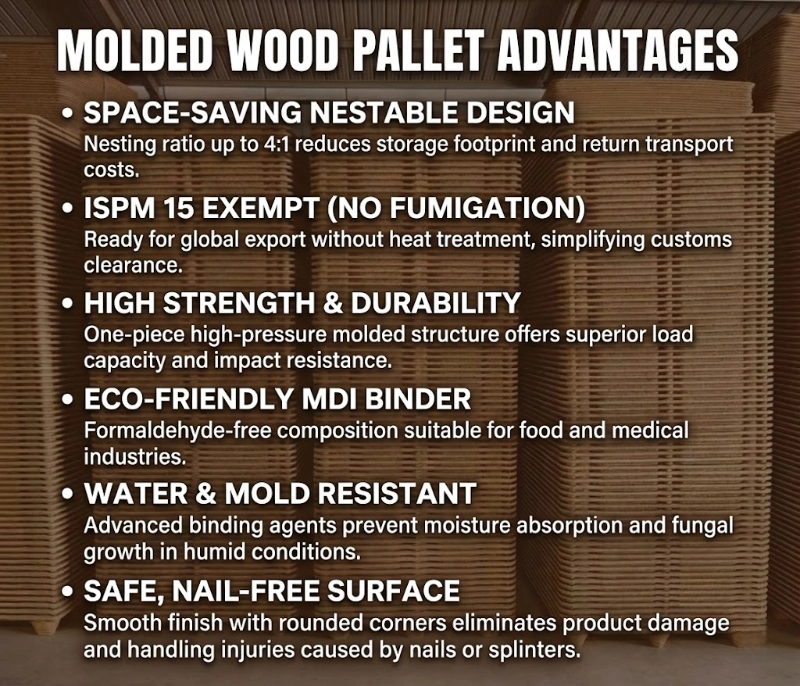
The evidence sits in the body, not only in the certificate. Deck, reinforcement ribs and support feet are molded as one body from recovered wood fibre on a 1600 ton hydraulic press at about 150 to 180 degrees Celsius, with no nail to withdraw, no board joint to split and no separate foot to work loose, and deck flatness is held near plus or minus 2 mm. The 1140 x 1140 x 135 mm drum unit runs about 17 kg with 2500 kg dynamic and 7000 kg static load and 96 plus or minus 3 mm fork entry, the 1200 x 800 x 125 mm nine leg unit about 14 kg with 2000 kg dynamic and 6000 kg static load, four way entry, guide slots and roughly 4 to 1 nesting, and the 800 x 600 x 125 mm six leg unit about 6 kg with 1000 kg dynamic and 3500 kg static load. The photographs on this page show the molded rib pattern on the deck face and the nested stack behind it. The result is a pallet that clears a REACH and CARB reading with a document instead of a debate, keeps a treated wood certificate out of the file, ships inside the ISPM 15 processed wood category, and returns as a quarter height stack. Limits are stated plainly: the nestable single face unit is not a long term racking pallet, load and nesting are confirmed against the specification sheet for the actual cargo, and a fumigation free reading remains a destination rule and forwarder question.
- Binder chemistry is stated as MDI polyisocyanate with no formaldehyde in the binder, and a CARB-NAF no added formaldehyde position is claimed with certification supplied per product and per plant
- The competing urea formaldehyde pressed pallet is described with hedged supplier literature figures and a water soak swelling behaviour, not with a measured accusation against a named competitor
- Specification values used are the drum, nine leg and six leg model references with their dynamic and static loads, fork entry, four way entry, guide slots and about 4 to 1 nesting
- Limits are stated plainly: the pallet does not replace the shipper's own REACH registration and safety data sheet duties, the nestable single face unit is not a racking pallet, and a fumigation free reading stays a destination and forwarder question