Nail-Free Deck for FIBC and Coated Drum Handling
The Bag Base and the Drum Chime Carry the Whole Load
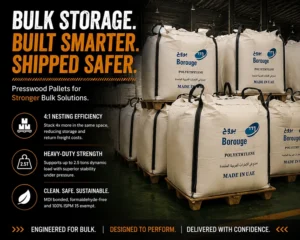
A chemical, mineral or food ingredient site that loads FIBC jumbo bags and coated steel drums by forklift keeps the pallet in direct contact with the product: the bag base is woven polypropylene carrying 1 to 2 tonnes of fill, and the drum base is a painted or lacquered chime ring that gets dragged across the deck at every pick and place. On a nailed solid wood pallet those two contact points sit on an assembly of sawn boards and steel fasteners, so a proud nail head or a lifted splinter becomes a puncture path into the bag weave, a scratch path into the drum coating and a hand injury path for the operator who guides the load. Ampallet is a presswood pallet molded in one piece from wood fibre and an MDI binder, with no nail, no screw and no separate foot anywhere on the deck, so three separate losses close on one change.
Why a Sawn Board Deck Keeps Producing Nails and Splinters
A nailed wood pallet is a two-material assembly: sawn boards, and the steel that holds them together. Nails are driven and countersunk at the bench, but the boards around each head dry, shrink and move under cyclic load, so a head that sat flush on the first day can stand proud by the third handling. Every re-boarding pass adds a fresh population of nail heads and a fresh sawn edge. Splinters come from those edges and from board ends that a fork tine has lifted, and they are sharp enough to open a woven bag or a glove. Nail pops prevention is therefore not a maintenance habit but a design question: as long as the deck is an assembly, there is a fastener at the contact face and no route to no puncture to packaging. The same mechanism puts cut-resistant gloves on the line item list, because the PPE is compensating for the platform under the load rather than for the load itself.
One Molded Body Removes the Fastener and the Sawn Edge
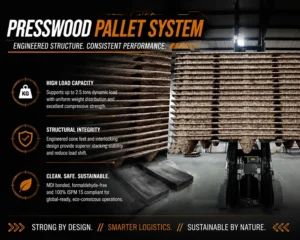
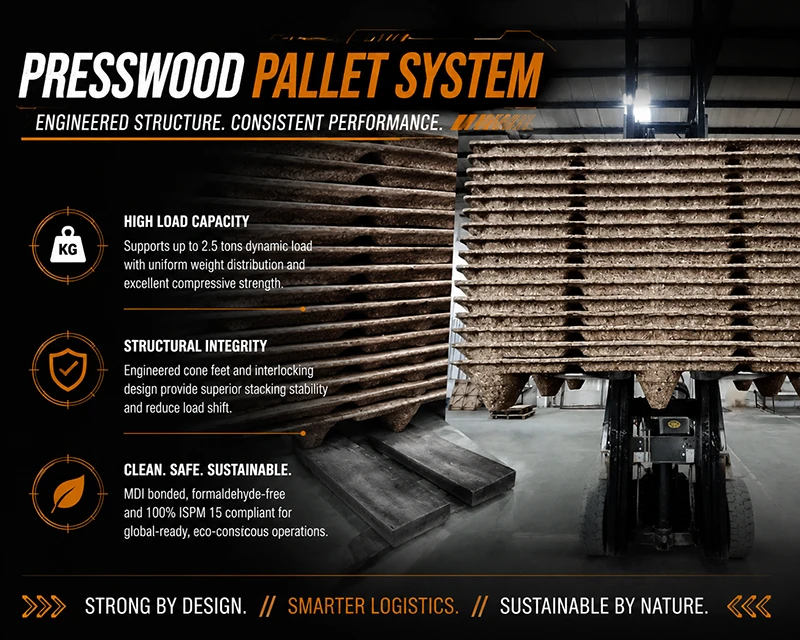
Ampallet compressed wood pallets are not an assembly. Wood chips and plant fibre are steam dried through a cycle from about 148 down to 138 degrees Celsius, blended with an MDI polyisocyanate binder, and pressed at about 220 degrees Celsius and 1400 psi, so deck, reinforcing ribs and support feet leave the mold as a single body. Internal temperature passes 105 degrees Celsius and stays above 56 degrees Celsius for 30 minutes or more, and finished moisture sits at 9 percent or below, which is the same process chain that keeps the fiber pallet stable in humid sea freight. There is no nail to work proud, no board joint to open and no sawn board end to lift. Corners are molded round at R25 on the 800 x 600 unit and R35 on the larger decks, edges leave the mold with a chamfer, and the deck plane is held near plus or minus 2 mm, so a bag base or a drum chime meets a smooth pressed face instead of a fastener head or a splintered edge.

The Numbers a Buyer Can Check, and the Loss That Stops
Specify against model references rather than a single headline figure. R1414 is 1140 x 1140 x 135 mm, nine legs, about 17 kg, 2500 kg dynamic and 7000 kg static load, 96 mm fork entry. R1208 is 1200 x 800 x 125 mm, nine legs, 13 to 14 kg, 2000 kg dynamic and 6000 kg static, 92 mm fork entry. R0806 is 800 x 600 x 125 mm, six legs, about 6 kg, 1000 kg dynamic and 3500 kg static. All three are four-way entry with guide slots, corner height difference held to 3 mm or less, and nesting near 4 to 1 for high density storage of empty units between shipments. The end result on the dock is narrow and can be checked by hand: no nail head and no splinter at the contact face, so bag weave is not abraded by the deck, drum coating is not scraped to bare steel, there is no nail cleanup before a load goes out, and the operator is not reaching past a fastener to guide a tonne of cargo. Limits are stated plainly: a one-piece body is replaced rather than re-boarded after structural damage, the nestable single-face unit is not a long-term racking pallet, load figures follow the confirmed specification for the actual bag or drum count, and a fumigation-free reading under the processed wood category stays a destination rule and forwarder question.
- one-piece nail-free molded deck replaces the nailed board assembly
- section bodies are plain text with no tags or angle brackets
- model load and dimension figures come from the product brief per model
- limits stated: replace rather than re-board, no racking load, destination rule