Automated warehouse and AGV interface
An unmanned cell reads the pallet as a measurement, not as a platform
A chemical or material supplier that runs its internal moves on AGVs, an automated store and a palletizing robot eventually finds that the pallet is the only part of the cell still arriving with millimetres of variation: a nailed heat treated wood pallet can spread 10 to 15 mm in length between units of a single delivery, so a fork misses the pocket, a photo-eye sees a deck edge that is not there and the line faults into a manual re-stack. Ampallet is a molded wood pallet pressed in one piece in a steel mold, with height held to about plus or minus 2 mm, four-way entry with guide slots and no nail to lift, which turns dimensional consistency into something a batch carries rather than something a buyer hopes for. This page follows one automated lane from the fault log back to the mold.
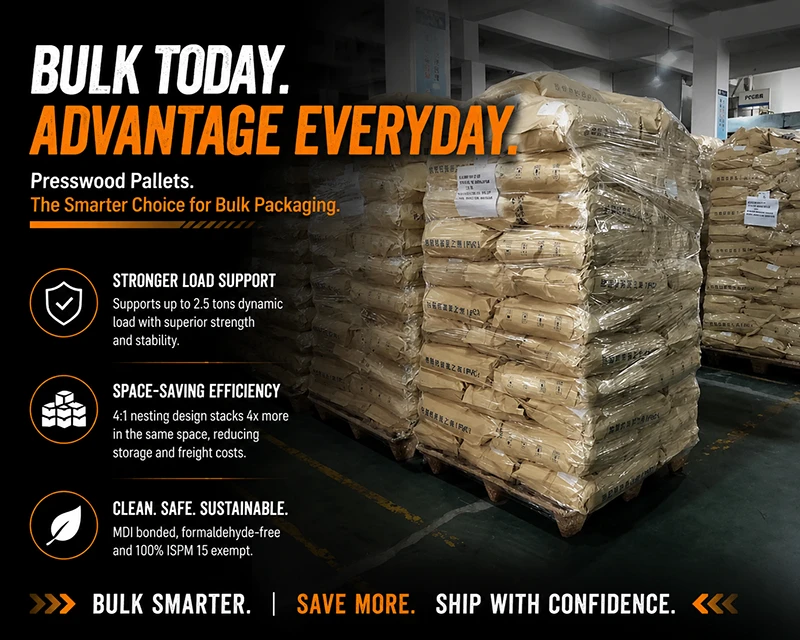
Where a nailed wood pallet loses the takt: board spread, nail lines and a deck that moves between units
A nailed solid wood pallet is an assembly, so its outside dimensions are the sum of board length spread, board crown and cup, bearer straightness, nail set and moisture movement. Sawn boards come from different logs and different mills inside the same delivery, they dry at different rates, and no two units are pressed against the same steel. A pallet built this way can move 10 to 15 mm in length between units of one order and still pass a visual check, which is exactly the spread an automated infeed cannot absorb. Add the mechanical failure path: boards split along the nail line under a concentrated drum load, a lifted board or a proud nail head catches a roller, a chipped corner changes the geometry the pin stop sees, and a pallet that passed goods-out inspection becomes a jam at the cell. Repair makes it worse, because a re-boarded pallet is a new geometry carrying the old corner.
One mold, one body: how a presswood pallet holds dimensional consistency
Ampallet is a molded wood pallet pressed in one piece from recovered wood fibre and an MDI polyisocyanate binder on a 1600 ton hydraulic press at about 150 to 180 degrees Celsius to about 9 percent finished moisture. Deck, reinforcing ribs and nine conical support feet come out of one steel mold, so outside length, fork pocket position and deck plane are set by the tool rather than by the board. The specification sheet holds height at plus or minus 2 mm, corner height difference at 3 mm or less, round corners at R25 or R35 within 2 mm, and fork entry at 92 plus or minus 3 mm on the 1200 x 800 unit and 96 plus or minus 3 mm on the 1140 x 1140 drum unit, inside the 90 to 95 mm band most conveyor and AGV forks are set for. Four-way entry and molded guide slots let the forks square to the pocket instead of hunting for it.
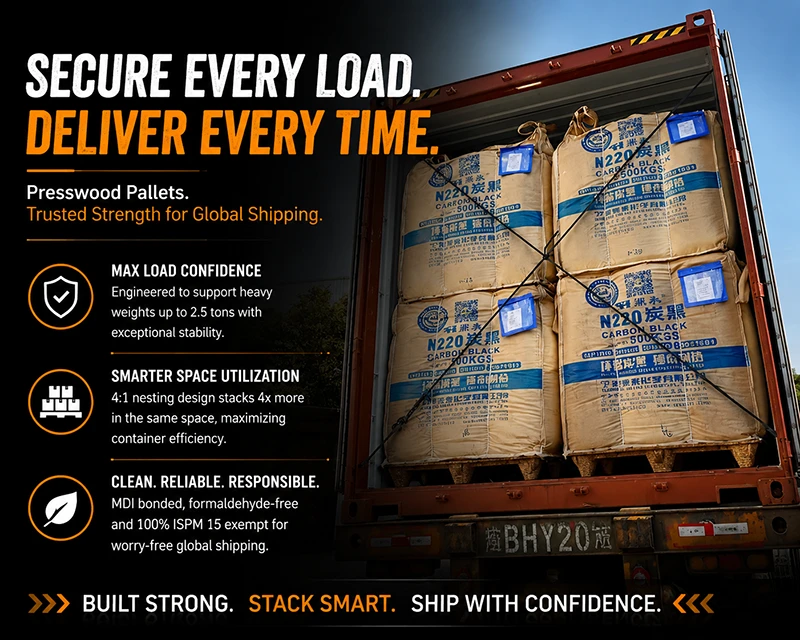
What the lane gets back, and the limits stated plainly
Design references for this lane: the 1200 x 800 x 125 mm nine-leg unit at about 13 to 14 kg with 2000 kg dynamic and 6000 kg static load; the 1140 x 1140 x 135 mm nine-leg drum unit at about 17 kg with 2500 kg dynamic and 7000 kg static load; the 800 x 600 x 125 mm six-leg unit at about 6 kg with 1000 kg dynamic and 3500 kg static load. There is no nail to withdraw, no separate foot to work loose and no board joint to open, so the geometry the cell reads on day one is the geometry it reads four hundred days later, with no nail cleanup and no re-boarding bench between loads. What that buys is a stable takt: fewer sensor faults, fewer manual re-stacks and an unmanned workshop that stays unmanned across a night shift. Being processed wood, the pallet also keeps a fumigation free reading available, subject to destination rule and forwarder confirmation. Limits are stated plainly: plus or minus 2 mm is a tooling and inspection position on the confirmed footprint, not a promise for every custom mold, the AGV fork, roller, pin stop and sensor interface are confirmed per lane with the integrator, the nestable single face unit is not a long term racking pallet, and load is confirmed per specification.
- One-piece molded body: no nail, no separate foot, no board joint to open under a concentrated drum load
- Height held to plus or minus 2 mm, corner height difference at 3 mm or less, round corners at R25 or R35 within 2 mm
- Four-way entry with molded guide slots and 92 to 96 mm fork entry on the two main footprints
- Model references: 1200 x 800 nine-leg at 2000 kg dynamic and the 1140 x 1140 drum unit at 2500 kg dynamic and 7000 kg static



