Bulk chemical storage
Where a Bulk Chemical Store Actually Spends Its Floor
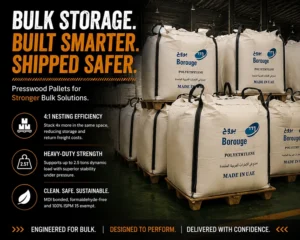
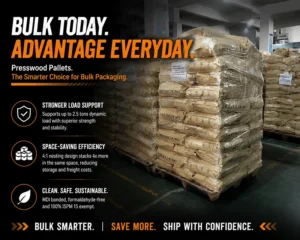
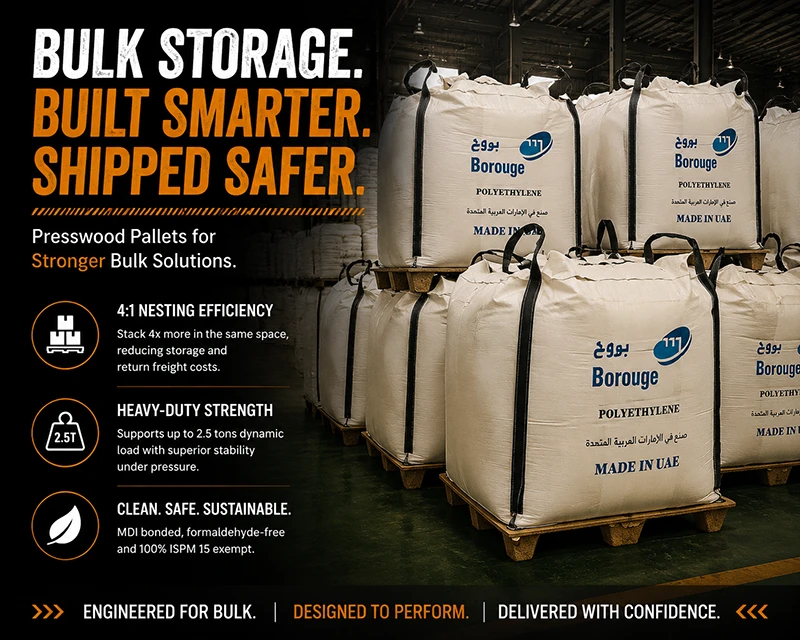
A bulk chemical raw material store does not run out of floor because of the load, it runs out of floor because of the empty pool. Bagged mineral filler, resin sacks, drummed intermediates and one-way export lots all pull pallets through the same bay, and a rigid solid wood or heavy duty plastic pallet takes the full deck footprint whether it is carrying two tonnes or nothing at all. Ampallet is a nestable presswood pallet molded in one piece from recovered wood fibre and an MDI binder, and its inverted cone feet settle into the deck recesses of the unit below at about a 4 to 1 nesting ratio, so the same pallet count that used to hold a bay holds roughly a quarter of it. This page follows that arithmetic through a bulk material warehouse: the scene, the rigid pallet problem, the molded geometry that fixes it, the model and load references behind the claim, and the limits a site still has to confirm.
Why Rigid Solid Wood and Heavy Duty Plastic Never Gave the Floor Back
The pallets a bulk chemical store already owns were designed to carry, not to wait. A nailed solid wood GMA or Euro pallet is a deck on fixed blocks, and a heavy duty plastic pallet is a molded body on fixed feet: loaded or empty, each unit claims the same footprint, so a thousand empty units claim the same thousand footprints as a thousand loaded ones. Stacking does not recover it. The fixed feet land on the deck below and the stack grows at the pallet height instead of settling into it, so an empty stack of the same count runs to roughly 2.7 metres where a nesting build runs near 0.75 metres, and the difference is bays of covered floor that cannot be used for raw material. Plastic makes the same point with a price tag: a heavy duty unit at 40 to 120 US dollars a unit is bought for durability and still takes full floor when empty, which is a strange asset to park in front of finished goods. Heat treated wood adds its own custody cost on top, because every consignment carries a treatment certificate and an IPPC mark that has to be managed by someone. None of these pallets is wrong for the load; they are wrong for the hours between loads.
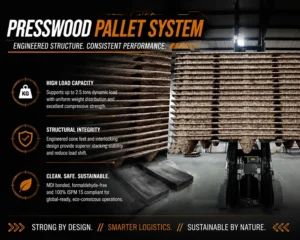
What Makes an Ampallet Presswood Pallet Nest: Cone Feet Into a Molded Deck Recess
The nesting is geometry, not a folding accessory. Ampallet is a molded wood pallet pressed in one piece from recovered wood fibre and an MDI binder on a 1600 ton press at about 150 to 180 degrees Celsius, with deck, reinforcing ribs and support feet coming out of one steel mold at roughly 9 percent finished moisture. Because the feet are molded, they can be given an inverted cone profile and the deck can be given a matching recess, so an empty unit settles into the one below instead of standing on it, and the stack closes at about a 4 to 1 nesting ratio. The same one-piece body removes the other reasons an empty stack is slow to handle: there is no nail head, no separate foot and no board joint to catch when a stack is lifted, and the molded guide slots plus four-way entry let a forklift square to the stack from either side. Design references for the bulk material lanes are the 1200 x 800 x 125 mm nine-leg unit at about 13 to 14 kg with 2000 kg dynamic and 6000 kg static load, the 1140 x 1140 x 135 mm chemical drum unit at about 17 kg with 2500 kg dynamic and 7000 kg static load and a 92 to 96 mm fork entry, and the 800 x 600 x 125 mm six-leg unit at about 6 kg with 1000 kg dynamic and 3500 kg static load. With the deck held near plus or minus 2 mm, a nested stack is a straight column rather than a leaning one, which is what makes it safe to place in a bay next to loaded goods.
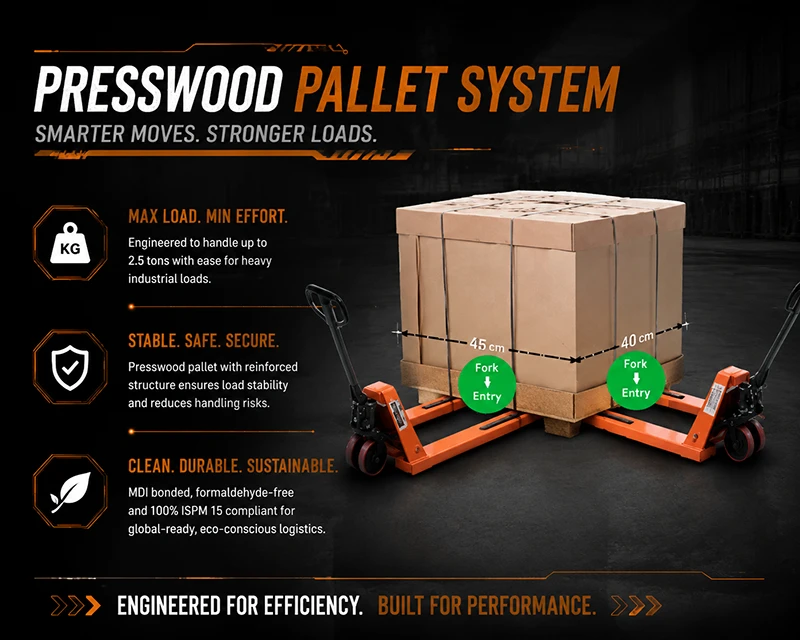
The Result on the Floor, and the Numbers a Site Still Has to Confirm
The arithmetic the store is buying is simple: the same pallet count occupies about a quarter of the floor it used to, because four units now stand roughly where one stood. Published positioning places empty pallet stacking saving near 70 percent, with storage capacity at about 2.5 times on the same floor, and the operational effect is that the buffer stops competing with raw material and finished goods for the covered bay, pallet staging moves off the picking aisle, and one forklift cycle carries four times the empty units back to the filling line. The cost of the moulded pallet itself stays on the working asset rather than on a parked one, which is the difference between a pool that grows with throughput and a pool that grows with storage. Four limits belong in the file. Floor saving and nesting ratio are recalculated per site and per mold rather than assumed from the 4 to 1 reference. The nestable single-face unit is not a long-term racking pallet, so anything stored in a rack needs the double-face or reinforced build. Load is confirmed against the specification sheet for the actual bag, drum or IBC weight and stacking height. And a fumigation-free reading stays a destination rule and forwarder question, not a property this page can decide for a given lane.
- All figures, model sizes and load references used here come from the resolved ampallet product files and the storage positioning already published on this site; no new certification, EPD or carbon claim is introduced.
- Floor saving, nesting ratio and load are stated as per site and per mold values, and the nestable single-face unit is explicitly excluded from long-term racking duty.
- Section bodies are plain text only with no tags, attributes or angle brackets; the fixed renderer owns the section, paragraph, image and contact CTA markup.
- Two images were imported once through wp_media_batch from the ampallet designer gallery with the indexed ALT text, and no third image or external URL is used.