Making the strategic decision to bring pallet production in-house is a significant step forward for any business. The financial and operational benefits are clear. Yet, for many business owners and plant managers in regions like the American Midwest, the biggest hesitation isn’t about the numbers—it’s about the practical realities of implementation.
You may be thinking, “This is a great strategy, but we are not machine experts. I’ve never run a production line like this before. Will the installation be a nightmare? Is the machine too complicated for my team to operate? What happens if something goes wrong?”
These are valid, intelligent questions. The transition to becoming a producer involves new processes, and it’s natural to have concerns about the unknown. In this article, we will address these concerns head-on with ten candid answers to the most common questions we receive from first-time owners.
1. Do I need to build a special, reinforced foundation for such a heavy machine?
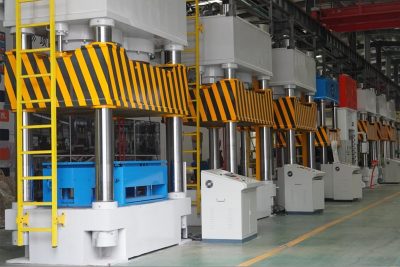
This is one of the most common fears, as it involves significant construction costs. The answer, for most installations, is no. The machine is engineered so that the immense pressing force is self-contained within its structure. The floor only needs to support the static weight of the machine itself (approximately 37 tons). A standard 6-inch thick concrete floor, common in many industrial facilities, is sufficient.
2. How difficult is the installation process?
We have simplified the process as much as possible. Each compressed wood pallet machine is fully adjusted and tested in our facility before it is shipped. It is then partially disassembled for transport. When it arrives, the core systems are already aligned. Installation primarily consists of re-assembly, positioning, leveling, and connecting the electrical supply.
3. Is the machine difficult for an inexperienced team to operate?
The machine is designed for simplicity. The control panel features centralized buttons with straightforward modes like “Adjustment” and “Semi-Automatic.” This turns the daily production process into a repeatable, easy-to-learn sequence that a properly trained operator can master quickly.
4. What does routine maintenance actually involve?
You do not need a dedicated hydraulics specialist. The maintenance is designed to be preventative and straightforward. A typical routine includes daily cleanup, weekly lubrication checks, and periodic replacement of common wearing parts like hydraulic seals.
| Frequency | Maintenance Task | Purpose |
|---|---|---|
| Daily | Cleanup of debris & system check | Prevents blockages and ensures safe startup. |
| Weekly | Check lubrication levels | Ensures smooth operation of hydraulic and transmission parts. |
| Periodically | Replace wearing parts (e.g., seals) | Maintains efficiency and prevents downtime. |
5. What kind of after-sales support do you offer?
Your investment is protected by our commitment to partnership. We offer a 24-hour timely response by email and phone. Should any parts fail due to non-human factors within the first 12 months, they are replaced free of charge. Beyond that, we provide paid maintenance services for the life of the machine.
6. Can a single machine produce different sizes of pallets?
Yes, absolutely. The machine is a flexible asset. By simply using different molds, a single compressed wood pallet machine can produce a wide variety of pallet sizes and designs. A larger machine is also downward-compatible, meaning it can produce any size smaller than its maximum capacity.
7. Can we customize the pallets with our company logo?
Yes, this is a popular request. We can design the mold to include your company’s logo, turning every pallet you ship into a branding opportunity.
8. Can the entire production line be fully automated?
Yes. While a standalone press is highly efficient, we can design and implement a fully automated production line, from raw material chipping and drying to automated pallet retrieval and stacking.
9. How long can we expect the machine to run without issues?
A properly installed and maintained production line is designed for stable, continuous operation. Adherence to the simple maintenance schedule can prevent most common issues over a long service life.
10. Are you a direct manufacturer or a trading company?
This is a crucial question. We are a professional manufacturer with over a decade of history. When you work with us, you are dealing directly with the engineers who design, build, and support your machine.
We hope these answers provide clarity and build your confidence. Transitioning to in-house production is a significant, but achievable, step. Our goal is to ensure that you feel fully supported, making your investment not just a smart financial decision, but a stress-free operational one as well.