For managers in the export and logistics sectors, the inefficiency of traditional pallet production is a constant challenge. Relying on manual labor is not only slow and costly but also creates a bottleneck in a competitive market that demands speed and cost-effectiveness. How can your company break through this efficiency barrier?
The answer lies in technological innovation. By investing in a modern compressed wood pallet machine, you can automate production, slash labor costs, and significantly boost output. Let’s dive into the specific technologies that make this possible, supported by real-world case studies.
The “Efficiency Bottleneck” of Traditional Methods
1. Low Production Output
Manual pallet production is inherently slow. A medium-sized operation might only produce 500 pallets a day, which is often insufficient for large-scale export demands, leading to delays and missed opportunities.
2. High Labor Costs
Traditional methods are labor-intensive. If the labor cost per pallet is around $1.40, producing 100,000 pallets annually amounts to a staggering $140,000 in labor costs alone. This significantly eats into your profit margins.
The Technological Revolution of Modern Pallet Machines
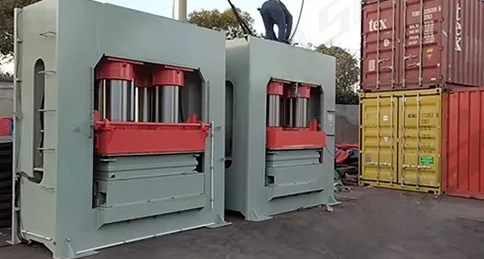
A compressed wood pallet machine leverages several key technological advancements to deliver superior performance and efficiency.
| Technological Feature | Key Benefit | Impact on Your Business |
| Servo Control System | Automatically adjusts operating speed to match production needs. | Reduces energy consumption by 25%-55% and improves production responsiveness, lowering operational costs. |
| Cartridge Valve Integrated System | Minimizes hydraulic shock and extends the system’s lifespan. | Offers a service life 2-3 times longer than traditional systems, ensuring stable operation and reducing maintenance costs. |
| Independent Electrical Control | Features centralized controls and a design that simplifies maintenance. | Allows for quick fault location and easy operation with both adjustment and semi-automatic modes, minimizing downtime. |
| Dual Molding Processes | Supports both fixed-stroke and fixed-pressure molding with pressure-holding functions. | Ensures consistent product quality and strength, allowing you to meet diverse customer requirements with precision. |
Real Case Studies: Efficiency Through Technology
Case 1: Furniture Exporter Quadruples Production
A furniture exporter in Ohio needed to produce 2,000 pallets daily, a goal unattainable with their old methods. After upgrading to a new molding machine, they quadrupled their output, effortlessly meeting their export targets.
Customer Feedback: “Since automating, our production efficiency has skyrocketed, allowing us to meet all our export demands without a problem.”
Case 2: Electronics Manufacturer Cuts Labor Costs by 80%
An electronics manufacturer in California was spending over $140,000 annually on labor for pallet production. By investing in an automated molding machine, they slashed that cost to just $28,000, saving over $112,000 a year.
Customer Feedback: “Automation has dramatically cut our labor costs and significantly boosted our company’s profitability.”
Case 3: Logistics Firm Achieves High Equipment Stability
A major logistics firm in Texas invested in a molding machine to enhance production efficiency. The machine’s stability and low failure rate have ensured continuous, reliable operation.
Customer Feedback: “The equipment’s stability is outstanding. Our production efficiency is guaranteed, allowing us to execute our plans smoothly.”
How to Begin Your Technological Innovation Journey
If production efficiency is a pain point for your business, it’s time to embrace a more advanced, economical solution. Investing in a press with modern technology automates your process, leading to significant gains in efficiency and reductions in labor costs.
This is the solution you’ve been looking for. Are you ready to take the next step?