An international client planned to establish a new factory in Iran to produce molded pallets. Their vision was ambitious and sustainable: to transform a wide array of locally available wood and plant-based waste into durable, high-demand industrial pallets. This case study outlines the journey from initial requirements to a fully-engineered, scalable production line designed for efficiency and quality.
The Challenge: A Diverse Mix of Inputs and Ambitious Goals
The project’s success depended on designing a system that could handle unique operational challenges and meet specific output targets. Our team began with a thorough analysis of the client’s needs and on-site conditions.
| Core Project Requirement | Specification |
|---|---|
| Versatile Raw Materials | Tree branches, wood chips, sawdust, furniture scrap, bamboo, sugarcane bagasse, and other fibrous materials. |
| Specific Adhesive | Urea-formaldehyde glue, influencing drying and pressing stages. |
| High-Capacity Production | Initial goal of 1,000 pallets/day, scalable to 4,000 pallets/day. |
| Defined Product Specifications | Two sizes (1100x1000mm, 1300x1000mm) with 1-1.5 ton dynamic and 4-6 ton static load capacity. |
| Site & Energy Constraints | 360 m² factory floor, 380V power, and natural gas for drying. |
The Engineered Solution: Key Equipment Breakdown
Our technical proposal detailed a complete line of necessary equipment, engineered to work seamlessly from raw material input to finished product output with a state-of-the-art compressed wood pallet machine.
- Step 1: Raw Material Preparation (Crushing & Grinding): A comprehensive crusher for initial breakdown and a grinder for finer pulverization to ensure optimal fiber size.
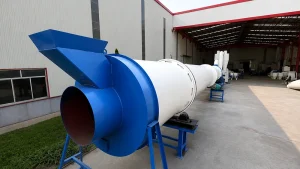
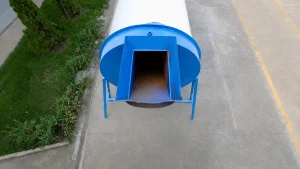
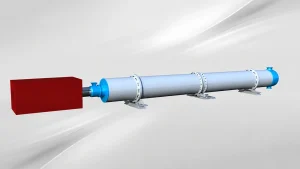
- Step 2: Drying: An industrial rotary dryer to reduce moisture content to below 8%, critical for quality control when using urea-formaldehyde resin.
- Step 3: Glue Mixing: An automatic glue mixer for precise, even distribution of the adhesive onto the wood fibers.
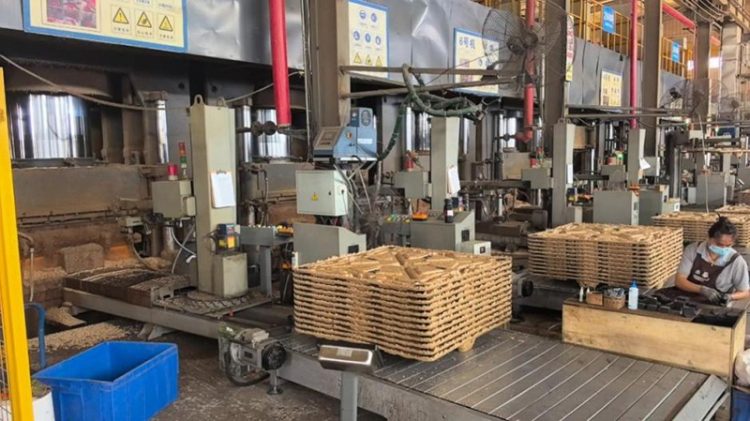
- Step 4: Molding (The Core of the Operation): A hydraulic press and mold temperature machine to ensure rapid, consistent pressing and curing of the pallets.
The Automation Strategy: A Critical Decision
A key decision was the level of automation. Based on our expertise, we recommended a fully-automatic production line. This solution utilizes single-station hydraulic presses, each paired with an independent robotic arm for loading and unloading. This “decoupled” automation is highly reliable; if one compressed wood pallet machine requires maintenance, the rest of the line can continue to operate, preventing a total production shutdown. It ensures a consistent production rhythm and reduces manual labor intensity.
Our Commitment: Global Standards and Long-Term Support
Building world-class industrial facilities requires a foundation of trust, quality, and reliable support.
- Adherence to International Standards: All machinery and electrical components are designed and manufactured to meet rigorous international technical and safety standards.
- Comprehensive After-Sales Service: Our commitment extends far beyond delivery, including on-site installation and training, a one-year warranty, and lifetime technical support.
By combining a deep understanding of the client’s unique raw materials and production goals with expert knowledge of process engineering, we delivered a robust, scalable, and high-quality solution. This molded pallet production line is now poised to turn regional waste materials into valuable assets, ready to meet market demand today and scale for the future.