You have analyzed the risks, calculated the hidden costs, and identified a clear path to a more efficient and resilient supply chain. You know that transitioning from traditional wood pallets to a modern engineered system is the right decision. Now, you must secure buy-in from your executive team.
To do this, you need more than an idea; you need an undeniable business case. You need to speak the language of the C-suite: data-driven analysis, risk mitigation, and clear, quantifiable Return on Investment (ROI).
The following document is a professional template designed to help you build that case. It provides the structure, the data-backed arguments, and the professional tone required to turn your operational insights into a strategic, approved initiative. Copy this template, fill in the bracketed sections with your company’s specific data, and adapt it to make your case.
INTERNAL MEMORANDUM
TO: [C-Suite Decision Maker: e.g., Chief Financial Officer, Chief Operating Officer]
FROM: [Your Name, Your Title e.g., Director of Logistics, Head of Operations]
DATE: [Current Date]
SUBJECT: Strategic Recommendation for Supply Chain Optimization: Transitioning to an Engineered Pallet System
1. Executive Summary
This memorandum outlines a strategic proposal to transition our company from its current reliance on traditional solid wood pallets to a modern, engineered press wood pallet system. This initiative is projected to generate significant, quantifiable annual savings of [Enter Your Final ROI Number] by reducing direct costs, eliminating operational inefficiencies, and mitigating critical supply chain risks.
This is not a simple procurement change. It is a strategic investment in operational resilience, cost certainty, and our long-term competitive positioning, particularly in light of upcoming international regulations such as the EU’s Carbon Border Adjustment Mechanism (CBAM).
2. The Problem Statement: The Hidden Costs and Risks of the Status Quo
Our current use of solid wood pallets, while conventional, exposes our business to a range of unnecessary costs and unacceptable risks that are often buried in operational budgets. These include:
- Mandatory Compliance Costs & Risks: All wood pallets for export require costly and time-consuming heat treatment or fumigation to comply with ISPM15 standards. This process introduces a significant risk of documentation errors and customs holds, which can lead to catastrophic delays and financial penalties.
- Gross Logistical Inefficiencies: The non-nesting design of wood pallets leads to poor space utilization. This directly inflates our inbound freight and warehousing costs.
- Safety & Damage Concerns: Protruding nails and splinters present a persistent safety hazard to our personnel and are a frequent cause of damage to finished goods packaging.
3. The Proposed Solution: An Engineered, High-Performance Pallet System
The proposed solution is to adopt a logistics platform built on an engineered press wood pallet. These units are specifically designed to address the weaknesses of our current system through superior technology and design.
Key advantages include:
- Total Export Compliance by Design: These pallets are manufactured under intense heat and pressure, making them inherently sterile. They are 100% exempt from ISPM15 fumigation and inspection requirements, completely eliminating this risk variable from our supply chain.
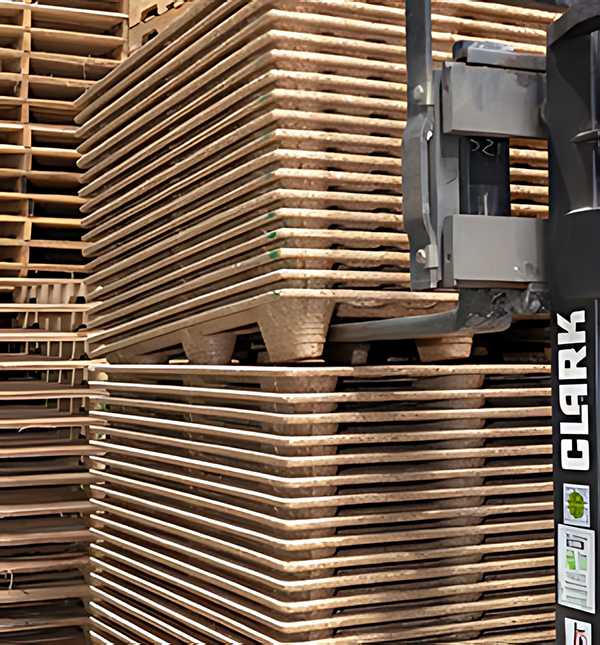
- Radical Efficiency Gains: A nestable design allows up to 1650 units to fit in a single 40-foot container, compared to just 450 wood pallets. This 3.6x increase in density drastically cuts inbound freight costs and frees up valuable warehouse space, as a stack of 65 pallets is less than 2.4 meters high.
- Superior Strength & Safety: Engineered for consistent high load capacities (Dynamic: ≥2.5 tons, Static: 7-10 tons), these pallets outperform wood. They are manufactured as a single, nail-free piece, eliminating the risk of product damage and employee injury.
- Future-Proofed for Sustainability: Manufactured from over 98% recycled wood fibers, these pallets possess a certified low-carbon footprint. This provides a significant and quantifiable cost advantage under the EU’s CBAM, effectively acting as a hedge against future carbon taxes.
4. Financial Analysis: Return on Investment (ROI)
The financial case is compelling. By shifting our focus from a simple unit price to a Total Cost of Ownership (TCO) model, the savings become clear. The following table contrasts our current system with the proposed system.
| Cost Category (Annual) | Current System (Wood Pallets) | Proposed System (Molded Pallets) | Projected Annual Savings |
|---|---|---|---|
| Direct Costs | |||
| Procurement Cost | [Enter Your Calculation] | [Enter Your Calculation, noting 30-50% savings] | [Enter Savings] |
| Compliance Cost (Fumigation) | [Enter Your Calculation] | $0 | [Enter Savings] |
| Operational Costs | |||
| Inbound Freight | [Enter Your Calculation] | [Enter Your Calculation] | [Enter Savings] |
| Strategic Costs (Avoidance) | |||
| Risk of Customs Holds | [Enter Your Annualized Risk Cost] | $0 | [Enter Savings] |
| Future Carbon Tax Liability (EU) | [Enter Your Projected Carbon Cost] | $0 | [Enter Savings] |
| TOTAL PROJECTED SAVINGS | [Enter Your Final ROI Number] | ||
5. Recommendation and Next Steps
The data indicates that a transition to an engineered pallet system offers substantial financial benefits and strategic advantages. It is a clear opportunity to reduce costs, de-risk our international supply chain, and enhance our competitive standing.
I recommend we proceed with the following actions:
- Authorize a Pilot Program: Approve a limited-budget pilot program for a key export lane to validate these findings within our specific operational environment.
- Develop a Phased Rollout: Based on the success of the pilot, develop a phased implementation plan, starting with all international shipments.
- Update Procurement KPIs: Revise purchasing metrics to prioritize TCO and risk mitigation over simple per-unit price.
This template provides the structure and the verified data points to build a powerful, logical, and financially sound argument. By combining it with your company’s own numbers, you are no longer just an operations manager suggesting a change; you are a strategic business leader presenting a clear, data-driven path to improved profitability and resilience.