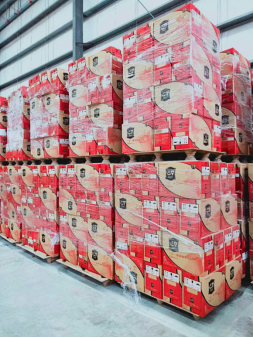
Cross-border e-commerce and logistics companies constantly face a critical challenge: how to reduce transportation costs. In today’s expanding global market, rising logistics expenses are putting significant pressure on corporate profits. While you may have explored various cost-saving measures, the “hidden” costs in transportation, particularly the choice of pallets, are often overlooked and can lead to considerable expense.
This article will detail how choosing the right pallet solution can save you money on every shipment and help you maintain a competitive edge. Let’s explore how fiber pallets can significantly lower your cross-border logistics and transportation costs.
1. Lightweight Design to Reduce Transportation Costs
Traditional wooden and plastic pallets have a significant deadweight, which directly increases the cost of every shipment. In cross-border logistics, pallet weight is a fundamental component of freight charges, which are typically calculated by weight and volume. Every extra pound means higher shipping fees.
Engineered to be lighter while maintaining high load-bearing capacity, our pallets reduce the self-weight of each unit without compromising strength. For instance, if you ship 1,000 traditional wooden pallets weighing 45 lbs each, switching to a lighter alternative that is 10-20% lighter means you can load more goods into the same space, effectively lowering the per-unit shipping cost.
| Pallet Type | Weight per Pallet | Total Weight (10,000 Pallets) | Weight Savings |
| Traditional Wood Pallet | 45 lbs (approx. 20kg) | 450,000 lbs | – |
| Fiber Pallet | 33 lbs (approx. 15kg) | 330,000 lbs | 120,000 lbs |
Based on average international air or sea freight rates, this weight reduction translates into substantial savings. By minimizing pallet weight, you not only cut shipping costs but also optimize space utilization, enhancing overall transport efficiency.
2. Stacking Design to Maximize Storage Space
Warehouse storage is another major expense in cross-border logistics. Inefficiently designed pallets that cannot be stacked compactly waste valuable warehouse space, leading to higher storage costs. Our pallets feature an excellent nesting design, allowing them to be stacked tightly to save floor space.
While traditional wooden pallets have design limitations that prevent high stacking, the superior stackability of our solution can increase storage efficiency by up to 50%. This means you can store more goods in the same footprint, reducing your unit storage cost and decreasing your reliance on large warehouse spaces.
3. No Fumigation Required, Simplifying Global Shipments
When using traditional wood pallets for international trade, companies often incur extra costs for fumigation to meet quarantine requirements. This treatment is an added expense and can lead to delays if cargo is held for inspection. Our fiber pallets are compliant with ISPM 15 international standards and are exempt from fumigation.
This feature directly eliminates fumigation expenses, which can range from $20-$30 per pallet. For a company using 1,000 pallets annually, this translates to $20,000-$30,000 in savings. By choosing a fumigation-free option, you save money and avoid the logistical inefficiencies caused by quarantine delays.
4. Durability to Reduce Replacement Frequency
Pallet durability directly impacts long-term logistics costs. Traditional wooden pallets often crack, deform, or break after repeated use, requiring frequent replacement. In contrast, our pallets are manufactured using high-temperature and high-pressure molding technology. This process creates a durable product that withstands the rigors of high-intensity transportation without deforming or failing, reducing long-term replacement costs.
If a conventional wood pallet needs replacement after five uses, while a more durable pallet lasts for over ten cycles, you cut your purchasing frequency in half. This leads to lower overall procurement expenses and a more reliable supply chain.
By leveraging the advantages of a lightweight, stackable, fumigation-free, and durable design, you can significantly reduce costs across transportation, warehousing, and long-term operations. These detailed optimizations accumulate into substantial savings, giving you a competitive advantage in the global market.
For cross-border e-commerce and logistics companies, selecting the right shipping platform is a strategic decision to optimize your entire logistics process. Let’s work together to achieve true cost control and operational efficiency in your cross-border logistics.