
When “We Recycle” Stops Being Enough
Most responsible logistics networks already run pallet pooling, repair, and take-back programs. The narrative looks green on the surface, yet anyone reading the ESG report closely will spot the same weak point: traditional wooden pallets still hit a ceiling. They get repaired once, downgraded twice, and eventually chipped, landfilled, or burned. The loop is partial, and under ESG scrutiny a partial loop can be framed as greenwashing.
The gap is structural. A nail-fastened stringer pallet can only lose so many boards before it is no longer safe or dimensionally stable. At that point the only honest destination is waste. That is why more operators are looking at Commercial Wood Pallet Equipment not as another production machine, but as the physical closing mechanism for a circular pallet system.
The Repair-and-Downgrade Ceiling
Pooling operators know the sequence well:
- First repair: replace a deck board or a stringer.
- Second repair: accept a lower grade and a reduced load rating.
- Final stage: metal-contaminated fragments leave the loop entirely.
Each step is still called “recycling,” but the material is moving toward disposal, not back to pallet form. The process also consumes labor, transport, and inspection time. For brands that need their Scope 3 and waste-diversion numbers to survive an audit, this trajectory is a problem.
The root cause is the Traditional Pallet Nailing Machine model itself: once a pallet is built with nails, staples, and mixed wood grades, fully returning it to clean pallet feedstock becomes impractical. The loop is open by design.
Why AutoML Commercial Wood Pallet Equipment Closes the Loop
AutoML is an Automated Pallet Manufacturing Line built around the One-piece Pallet Press Solution. Instead of fastening boards together, the system shreds recovered pallets and wood waste into fiber, dries and blends the material, then hot-presses it into a single-piece molded pallet. There are no nails, no stringers to split, and no progressive downgrading.
Because the output is a Nail-free Wooden Pallet Process, end-of-life units can be collected, crushed, and fed straight back into the Molded Pallet Production Line. The same pallet becomes feedstock for the next generation. In theory this cycle can repeat indefinitely, which is the only setup that supports a true zero-waste claim rather than a recycling claim with a hidden disposal stage.
The feedstock story also matters for compliance. Wood products produced entirely from material that has completed its lifecycle and would otherwise be discarded as waste fall outside the due-diligence scope of the EU Deforestation Regulation. A line running on 100 percent recovered wood fiber therefore gives compliance teams a hard, regulatory anchor for the green narrative—something far stronger than a slide that says “we recycle.”
Structure and Process Evidence
High-pressure molding
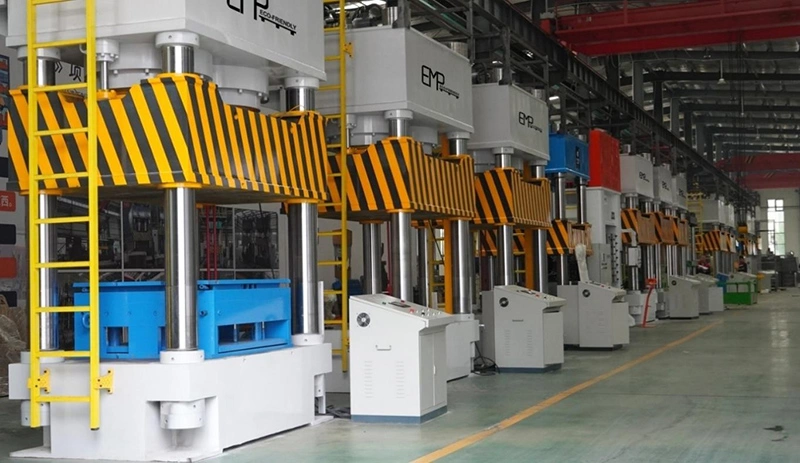
The AutoML Wood Pallet Making Machine uses High-Pressure Pallet Molding 3000T to consolidate blended fiber into a dense, dimensionally stable part. The 3000-ton press produces consistent wall thickness and load-bearing geometry across batches, which removes the variability that shortens conventional pallet life.
Nail-free, metal-light design
Because the pallet is molded in one piece, there are no nails or staples to remove at end of life. Collection and regrind costs drop, and the risk of metal fragments damaging downstream processing equipment is minimized. This is the practical reason the loop can stay closed.
Fumigation-free and export-ready
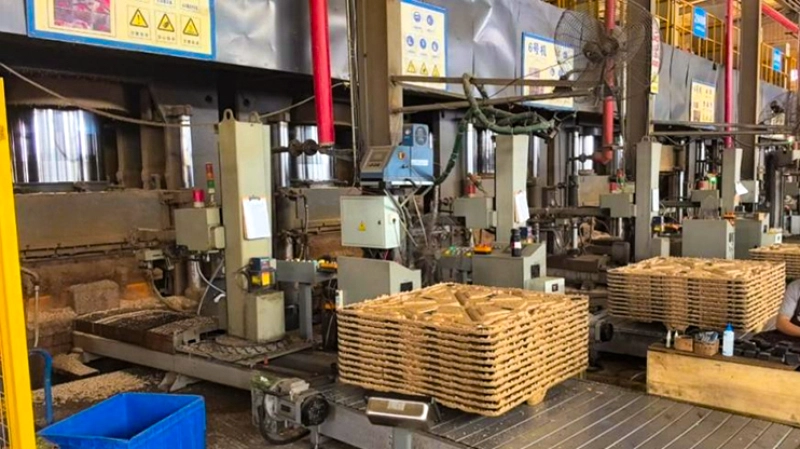
The heat and pressure applied during molding satisfy ISPM-15 requirements without additional chemical treatment. The output is ISPM-15 Exempt Pallet Equipment-ready material, or more precisely a Fumigation-free Pallet Machine product. For export flows this removes port delays and fumigation costs while keeping the shipment compliant.
Nested storage and return transport
Molded pallets nest when empty. Nestable Pallet Manufacturing cuts the volume of empty returns, which matters for any operator running closed-loop pooling over long distances.
What the Final System Looks Like
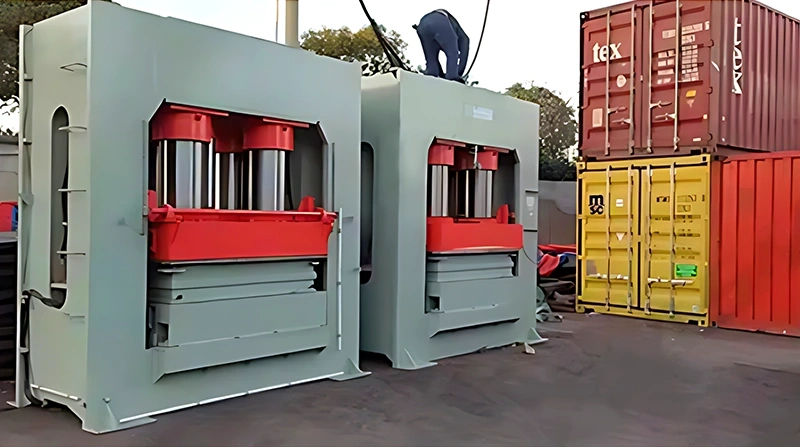
With the AutoML Industrial Pallet Molding Equipment installed, the flow becomes circular in a physical, auditable way:
- Damaged and end-of-life pallets enter the site as recovered feedstock.
- Shredding, drying, and blending turn that material into clean fiber.
- The press line outputs new one-piece pallets.
- Those pallets are used, returned, and eventually crushed again.
No repair backlog, no grade-B stock, no landfill leakage. The operator moves from a recycling story to a Wood Waste to Pallet Conversion system. That distinction is what makes the ESG claim defensible.
The Business Case Beyond Sustainability
The same loop also improves unit economics. Feedstock cost is decoupled from virgin timber volatility. Labor spent on inspection and repair is redirected to throughput. Empty return freight drops because of nesting. Over a multi-year horizon the setup becomes a High ROI Pallet Production Setup, not because the machine is marketed as “advanced,” but because the material model removes recurring costs that conventional lines cannot escape.
Need a defensible zero-waste pallet line?
If your network already collects pallets but still loses too many to repair, downgrade, and disposal, the AutoML Compressed Wood Pallet Machine line can turn that stream into new pallet output. Contact us to review feedstock, capacity, and layout for your site.