
The Compliance Shift: Premium Pellet Markets Now Demand Proof of Origin
Energy buyers in Europe and Japan are no longer satisfied with a generic biomass label. EUDR requires geolocation and due-diligence documentation for woody feedstocks, SBP certification expects a clear chain of custody, and Japanese utilities increasingly ask for FSC or PEFC-backed pellet supply. Regulators in several jurisdictions explicitly encourage using only wood waste, by-products and residues while limiting reliance on small-diameter roundwood. For pellet plants, the ability to prove that feedstock is legal, low-carbon and by-product-derived has become a market-entry barrier rather than a nice-to-have.
The Old Route: Roundwood and Thinning Logs Create a Paperwork Burden
Plants that source roundwood or small-diameter logs face a heavier compliance load. Each load needs origin documentation, harvest permits and sustainability declarations. Any gap in the paper trail can trigger non-conformities under EUDR, SBP or FSC/PEFC audits. In addition, public perception and buyer scoring increasingly penalize feedstocks that look like virgin timber rather than recovered material. The result is slower customs clearance, lost premium contracts and higher audit costs.
Why a Hammer Mill Crusher Fits the By-Product Pathway
By running a hammer mill crusher on-site, a pellet producer can transform production offcuts, broken pallets, sawmill edgings and agroforestry residues into controlled ≤5 mm sawdust. Because these inputs are classified as by-products or waste rather than harvested wood, the compliance narrative shifts: the feedstock is recovered, not extracted. That distinction is exactly what EUDR, SBP, FSC and PEFC frameworks reward, and it lowers the plant’s exposure to roundwood traceability requirements.
Structure, Parameters and On-Site Evidence
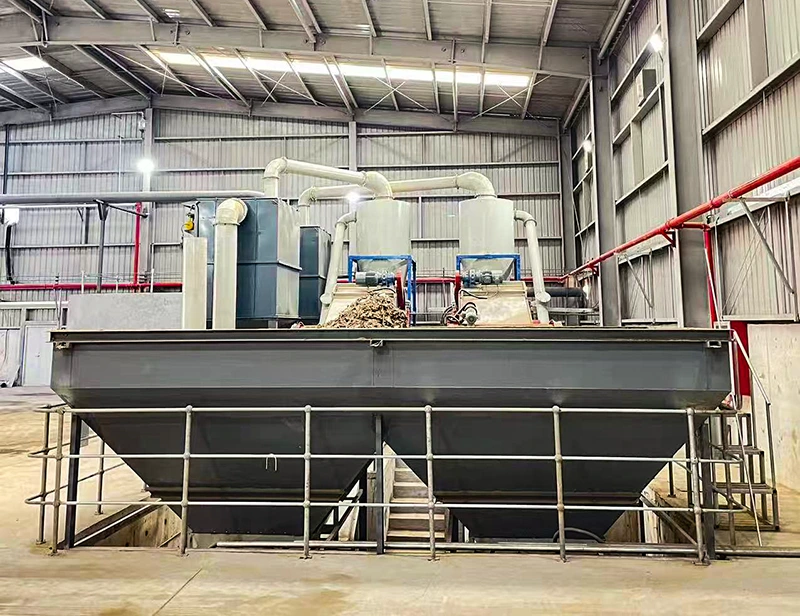
The Pulvz hammer mill crusher is built around a manganese steel hammer plate set and a high-hardness alloy screen that controls final particle size. A replaceable mesh lets operators switch between coarser output for board plants and finer ≤5 mm particles for pellet feedstock. Belt conveyor feeding supports continuous running, while the cyclone separator keeps dust out of the workshop and returns clean material to the process. A magnetic separator option removes nails and staples from recycled pallet feed before they reach the crushing chamber, protecting the hammer plates and keeping the output metal-free. Rated from 1-8 t/h and offered in F-800 to F-1500 sizes, the unit can be sized to the residue volume a plant actually generates.
- Manganese steel hammer plates handle abrasive pallet wood and bark without frequent replacement.
- Replaceable mesh screens lock in the particle size band the downstream pellet mill expects.
- Cyclone dust collection keeps the recovered-fiber area compliant with site environmental checks.
- Magnetic separation removes ferrous contaminants from recycled wood, an audit point many certification schemes inspect.
- Belt conveyor feeding allows residues to be fed straight from the trimming or sorting line, minimizing double handling.
The Result: A Traceable, Circular Feedstock Supply
With the hammer mill crusher placed at the front of the pellet line, waste wood and by-products are converted into a uniform, documentable feedstock. Each batch can be tied to a known internal residue stream or a contracted recovered-wood supplier, making chain-of-custody records simpler and more defensible. Pellet producers gain a practical route toward FSC/PEFC-controlled-wood claims, SBP-compliant feedstock status and EUDR-ready documentation, while reducing dependence on thinning logs and imported roundwood. In a market where compliance is becoming a price premium, that circular setup is a direct competitive advantage.
Build a Compliance-Ready Feedstock Line
Send us your residue type and target pellet output. We will match the right hammer mill crusher, screen mesh and dust-collection layout to your FSC, PEFC, SBP or EUDR workflow.