
The Scenario: Large Pallet Operators Are Betting on Automation
Across the pallet industry, the conversation has shifted. Where automation was once a nice-to-have upgrade, the largest pallet companies now treat it as a survival tool — the lever they pull to raise output per worker before labor costs swallow the margin entirely. A pallet manufacturing plant that runs on manual nailing and manual stacking is watching three forces converge at once: persistent recruitment difficulty, year-on-year wage inflation, and tightening immigration policy that shrinks the pool of seasonal and contract labor the industry has always relied on.
The result is visible on every shop floor that still depends on hand labor. Wherever capacity is tied to traditional nailed wooden pallet lines — workers feeding boards, workers operating nail guns, workers stacking and inspecting — the cost curve only bends one way. Delivery schedules become unstable because a single absent crew member slows the whole line. The operation is, in effect, selling a product whose unit cost is dictated by the local labor market, not by the machine.
The Problem: Nailing Lines Scale With Headcount, Not Equipment
A wooden pallet nailing machine still needs operators to stage lumber, feed stringers, flip assembled pallets, and stack finished units. Double the output and you roughly double the crew. That is the structural ceiling: the line’s capacity is bounded by how many people you can hire, train and retain — and in a tightening labor market that ceiling keeps dropping.
Meanwhile wages keep climbing. Every annual increase flows straight into the cost of every pallet that leaves the yard. And because nailed pallets require individual board handling, there is no process step where the labor content can be engineered out without abandoning the nailing process entirely. The producer is trapped: he cannot raise prices enough to cover the wage curve, and he cannot cut labor without cutting output.
Why Molded Pallet Forming Is Fundamentally Different
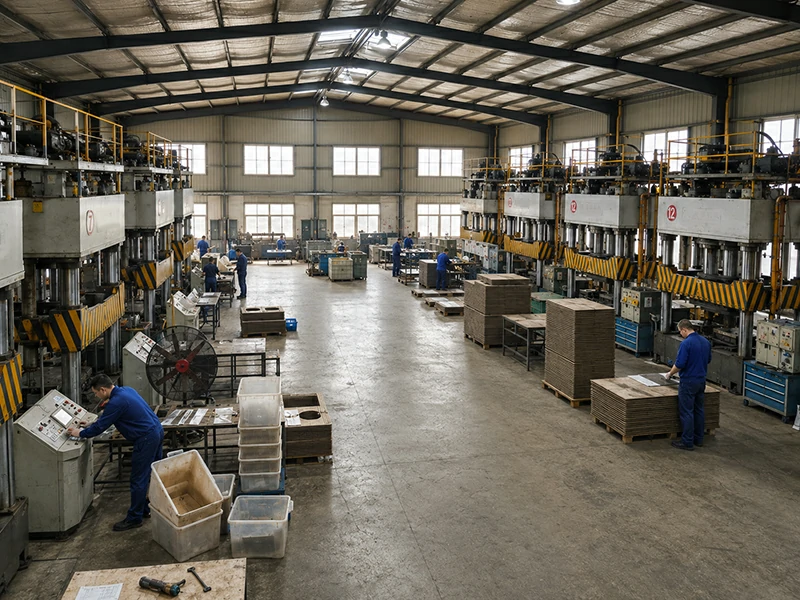
A hydraulic press machine replaces the entire nailing-and-stacking workflow with a single compression molding cycle. The four stages — crusher / grinder, dryer, glue mixer, hot press molding — run as a continuous flow. There is no board staging, no nail gun, no manual flipping. The molding die / mold is filled with prepared fiber, the hydraulic cylinder closes, a one-press forming cycle produces a complete pallet, and the ejector (top eject) pushes it out — all in a short molding cycle measured in seconds, not minutes.
That means the labor model inverts. Instead of scaling headcount with output, the hydraulic press machine sustains an automated hot press rhythm where a small crew monitors the line rather than performing the forming step by hand. High output per shift is a function of machine tonnage and cycle time, not of how many workers are standing at the press.
Two Tiers, One Platform: Semi-Automatic or Full-Automatic
EMP offers the hydraulic press machine in two configurations, so a producer can match automation depth to his current labor cost and capacity target:
- Semi-automatic pallet production line — the press cycles automatically; loading and unloading are assisted but still involve an operator. Manpower per shift is already far below a comparable nailed-pallet line.
- Automatic pallet production line — loading, pressing, ejection and stacking are linked through the conveyor system, compressing the last manual steps at the front and back of the press.
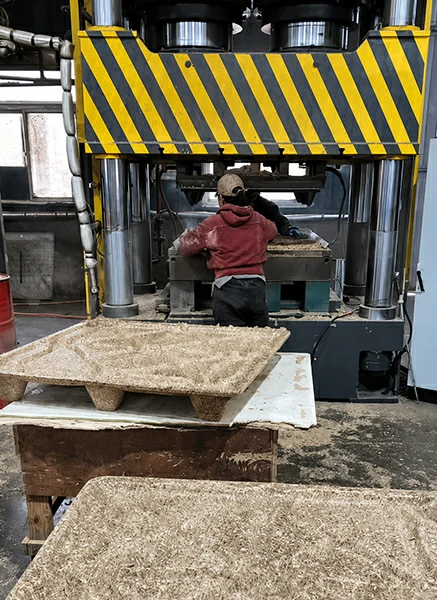
The critical point is that both tiers sit on the same Y32 three-beam four-column hydraulic press platform. A producer who starts at semi-automatic can upgrade to full-automatic later — new preheater and conveyor modules, same press body, same mold — without tearing out the installed line. The investment is incremental, not a rebuild.
Structure and Parameters: Tonnage for Every Capacity Level
The hydraulic press machine is offered across four tonnage points, so a producer selects by the pallet size, cavity count and daily volume he needs:
- Y-1250 hydraulic press — entry-level single-cavity forming for standard 1200×1000 warehouse pallet and export pallet sizes.
- Y-1600 hydraulic press — mid-range tonnage for heavier forklift pallet dynamic loads.
- Y-2000 hydraulic press — higher tonnage for thicker pallets or denser wood fiber feed.
- Y-2500 hydraulic press — top tonnage for double-cavity molds or oversized shipping pallet tools.
Pressed at a hot press molding density near 900 kg/m³, each pallet comes out as a one-piece molded shape — no nails / no splinters, a uniform load surface, and a nestable design that cuts empty-pallet storage and nestable return transport volume. The platen size and motor power are matched to the chosen mold, and the hydraulic pressure (tonnage) is rated for the pallet’s target dynamic load of 1.5–2 tonnes and static load of 5–8 tonnes — fully comparable to a conventional racking pallet.
Because the press is built on a solid column design with a bolted top beam / slide / worktable structure, it can be broken down for container shipping and reassembled on a standard factory slab — a turnkey pallet plant that fits a real-world pallet maker’s installation plan, not a theoretical one.
The Result: A Direct Hedge Against the Wage Curve
For a producer already running molded pallets, adding a hydraulic press machine at a higher automation tier means the marginal ton of output no longer requires a marginal hire. The automatic production line keeps pressing through a short molding cycle whether the local labor market is tight or loose, and the per-pallet labor cost drops as wages rise — the exact opposite of what happens on a nailed-pallet line.
That is why the largest operators are moving now. Automation is no longer the upgrade you make when you have spare capital; it is the hedge you install before the wage curve makes your current process uncompetitive. A hydraulic press machine running on the Y32 platform — semi-automatic today, full-automatic tomorrow, four tonnage steps to scale with — is the piece of equipment that makes that transition possible without abandoning the process the producer already knows.