
Why Packaging Supply Becomes a Dispatch Constraint
Manufacturers of high-value export goods, photovoltaic modules among them, plan despatch around a shipping calendar rather than around a general stock level. If pallets arrive late, finished product sits in the warehouse and the shipment misses its slot. An external supplier’s production rhythm, its own order queue and transport lead time all sit outside the exporter’s control, which is why packaging supply becomes a scheduling question rather than a purchasing one.
Producing pallets in-house is one way to bring that variable inside the plant. It is also a capital project with its own rhythm, so the decision has to be sized against the order book rather than against the desire for independence.
What In-House Production Actually Requires
A chain, not a single press
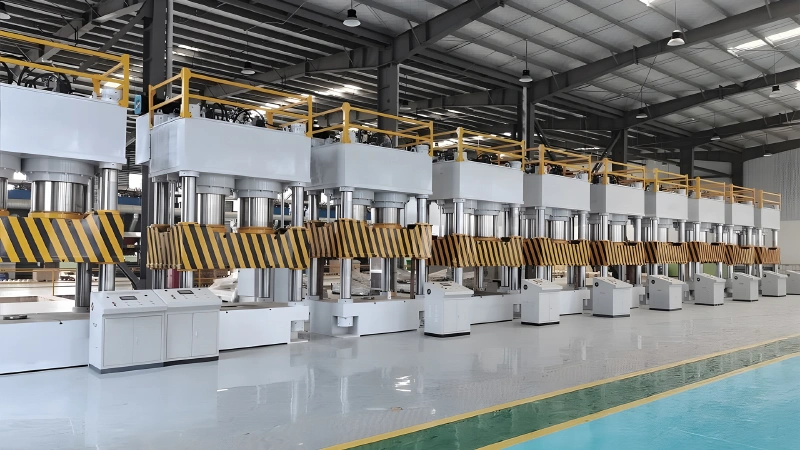
AutoML forms pallets through preparation of the fibre, drying, metered glue blending, weighed spreading, hot pressing, and demoulding with stacking. A press on its own assumes that a weighed, blended charge arrives at the mould and that the formed part is removed. For an internal supply operation, the whole chain has to hold the same beat as the despatch schedule, upstream and downstream included.
Cycle rhythm and counted output
A press cycle only becomes a supply rate when preparation, spreading, pressing and take-out hold together across a shift. Press count, mould count, shift pattern, changeover time, maintenance and the time needed to reach steady operation all sit between a nameplate figure and a monthly quantity that can actually be promised. Capacity used in a business case should be the second number, not the first.
Specification and documentation
Export customers often specify the pallet itself: footprint, fork entry, load behaviour, marking and the documents that accompany a delivery. An internal line has to produce that part consistently and keep the associated records, which makes tooling and the quality plan part of the supply decision rather than an accessory to it.
The line selection guide sets out how configuration follows those constraints; the fully automatic line and semi-automatic line pages describe the two ends of the range most projects sit between.
Sizing the Line Against Real Orders
Before a press count is discussed, put these figures on the table, taken from actual despatch records rather than a forecast:
- Average and peak daily pallet consumption across a year, including the shape of the peak rather than only its height.
- How many distinct pallet specifications are in use, and how often a changeover would be needed.
- Loss, damage and rejection rates in current packaging, and the buffer stock policy that covers them.
- Available floor area, ceiling height, electrical capacity, dust extraction and the crew that would run the section.
- Downtime tolerance, maintenance windows, and what happens if the line is unavailable during a shipping peak.
- Whether an external supplier is retained as a backup, and at what volume.
A line sized to the average will be short during the peak; a line sized to the peak may carry idle capacity for much of the year. That trade is a business decision, and it is better made with the despatch records in front of everyone.
Where the Scope Has to Be Confirmed
Output, product suitability and delivery capability must be calculated against real orders and the agreed configuration. Equipment capability is not the same as a supply commitment: a line can be specified for a rate and still fall short if material preparation, tooling changes or the quality plan do not support it. The investment conditions and the outlet for the pallets have to hold alongside the technical configuration.
Press count, the degree of automation, the tooling set, the acceptance conditions and the ramp-up plan are confirmed during technical review and set out in the agreed proposal and contract. A project that expects full supply from the first day of operation is carrying a schedule risk that should be addressed openly in planning.
Next Step
Start with twelve months of despatch records and the pallet drawing your export customers actually accept. With those two, a line can be sized as an internal supply operation with a defined peak, a defined specification and a defined fallback, rather than as an equipment purchase.
FAQ
How many presses would we need?
It follows from peak daily pallet demand, the cycle and shift pattern, the number of specifications and an allowance for maintenance and changeover. It cannot be answered from a nameplate capacity figure alone.
Can we run the line only during shipping peaks?
That is possible in principle but it changes the economics, since the equipment still carries its capital cost while idle and the crew still needs to hold the process settings. It is worth comparing against a retained external supplier for the off-peak period.
Do photovoltaic modules need a special pallet?
They have their own handling and packaging requirements set by the customer and the shipment. Footprint, load behaviour, marking and documents should be taken from that specification and verified by testing, not assumed from the product category.
When would an internal line reach steady supply?
There is no fixed interval across projects. Site preparation, services, tooling, material qualification, process tuning and sample approval all sit before steady output. The plan should include a bridging supply arrangement for that period.
Is a semi-automatic line enough for internal supply?
It can be where volumes are moderate and labour economics favour it. The trade-off is greater dependence on manual work and a lower ceiling on repeatability, both of which matter when an export customer has a fixed specification.