
Why the chipping section is where the labour question is sharpest
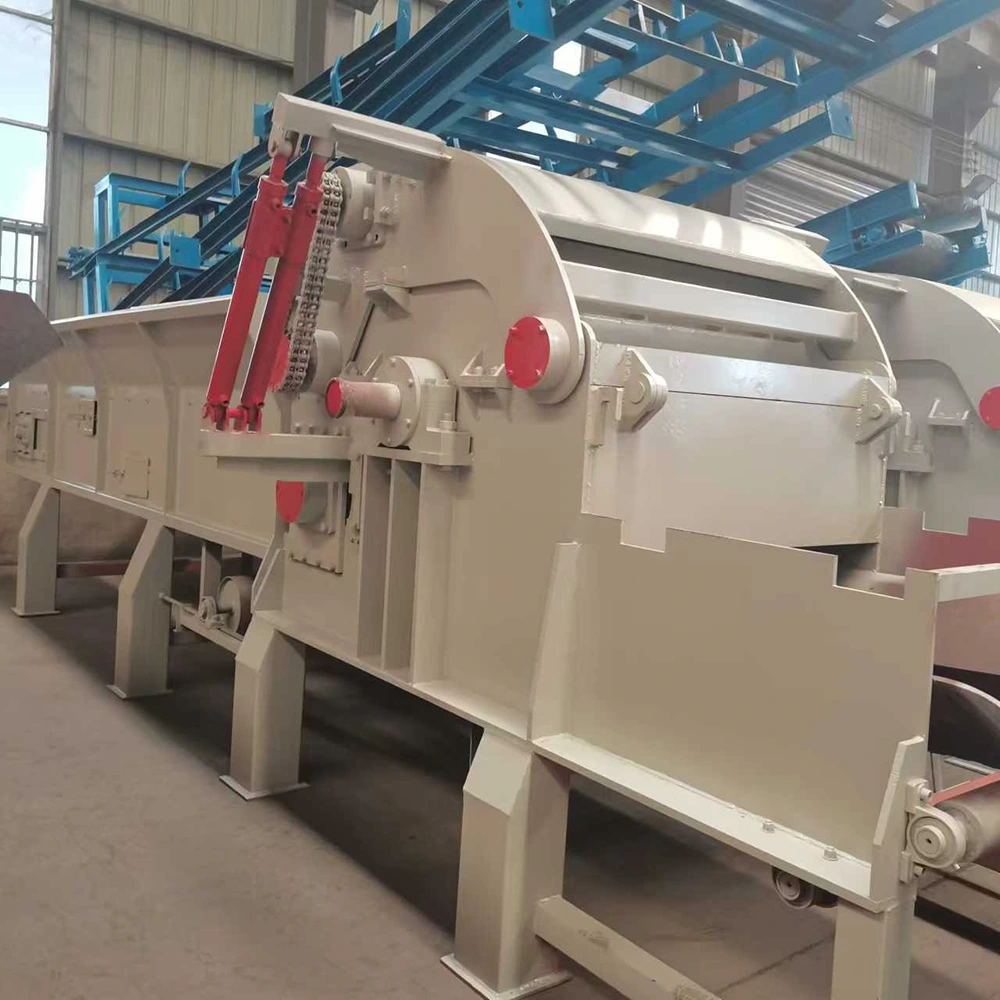
Most presswood pallet plants in 2026 are running with a thinner crew than they planned for. The line was scoped for three shifts, the press has an automatic take-out, the glue blender runs on recipes – but the log chipper at the head of the line still needs a person at the inlet, and the fly knives, the counter knife, the discharge screen and the bearings are still on a replacement clock. The hydraulic feed removes the manual pushing step. The skilled trade that maintains the chipping section – the one that knows when a knife is dull versus when the gap is wrong, that can read a chip sample and know whether the screen is stretched – has not been automated away.
This article is for the plant owner who has accepted that the log chipper will be run and maintained by a smaller, less specialised crew than the original project plan assumed. We work through what the design of a presswood log chipper needs to give that crew, what a general mechanic can actually do on it, and what genuinely still needs factory support or a specialist tool. The article is written for the second-year of operations, when the commissioning team has left and the line is on its own.
What a log chipper design needs to support when a specialist mechanic is not on payroll
The drum geometry of a presswood log chipper is mature technology. What differs between products is how the design accommodates the people who will look after it. Three design choices matter most when a specialist mechanic is not on the payroll.
Mechanical simplicity: bolted, no proprietary tools
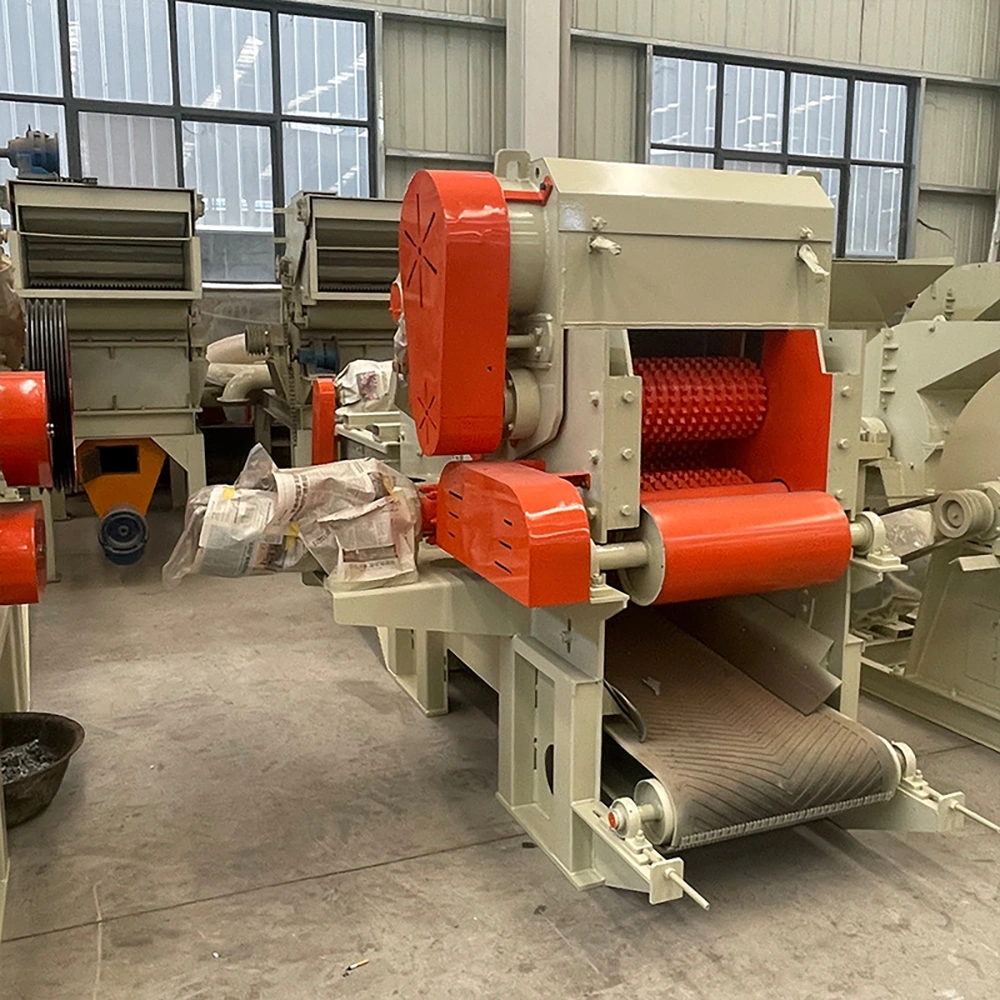
The first design choice is whether the fly knives and the counter knife are held with standard bolts or with proprietary clamp rings. Our log chipper line uses standard hex bolts on the knife-drum and the side cover. A general mechanic with a spanner set and a torque wrench can do a fly-knife change. The same task on a knife-drum held by a proprietary hydraulic clamp is a call to the factory, not a maintenance ticket.
The second design choice is whether the housing splits along a service seam. Our log chipper splits along the drum axis: the upper half lifts, the lower half opens at the discharge. A scheduled knife change or screen swap does not require removing the drum from the frame. That keeps a half-shift task on a half-shift task; it does not promote it to a full-day task.
Documented wear parts with lead times
The third design choice is whether the wear parts are documented and stocked, or whether the buyer has to source them at the point of failure. The fly knife set, the counter knife, the discharge screen (for the screen size you are running) and the bearings are the four items that fail first. The line stops the day one of them is the bottleneck. We publish the part list against the model number so the customer can carry the right spares; for plants outside China we quote the lead time at order so the spare-parts kit is sized to the shipping window, not to the machine’s MTBF.
On-site commissioning and what to ask for in writing
On-site commissioning is the moment when the specialist mechanic is in the building and the customer’s mechanic is in the building at the same time. That overlap is the entire reason it exists. What to put in writing before commissioning starts:
- The exact model and serial on every wear part, so future spare-parts orders do not require a phone call back to us to identify the variant.
- The knife gap setting for the customer’s target chip size, written in millimetres with the feeler-gauge value, not just “adjust to spec”.
- The screen selection for the customer’s target chip size, written as aperture and plate thickness.
- The lubrication schedule for the bearings and chain drives, written as intervals with the grease grade.
- A line in the protocol that says the customer’s mechanic performs the second knife change under observation, not the commissioning engineer. The second change is the test.
What a general mechanic can actually do on this machine
The split between “general mechanic” and “specialist” is real, and it should not be glossed over. Here is what the line typically looks like for a 6-8 t/h log chipper on a single-shift presswood line running with a small crew.
Daily checks the operator can do
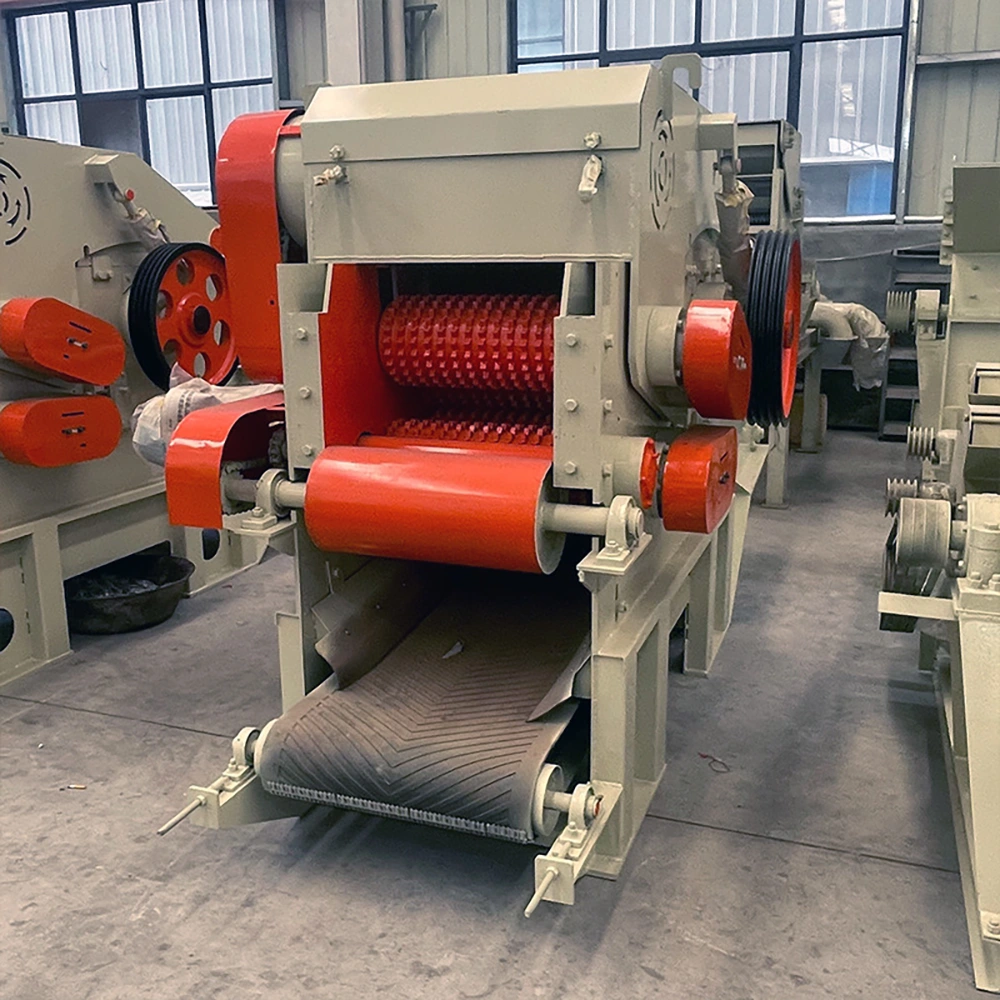
- Visual walk-around: oil drips under the gearbox, belt tension on the chipper drive, the chip sample at the discharge end. A general mechanic learns to read these in one shift.
- Bearing temperature by touch on the housing, after the warm-up cycle. A thermometer is a precision tool; a hand that has been burned once is also one.
- Counter knife gap by feeler gauge. The gauge is a standard tool; the value is in the manual.
Scheduled maintenance the general mechanic owns
- Fly knife rotation (swap side, sharpen, replace) on the schedule we publish, not on the day the chip sample changes.
- Discharge screen inspection: holes round, no cracks at the rails. A morning’s work, no specialist tools.
- Belt tension and alignment on the drive belts, the feed-roller chain and the discharge conveyor. Standard procedure, written in the manual.
- Lubrication on the schedule with the grease grade. The most common cause of an unplanned stop on a drum chipper is a bearing that was missed on lubrication. This is not a specialist task; it is a calendar task.
Knife and screen replacement – the half-shift task
On the X-215, X-216 and X-218 line the fly knife change is a two-technician, half-shift task: remove the side cover, unbolt the worn knives, bolt on the new set, reset the gap with a feeler gauge, run up empty for five minutes, sample the chips. The discharge screen is a similar task from the discharge end. Both are within the reach of a general mechanic who has been through one commissioning cycle and one shadowed knife change. They are not within the reach of an operator who has only ever watched.
What still genuinely needs factory support
- Drum rebalance after a knife set is replaced with non-identical weights. The drum is dynamically balanced at the factory; mismatched knives introduce vibration that the foundation was not poured for.
- Knife grade and heat-treatment questions. We do not publish those numbers (see the profile of what we will and will not put in writing); for plants that need to qualify the chipper for a specific application, the answer is a conversation with our engineering team, not a brochure.
- Electrical fault-finding on the PLC-linked cabinet. This is a controls job, not a mechanical job, and we list it separately on commissioning for that reason.
What this means for the second-year line stop budget
The honest framing of “running without a specialist mechanic” is not “no specialists, ever”. It is “specialist time is a line item, not a permanent position”. The design of the log chipper we ship is meant to make specialist time a scheduled event (commissioning, occasional remote support) rather than a daily dependency. Here is what we can and cannot put in writing for that calculation.
Numbers we can give
- Power and capacity per model: X-215 45 kW at 4-5 t/h, X-216 55 kW at 6-8 t/h, X-218 110 kW at 8-12 t/h.
- Chip length range: adjustable between roughly 20 and 40 mm depending on the feed-roller advance, with 30-35 mm as the typical band for presswood lines.
- The list of wear parts that fail first, against the model number, so the spare-parts kit can be sized to the shipping window.
Numbers we deliberately do not quote
- The wear-part life in hours per ton. The number depends on species, moisture, contamination (sand, nails) and chip length setting. We give a calculation for the customer’s feedstock, not a brochure number that would be wrong for most.
- “One operator” headcount. The hydraulic feed removes the manual pushing step; what the rest of the line needs depends on upstream loading, downstream conveying and local labour practice. We do not put a number on this in a brochure.
- “Zero downtime” or any uptime percentage. The honest answer is that scheduled knife changes and screen swaps take a half-shift each, and a 6-8 t/h chipper on a one-shift line has time for them in a normal week; a two-shift line needs the kit and the mechanic rotation to do them inside one shift.
Where this article stops
This piece is the labour side of our rotary drum chipper series for presswood lines. The other angles in the same series look at the buying decisions that surround the chipping section:
- Cost per pallet ledger. If your question is where on the per-pallet ledger the chipping section sets the floor, see the rotary-drum-chipper cost-per-pallet article.
- Capex right-sizing for new plants. If you are picking between a 45 kW, 55 kW and 110 kW first machine, that piece walks through the matching.
- In-house chipping vs outsourced chips. If the question is make-or-buy on the chipping step, the make-or-buy piece compares them.
- Compliance documentation and the 2027 EU machinery switch. If the market is the EU and you are planning for the 2006/42/EC to (EU) 2023/1230 transition, the export-compliance piece lists what we can and cannot sign.
- Chip consistency through the buyer load test. If the concern is a load-test rejection traced back to upstream chip size, the consistency piece is the path.
Send us your crew size and shift pattern. We will write the commissioning scope and the spare-parts kit list against your labour reality, not a generic one.