
Why an Internal Outlet Changes the Question
A sawmill or board plant produces residue continuously, but sells it discontinuously. The price and the collection schedule are set by buyers whose own demand moves with the season, with fuel markets and with the distance they are willing to haul. When that outlet weakens, the residue does not stop arriving. It simply accumulates.
An internal use changes what has to be evaluated. Instead of asking what someone will pay per tonne this month, the mill asks what the same fibre is worth as an input to a part it can produce and sell. That is a different calculation, and it begins with the condition of the material rather than with its price.
Connecting an Existing Mill to a Moulding Line
The connection is a process link, not a shared address. Residue leaves the mill in a form that reflects the mill’s own operation: sawdust from sawing, chips from chipping, offcuts from trimming. A moulding line needs a charge with a defined particle geometry, a controlled moisture content and a repeatable weight. Between those two states sit the preparation stages.
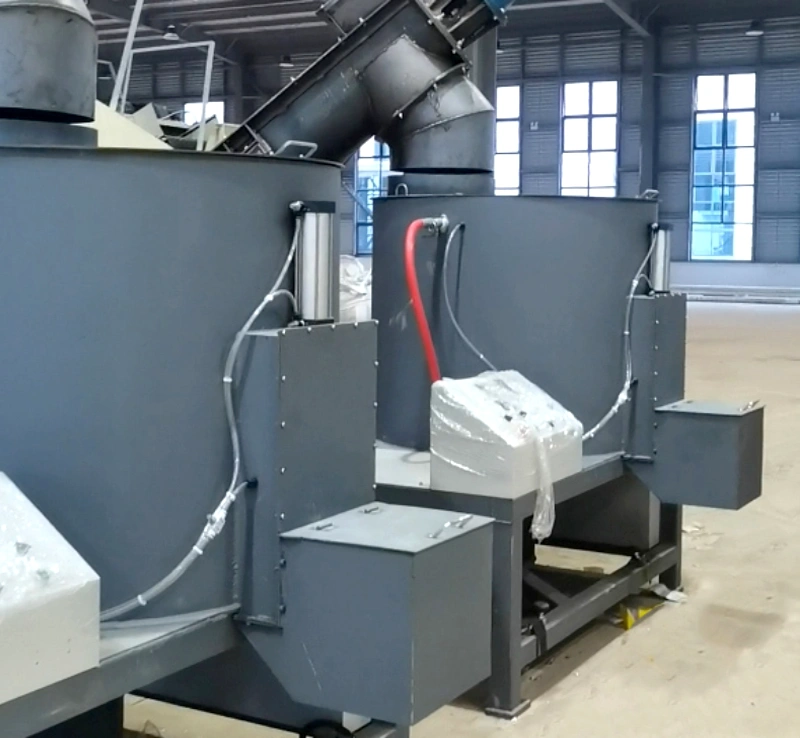
Size reduction brings oversized pieces into range. Drying sets the moisture before the material reaches the mould. Metered dosing and blending distribute binder through the fibre at a controlled ratio. A spreading unit then weighs and levels each charge, the heated press forms the pallet, and take-out stacking produces countable units. Equipment references for the individual stages are on the wood crusher, rotary dryer and glue mixer pages.
For a mill, the useful feature of this chain is that it consumes a steady, predictable amount of fibre. A buffer between preparation and moulding absorbs the difference between the mill’s production rhythm and the press cycle, so the line does not have to stop whenever the upstream operation pauses.
What ‘Stable’ Actually Requires
Calling a by-product stream stable usually means only that it keeps coming. For a moulding line, stability has four dimensions, and all four have to hold at the same time.
- Form: the particle size distribution stays within the range the mould can fill evenly.
- Moisture: the incoming level is known and can be brought to the target band without overloading the dryer.
- Cleanliness: metal, stone and non-wood material are at a level the separation stage can handle.
- Demand: the pallet specification being produced is one that buyers actually order, in the quantity the line will produce.
The fourth item is the one most often left out of a technical discussion. An internal outlet only works if the output has a destination. A line that converts residue into unsold pallets has moved the storage problem from the yard to the finished goods area.
When the Idea Does Not Hold
There are situations where adding a moulding stage is the wrong answer. If the residue is mostly fines unsuitable for the required fibre geometry, if its moisture is consistently high enough to make drying the dominant cost, or if contamination requires more separation than the project can support, the material is better handled through its existing outlets. A limited budget, a small site without space for the required enclosed areas, or a local market that will not absorb the output are equally valid reasons to stop.
Whether a particular by-product stream is suitable depends on its form, moisture content, contamination and on the customer’s own product requirements. Those are measured, not assumed, and they should be established before a configuration is fixed.
Next Step
The first step is a material audit across a representative production period, plus a clear statement of which pallet specification would be made and for whom. With those two pieces of information, the discussion can move from ‘what could we do with this residue’ to a defined process scope.
FAQ
Does the mill need to change how it handles residue?
Usually in small but important ways: keeping streams separate, avoiding outdoor moisture pickup, and knowing the weekly variation. Segregated, characterised material is worth more as an input than a mixed pile.
Can different residues be blended into one feed?
Sometimes, but the blend has to be characterised as its own input. Mixing changes particle distribution and moisture, and the mould sees the average of what arrives, not the intention behind the mix.
Is a semi-automatic configuration possible for a mill?
Yes. Where capital is limited or labour is available, a configuration built around the press and blending stage is a common starting point. The trade-off is greater dependence on operators for consistency.
What if we cannot sell the pallets locally?
Then the project has a sales problem rather than an equipment problem. The finished goods outlet should be established before the line is sized, including the specification local buyers order.
How much space do the added stages need?
It depends on which stages are included, the required enclosed areas, ceiling height for the press and the material flow between them. Layout is a project-level question answered during technical review, not a fixed figure.