
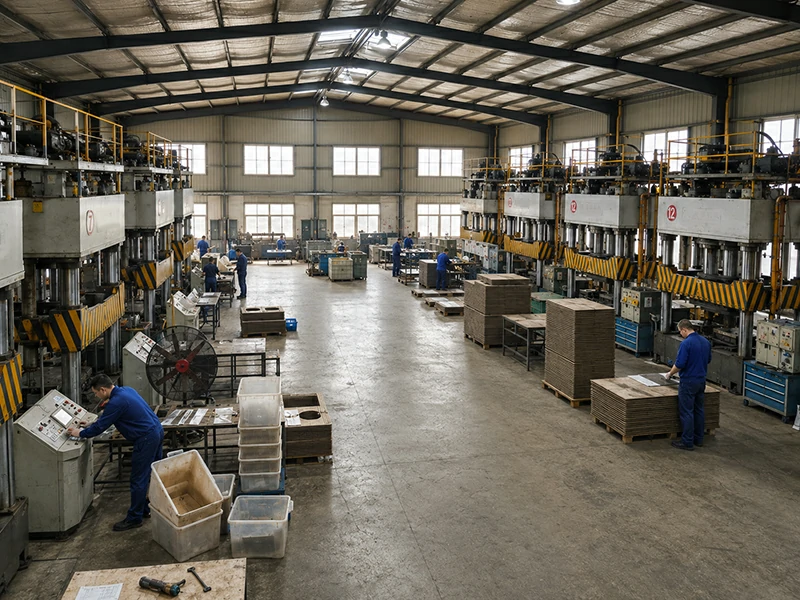
The Scenario: Residue-Rich Mills Sit Next to the Margin They Never Capture
A sawmill, planing mill, or panel plant generates wood residue continuously—planer shavings, sawdust, offcuts, and bark. For most of these operations that material is treated as overhead, not output. The default outlets are low on the value curve: burned for energy, pressed into particleboard, or chipped into wood blocks and spacers. The fiber leaves the gate, and the margin stays behind.
The Old Path Hits a Value Ceiling
Residue upcycling has quietly stalled at the midpoint of the value chain. Mills routinely turn waste into wood blocks, pellets, or particleboard—useful, but commodity-grade. What they almost never do is convert that same residue into a finished, load-bearing product that earns a premium. The missing step is the last one: molding loose residue into a whole, export-ready pallet. That final conversion is exactly where the highest added value lives, and it is precisely where most sites stop.
The result is a structural gap. A mill invests in grinding and drying, then hands the upgraded material to someone else to finish. It captures the cheap part of the chain and leaks the valuable part—the part a finished pallet would have delivered.
Why a Molded Pallet Hydraulic Press Machine Changes the Math
A molded pallet hydraulic press machine closes that gap by compressing wood residue directly into a single, one-piece molded wood pallet. There is no nailing, no stapling, and—because the material is formed under heat and pressure—no separate heat-treatment or fumigation step for phytosanitary compliance. The machine performs in one cycle what a conventional line does across three: assemble, fasten, then treat.
That single change rewrites the economics. Residue that used to leave as low-grade block feedstock now leaves as a finished pallet with a real bill of material and a real selling price. The value that used to leak at the “last step” is captured in-house.
Machine Structure and Capacity: What the Press Actually Delivers
The EMP platform is built as a four-column hydraulic press family, so capacity scales with the plant rather than forcing the plant to scale around the machine.
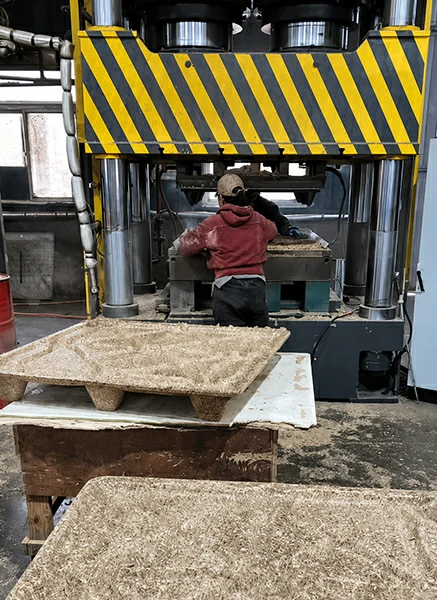
- Model range Y-1250 / Y-1600 / Y-2000 / Y-2500 — four tonnage classes spanning a single-shift regional mill to a continuous high-volume plant, so you size the press to your residue stream instead of the other way around.
- Y32 three-beam, four-column frame — the demountable structure ships and re-erects in kit form, which matters when you set up a press next to a new export plant overseas rather than importing a welded monolith.
- One-piece molding cycle — residue in, finished pallet out; no fasteners, no glue line, no post-mold heat treatment.
- EMP dual identity — the same equipment brand also runs as a pallet producer, so the machine and the product it makes are validated against the same spec sheet.
The Result: From Block Supplier to Finished-Pallet Producer
Put it together and the move is strategic, not just operational. A sawmill that once sold residue at block prices now runs a molded pallet hydraulic press machine on site and ships finished molded pallets. The pallets are nailing-free and fumigation-free, so they clear customs without the heat-treatment bottleneck that ties up conventional wooden pallets.
This is the pattern residue-rich operators are already positioned to exploit. A company with deep wood-block pressing experience and Euroblock know-how—Pfeifer is the textbook case—can bolt finished-pallet production onto its existing residue stream and capture the higher-margin tier instead of supplying it to someone else. The press is the machine that turns that lateral extension into daily output.
Conclusion
The ceiling on residue upcycling was never the material—it was the missing conversion. A molded pallet hydraulic press machine supplies that conversion: residue in, one-piece molded pallet out, nailing and heat treatment skipped, margin recovered. For any sawmill treating residue as a write-off, this is the step that turns waste into the most valuable thing on the lot.