
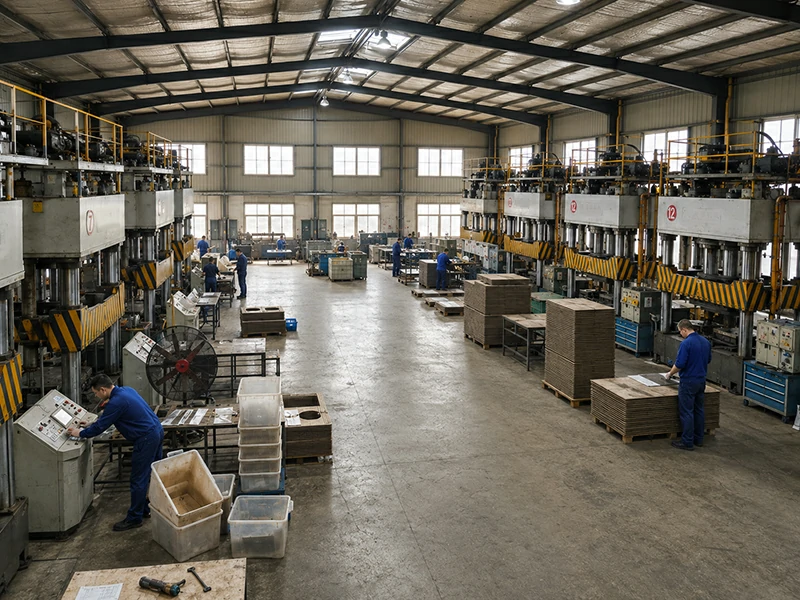
The Scenario: Export Demand Is Growing, but Exempt Capacity Is the Bottleneck
A pallet manufacturer supplying export forwarders watches the same specification appear on every RFQ: fumigation-free export pallet, no ISPM-15 mark, no chemical residue, low mould risk. These requirements are not preferences — they are hard conditions set by freight contracts, brand-owner packaging policies, and tightening customs enforcement at destination ports. The demand for exempt-category pallets is structural and rising.
But demand and capacity are two different numbers. The manufacturer can quote against any export order that lands, but it can only fulfil orders up to its existing molded-wood line ceiling. Once that line is running at full high output per shift, the next RFQ that arrives — for another 5,000 or 10,000 export pallet units — goes to whichever competitor still has exempt capacity on the bench. The order is not lost because of price; it is lost because of throughput.
The Problem: Nailed and Heat-Treated Lines Cannot Produce an Exempt Product
A traditional nailed wooden pallet line — even one running an efficient wooden pallet nailing machine — produces sawn-timber pallets that fall squarely inside ISPM-15. Every batch needs heat treatment or methyl bromide fumigation, carries a stamp, and is subject to inspection. A heat-treated wooden pallet line clears the quarantine bar but still carries treatment records and cannot satisfy the “no chemical residue” clause that pharmaceutical, food, and electronics shippers increasingly write into their packaging specs.
Neither line can fill the exempt-category gap. The manufacturer’s export order book is capped by its molded-wood capacity — and if that capacity is one shift on one press, every order beyond that threshold is an order handed to a competitor who invested in exempt throughput first.
Why a Molded Pallet Press Is the Capacity That Matches the Order Book
The pallets produced on a molded pallet press share the same ISPM-15 “processed wood” exemption classification as Litco’s Inca pallets — the product that established the fumigation-free export standard. Under ISPM-15 Annex I, wood that has been compressed under heat and pressure is no longer a quarantine risk: the process itself eliminates pests, larvae, and pathogens, so no post-process fumigation is required. Three process attributes make this classification defensible:
- High-temperature, high-pressure sterilisation. The hot press molding cycle subjects wood fiber — recycled wood, sawdust, wood shavings, wood chip — to temperatures and pressures that destroy all biological contamination. The pallet exits the mold sterile.
- MDI adhesive — no added formaldehyde. The binder is MDI adhesive, a polyurethane chemistry with no free formaldehyde. The finished pallet meets BP-free and no-chemical-residue requirements without any post-treatment step — nothing leaches into cargo during long sea transit.
- Density and moisture control. Pressed to approximately 900 kg/m³ with low residual moisture, the pallet resists mould growth in humid container environments — the “low mould risk” specification is met by the material, not by a fungicide coating.
For the manufacturer, this means a new molded pallet press adds not just pallets but exempt-category pallets — the specific product the export market is pulling. Adding a nailed line adds capacity in a category nobody is ordering; adding a molded line adds capacity in the category that every forwarder’s RFQ specifies.
Structure and Parameters: The Y32 Platform Behind the Press
The press is built on the Y32 three-beam four-column hydraulic press architecture. The top beam / slide / worktable structure with four solid column design uprights creates a rigid platen that applies uniform tonnage across the entire mold face. This is not just a structural specification — it is a compliance one. Under-density in any corner of the mold produces a pallet that cannot defend its exempt classification, because the sterilisation depends on every gram of fiber reaching the target temperature and pressure. Column rigidity ensures that every pallet in every cycle meets the density threshold the exemption requires.
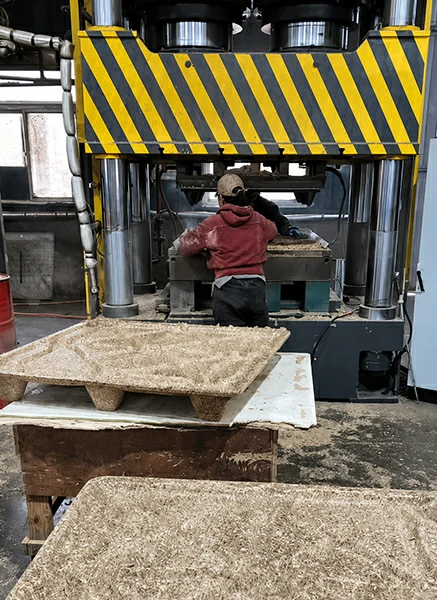
The Y-series tonnage ladder lets the manufacturer size the line to the order profile:
- Y-1250 hydraulic press — entry single-cavity single station pallet press for standard 1200×1000 shipping pallet footprints.
- Y-1600 hydraulic press and Y-2000 hydraulic press — mid-range tonnage for heavier logistics pallet or warehouse pallet load ratings.
- Y-2500 hydraulic press — high tonnage for a double station pallet press configuration that nearly doubles per-shift throughput on one foundation.
Each model sustains a short molding cycle in automatic molding rhythm: one compression molding stroke produces a finished one-piece molded shape with uniform load surface, no nails / no splinters, and a nestable design that keeps stackable empty pallets compact between shipments. The platen size and motor power are matched to the mold, and the full line — crusher / grinder, dryer, glue mixer, preheater, molding die / mold, hydraulic cylinder with ejector (top eject), and conveyor — is delivered as a turnkey pallet plant package.
Compliance Continuity: Same-Origin Process, Shorter Audit Cycle
For a manufacturer who already holds an ISPM-15 exemption dossier for molded pallets, adding a molded pallet press does not mean restarting the compliance conversation. The process is same-origin: the same wood waste and agricultural residue feedstock path, the same MDI adhesive no-formaldehyde binder, the same high-temperature pallet forming principle, the same 900 kg/m³ finished density. The new line’s product is a continuation of the existing exempt category — not a new product requiring a fresh exemption filing.
EMP accelerates this continuity by supplying the process parameters and compliance support documentation the customer’s audit team needs: the raw-material intake specification, the adhesive chemistry and dosing record, the molding temperature and pressure logs, and the ISPM-15 Annex I exemption basis. This compresses the window between “line installed” and “pallets approved for the export order book” — the period during which capacity physically exists but cannot yet be quoted against exempt-category demand.
The Result: Exempt Throughput That Matches the Export Order Book
Once the new line is commissioned and audited, the manufacturer’s ISPM-15 exempt capacity expands by exactly the increment the export market is pulling — whether that is a semi-automatic pallet production line or a full automatic pallet production line configured to the tonnage and footprint the RFQ stream demands. The orders that used to walk to the competitor because the existing line was maxed out now stay in-house, filled by pallets that carry no fumigation stamp, no chemical residue, and no mould-risk flag.
That is what a molded pallet press delivers in this scenario: not just more pallets, but more of the specific pallets the export market is ordering — produced on a turnkey plant setup that a manufacturer can install, audit, and quote against before the next order cycle closes.